
Bypassing the Copper Wall: The Strategic Imperative of CPO in 1.6T Fabrics
The 1.6T Inflection.
As AI clusters scale toward 100,000+ GPUs, the networking fabric has become the primary bottleneck. At 1.6 Terabits per port (1.6T), the physics of traditional electrical interconnects reaches a breaking point. The power required to move electrons across a standard PCB trace for 1.6T bandwidth now exceeds the switching power of the ASIC itself.
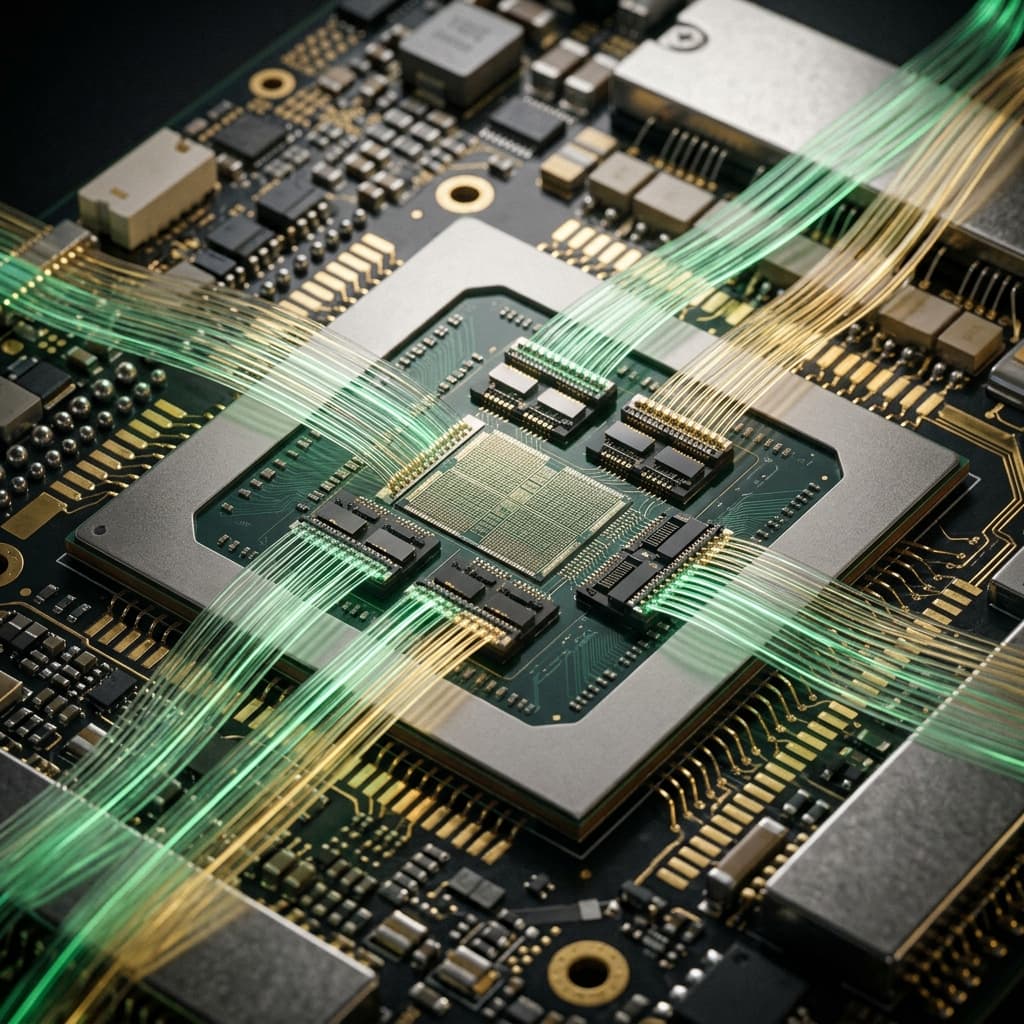
**Co-Packaged Optics (CPO)** represents the most radical architecture shift in networking history. By moving the optical engine inside the chip package—mere millimeters from the logic—we "bypass" the copper wall. This article explores the 2026 state of the art in CPO, from TSMC's hybrid bonding to the OIF's ELSFP laser standards.
The Physics of the Copper Wall
To understand why CPO is mandatory, we must understand the failure of the PCB trace at **224Gbps PAM4**. At these frequencies, electrons no longer flow through the center of a copper trace; they flow only on the very surface—a phenomenon known as the **Skin Effect**.
- **Dielectric Loss (Tan δ):** The PCB material itself absorbs energy, converting high-frequency signals into heat. Even with ultra-low-loss materials like Megtron-8, the loss exceeds 1dB per inch at 100GHz.
- **Inter-Symbol Interference (ISI):** At 224G, the duration of a single bit is so short that signals overlap before they even reach the standard OSFP transceiver.
- **The Power Tax:** To overcome these losses, traditional switches use massive **DSPs (Digital Signal Processors)** and **Retimers**. These chips consume 50% of the network's energy just to maintain signal integrity over 10 inches of copper.
By moving the optics into the package, the electrical trace length drops from **250mm** to **< 10mm**. This allows for "Direct Drive" or "LPO-style" circuits that eliminate the DSP entirely, reducing power from **15pJ/bit** to **sub-5pJ/bit**.

Heterogeneous Interposer
Showing the interface between the TSMC logic wafer and the GlobalFoundries SiPh wafer.
2.5D & 3D Packaging Breakthroughs
CPO is fundamentally a **packaging challenge**. We are taking two different species of silicon—Logic (Switch ASIC) and Photonics (Optical Engines)—and forcing them to live on the same substrate.
Broadcom Bailly
The 51.2T platform uses **2.5D integration**. It places eight **6.4T Silicon Photonics Optical Engines (OEs)** around a central Tomahawk 5 die. Each OE is connected via ultra-short high-density electrical links.
TSMC COUPE
The Compact Universal Photonic Engine uses **SoIC (System on Integrated Chips)** technology. It stacks the EIC (Electronic IC) directly on top of the PIC (Photonic IC) using **Hybrid Bonding**, reducing impedance to nearly zero.
Intel's approach utilizing **EMIB (Embedded Multi-die Interconnect Bridge)** allows for even larger packages, reaching 120x120mm. This space is critical for accommodating the massive fiber arrays (up to 1,024 fibers per switch) required for 1.6T densities.
2026 Packaging ROI
The ELS Standard & Reliability Logic
The most controversial decision in CPO history was the separation of the laser from the chip. In early 2024, proponents of "In-Package Lasers" argued for maximum integration. By 2026, the **External Laser Source (ELS)** has won.
Thermal Isolation
Lasers are extremely sensitive to heat. Placing a laser diode next to a 1000W AI chip results in a Mean Time Between Failure (MTBF) of months, not years. ELS moves the heat source to the front panel.
Blind-Mate Interconnects
The **ELSFP (External Laser Source Form Factor)** standard utilizes blind-mate connectors. The laser module plugs into the front panel and automatically aligns with the internal fiber array, allowing for hot-swappable replacements without interrupting the main switch ASIC.
ELS Specification (2026)
Silicon Photonics (SiPh) Fab Revolution
3nm CMOS Convergence
Optical modulators are now being manufactured in standard 300mm CMOS fabs. This allows photonics to ride the same "Moore's Law" curve as logic chips for the first time.
TDM & WDM Muxing
Achieving 1.6T requires either 8 channels of 200G or 16 channels of 100G. SiPh allows for Wave Division Multiplexing (WDM) built directly into the silicon waveguides.
Germanium Detectors
Since silicon is transparent to infrared light, we grow **Germanium (Ge)** epitaxially on the silicon substrate to create ultra-fast photodetectors capable of 112GBaud rates.
Manufacturing Yield: The 2026 Frontier
The primary barrier to CPO in 2023 was "compound yield." If you had 8 optical engines and each had an 80% yield, your total package yield was only 16% (0.8^8).
In 2026, **KGD (Known Good Die)** testing protocols at the wafer level have pushed optical engine yield to **99.2%**. This makes CPO as commercially viable as traditional chiplet-based CPUs (e.g., AMD EPYC).
Thermodynamics of Integration
AI chips in 2026 commonly consume **700W to 1200W**. Putting a Photonic Integrated Circuit (PIC) directly adjacent to this heat furnace creates a "thermal cross-talk" nightmare. If the PIC temperature fluctuates by more than **5°C**, the wavelength of the light shifts, and the link breaks.
To manage this, **Direct Liquid Cooling (DLC)** is mandatory for CPO switches. Cold plates now feature "Micropillar" structures that sit directly above the switch die and the optical tiles, extracting heat with 98% efficiency.
Thermal Budget Per OE
per 1.6T Tile
Tolerance (Δλ)
(Deionized Water)
Market Adoption & 1.6T Roadmap
Broadcom Bailly 51.2T demoed at OFC.
First CPO spine switches deployed in Meta data centers.
Broadcom Davisson (102.4T) enters volume production.
CPO becomes the default choice for all 1.6T+ fabrics.
The 1.6T-MSA Interoperability
One of the biggest risks to CPO was "vendor lock-in." In 2026, the **1.6T Multi-Source Agreement (MSA)** ensures that CPO engines from Marvell can talk to switches from Broadcom or Cisco. This standardization has unlocked massive capital investment from AWS, Microsoft, and Google.
Transitioning to CPO Architecture
Audit Thermal Margin
Before moving to CPO, ensure your rack cooling capacity (DLC) can handle the concentrated heat density of a 1.2kW switch package.
ELS-Ready Racks
Verify that your cabinet depths can accommodate the external laser modules and the increased fiber bend radius required for blind-mate connectors.
SDR Evaluation
Test Software Defined Routing (SDR) paths for the low-jitter characteristics of CPO. Many existing congestion algorithms can be tuned significantly more aggressively.
CPO Infrastructure Encyclopedia
Direct Liquid Cooling (DLC)
A mechanism for heat extraction where coolant is brought in direct contact with a cold plate sitting on the ASIC and PIC. Critical for keeping CPO engines below 65°C.
Mach-Zehnder Modulator (MZM)
An interferometric device used to modulate light intensity at ultra-high speeds (100GHz+). SiPh MZMs are the "drivers" of CPO links.
Insertion Loss budget
The total allowable loss in decibels (dB) between the transmitter and receiver. CPO provides a ~15dB advantage over pluggable OSFP by shortening the electrical path.
ELSFP (External Laser Source Form Factor)
An OIF-standardized module shape for external lasers. It handles the fiber-coupling, power management, and cooling of the CW laser source independently from the main switch chassis.
Photonic Integrated Circuit (PIC)
A chip that contains optical components like waveguides, modulators, and detectors. In CPO, the PIC is the "optical engine" bonded to the logic die.
Hybrid Bonding
A non-bump bonding technique (like TSMC SoIC) that joins two silicon dies at the surface atomic level, enabling higher interconnect density than traditional bumps.
🔍 SEO Technical Summary & LSI Index
- 2.5D/3D Heterogeneous Integration
- Silicon Photonic Integrated Circuits
- High-Bandwidth Density (Tbps/mm)
- Glass Substrate Scaling
- Sub-10mm Electrical Traces
- Hybrid Cu-to-Cu Bonding
- OIF CPO Framework
- External Laser Source (ELSFP)
- Mach-Zehnder Modulators (MZM)
- Continuous Wave (CW) Lasers
- 1.6T Multi-Source Agreement
- Blind-Mate Blind Coupling
- Picojoules per Bit (pJ/bit)
- Dynamic Power Allocation
- DSP-less Direct Drive
- Thermal Resistance (Rth)
- Direct Liquid Cooling sw
- Micro-Pillar Cold Plates
- Broadcom Bailly/Davisson
- Marvell Teralynx CPO
- Intel Silicon Photonics
- Cisco Silicon One + Acacia
- TSMC COUPE/SoIC
- GlobalFoundries Fotonix
Fiber Management at CPO Density
A single 102.4T CPO switch (Broadcom Davisson-class) can terminate up to 64 ports of 1.6T, each implemented as 8 fibers at 200G per lane. That is 512 optical fibers directly attached to the switch ASIC package — with no faceplate transceivers to act as service loops. The fiber management problem shifts from "plugging in a QSFP cable" to "micro-splicing a 512-fiber ribbon array to the mid-board connector with micron-level alignment." Every fiber bend radius below 5mm induces 0.3dB of macrobending loss, and in a CPO architecture, there are no field-replaceable patch cords to absorb cable strain.
Blind-Mate Fiber Connectors
The OIF CPO framework specifies a blind-mate MT (Mechanical Transfer) ferrule interface that aligns the CPO package's edge-coupling grating couplers to the fiber array. The connector is designed for 0.5dB max insertion loss with 200 re-mate cycles. In deployment, the fiber ribbon is pre-terminated in a factory with a polished MT ferrule on the switch end and standard LC connectors on the panel end. The installation procedure involves mounting the switch, attaching the fiber tray with integrated bend-limiters, and then sliding the MT ferrule into the CPO module's alignment guide, which latches with an audible click at zero insertion force.
Fiber Trunk Routing and Service Loops
To allow switch replacement without replacing the fiber plant, the fiber trunk is routed through a service loop cassette mounted in the rack's overhead cable tray. The cassette stores 3 meters of slack fiber in a figure-8 pattern with 10mm minimum bend radius. When the switch is pulled out for maintenance, the service loop pays out enough fiber to allow the blind-mate connector to be disengaged. The cassette also contains an OTDR (Optical Time Domain Reflectometer) monitoring port that allows the NOC to verify fiber integrity without disturbing the connector.
Automated Fiber Inspection and Cleaning
A contamination particle of just 1 micron on the MT ferrule face can cause a permanent 1dB loss across all 8 fibers. CPO racks are being equipped with robotic ferrule inspection arms: after every blind-mate connection cycle, a borescope camera on a linear actuator scans each ferrule row in under 2 seconds. If contamination is detected (a particle larger than 0.5 microns), the arm deploys a dry-cleaning reel that wipes the ferrule with a single-pass micro-fiber tape. This automation has reduced CPO link failures during commissioning from 12% to under 0.5%.
"The fiber management for our first CPO deployment took 3x longer than the electrical installation. Once automated, it became the most reliable part of the fabric."
Thermal Management of Co-Packaged Optics Modules
The primary engineering challenge of co-packaged optics is not optical alignment or fiber management — it is heat. Placing an optical engine within 5 mm of the switch ASIC means the optical components must operate at the ASIC's junction temperature, which can reach 105°C under full load. Silicon photonic modulators and germanium photodetectors are highly temperature-sensitive: the modulator's electro-optic coefficient (r33) decreases by 0.3% per °C, and the photodetector's dark current doubles every 10°C above 85°C. At 105°C, a silicon photonic modulator requires 2.5x the drive voltage compared to 60°C, directly increasing the power consumption of the laser driver.
The thermal budget for a CPO module is determined by the maximum junction temperature of the laser source. Continuous-wave (CW) lasers — the most common light source for CPO — are typically rated for a maximum case temperature of 85°C. In a CPO module, the laser is mounted on a **Thermo-Electric Cooler (TEC)** that maintains its temperature at 55°C even when the ambient switch temperature is 105°C. Each TEC consumes 2-3 W of electrical power per laser, drawing heat away from the laser and rejecting it into the switch's heatsink. For a 102.4 Tbps CPO switch with 64 lasers (one per 1.6T port group), the TEC power alone is 128-192 W — a significant fraction of the total switch power budget of 1,500 W.
Thermal crosstalk between adjacent optical channels is a second-order effect that limits channel density. Each silicon photonic Mach-Zehnder Modulator (MZM) dissipates approximately 50 mW of heat into the silicon substrate. With 64 modulators packed into a 5 mm x 5 mm die, the local heat flux reaches 128 W/cm^2 — comparable to the heat flux of the switch ASIC itself. This creates thermal gradients across the photonic die, causing differential expansion that misaligns the grating couplers. The misalignment increases coupling loss by 0.1 dB per degree of thermal gradient, and a 10°C gradient across the die produces a 1 dB loss penalty — enough to close the link margin.
Mitigating these thermal effects requires **through-silicon thermal vias (TSTVs)** in the photonic interposer. These copper-filled vias conduct heat from the modulator layer to a dedicated thermal spreader on the backside of the interposer, reducing the thermal gradient from 12°C to 3°C in production 2026 designs. The next generation of CPO modules will integrate **microfluidic cooling channels** directly into the silicon photonic interposer, circulating dielectric coolant (3M Novec 7500) through 50-micron wide channels etched between the modulator rows. Microfluidic cooling reduces the junction temperature of the photonic devices from 105°C to 65°C, eliminating the need for TECs entirely and saving 150 W of switch power.