
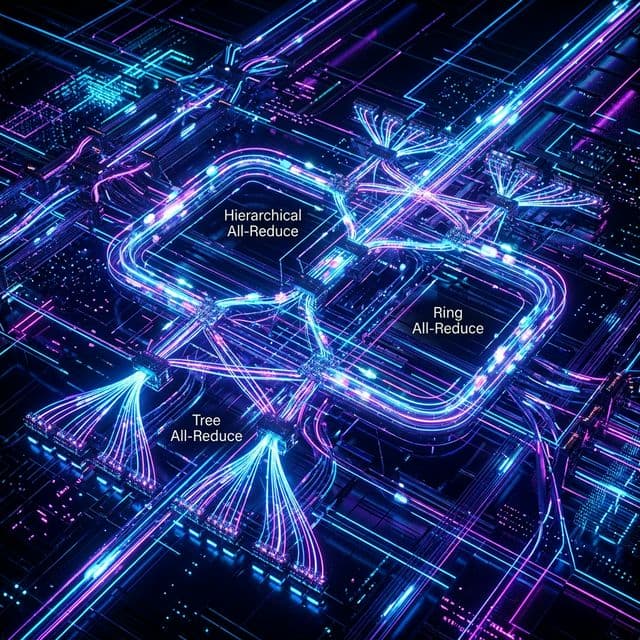
How NCCL Optimized Collective Operations Work
The communication tax of AI.
In Parallel Distributed Training (DDP), every GPU calculates its own weight updates (gradients) based on a small slice of data. However, before the next step of training begins, every GPU in the cluster must reach a consensus on the **Global Average** of those gradients.
Failure to synchronize fast enough results in "Comm Bottleneck," where GPUs sit idle, waiting for the network. **NCCL** (pronounced 'Nickel') is the industry-standard library that automates this synchronization with extreme efficiency.
All-Reduce
The most critical op. It sums gradients across all GPUs and broadcasts the result back. Used in 99% of training loops.
All-Gather
Used when cada node needs to know the unique value from every other vertex in the fabric. Essential for model parallelism.
Broadcast
Copying a master model state from Rank 0 to every other peer in the world group.
The Algorithm Selection Logic
Standard Ring
Optimal for large messages (gradients). It partitions the data into N chunks (N = GPUs). Each chunk is rotated around the cluster. This keeps the per-GPU bandwidth at 2GB/bandwidth independent of N.
Double Binary Tree
Used for small, latency-sensitive messages. It scales with O(log N) depth but consumes more overall bandwidth than the ring for huge payloads.
Latency vs. Bandwidth.
NCCL automatically switches its engine based on message size and detected topology.
GPU Direct RDMA
The Power of Direct Access.
Why waste CPU time? GPUDirect allows a remote GPU to read memory from a local GPU directly over the network (RoCE/IB) without copying to System RAM. This is the 'Magic Sauce' of NCCL.
The Topology Problem
NCCL is **Topology Aware**. It probes the PCIe bus, the NVLink lanes, and the external NICs to build a hierarchical map. It prefers NVLink (900GB/s) for intra-node comms and RoCE/IB for inter-node. If you misconfigure your PCI layout, NCCL might fallback to slow system memory copies.