
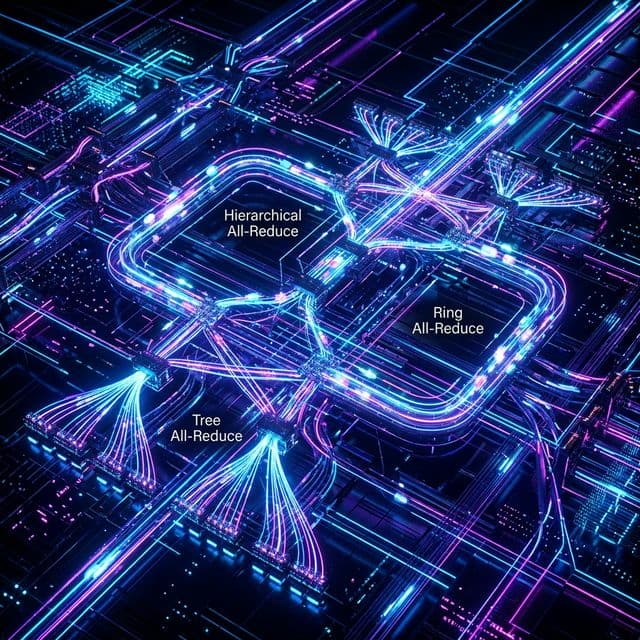
How NCCL Optimized Collective Operations Work
The communication tax of AI.
In Parallel Distributed Training (DDP), every GPU calculates its own weight updates (gradients) based on a small slice of data. However, before the next step of training begins, every GPU in the cluster must reach a consensus on the **Global Average** of those gradients.
Failure to synchronize fast enough results in "Comm Bottleneck," where GPUs sit idle, waiting for the network. **NCCL** (pronounced 'Nickel') is the industry-standard library that automates this synchronization with extreme efficiency.
All-Reduce
The most critical op. It sums gradients across all GPUs and broadcasts the result back. Used in 99% of training loops.
All-Gather
Used when cada node needs to know the unique value from every other vertex in the fabric. Essential for model parallelism.
Broadcast
Copying a master model state from Rank 0 to every other peer in the world group.
The Algorithm Selection Logic
Standard Ring
Optimal for large messages (gradients). It partitions the data into N chunks (N = GPUs). Each chunk is rotated around the cluster. This keeps the per-GPU bandwidth at 2GB/bandwidth independent of N.
Double Binary Tree
Used for small, latency-sensitive messages. It scales with O(log N) depth but consumes more overall bandwidth than the ring for huge payloads.
Latency vs. Bandwidth.
NCCL automatically switches its engine based on message size and detected topology.
GPU Direct RDMA
The Power of Direct Access.
Why waste CPU time? GPUDirect allows a remote GPU to read memory from a local GPU directly over the network (RoCE/IB) without copying to System RAM. This is the 'Magic Sauce' of NCCL.
The Topology Problem
NCCL is **Topology Aware**. It probes the PCIe bus, the NVLink lanes, and the external NICs to build a hierarchical map. It prefers NVLink (900GB/s) for intra-node comms and RoCE/IB for inter-node. If you misconfigure your PCI layout, NCCL might fallback to slow system memory copies.
NCCL Protocol Buffer Sizing and Ring Threshold Heuristics
NCCL internally manages a set of protocol buffers allocated on each GPU that serve as the send and receive windows for collective operations. These buffers are allocated from GPU HBM and are sized by the NCCL_BUFFSIZE environment variable (default 4 MB). The buffer size determines the granularity of the ring's chunk decomposition: for an All-Reduce on N GPUs, each GPU splits its gradient tensor into N chunks of size NCCL_BUFFSIZE, then rotates them around the ring. A larger buffer reduces the number of chunks but increases per-chunk transfer latency.
The threshold for switching between the Ring and Tree algorithms is controlled by NCCL_ALGO. NCCL measures the message size and checks it against internal heuristics derived from latency curves. For messages smaller than approximately 256 KB, the Double Binary Tree algorithm wins because its O(log N) depth dominates over the ring's O(N) latency overhead. For large messages (gradients > 1 MB), the Ring algorithm's constant-bandwidth property dominates: each GPU sends and receives exactly 2 x NCCL_BUFFSIZE of data regardless of N, making it bandwidth-optimal for large payloads.
The NCCL topology detection logic constructs a hierarchical graph of the PCIe tree, NVSwitch fabric, and NIC connections. It assigns a **distance metric** between pairs of GPUs based on the number of PCIe switches between them and whether they share an NVSwitch. GPUs connected via NVLink within the same NVSwitch domain receive distance zero and are aggregated into a single **NVLink domain**. Inter-domain communication falls back to NIC-based RDMA, and NCCL assigns a separate ring for each NIC to enable multi-rail operation.
Tuning NCCL for a specific cluster involves balancing NCCL_NTHREADS (default 1) against the available PCIe bandwidth per NIC channel. On systems with 8 NICs per node (800G total), setting NCCL_NTHREADS to 2 or 4 and NCCL_NSOCKS_PERTHREAD to 4 improves throughput by allowing the NIC DMA engines to be kept busy across memory banks. The NCCL_DEBUG=INFO output lists the chosen ring order and the detected NIC-to-GPU affinity, which should always be verified against the physical cabling diagram.
NCCL Proxy: The CPU-Based Failover Path for Collective Operations
When a GPU or its NVLink connection fails during a collective operation, NCCL must re-converge the ring without dropping the training loop. This is achieved through the **NCCL Proxy** — a CPU-based software layer that acts as a stand-in for the failed GPU in the collective communication pattern. Understanding the proxy's behavior is essential for building fault-tolerant training pipelines that survive hardware failures without losing training state.
The proxy mechanism is triggered when NCCL detects a GPU failure through the NVLink or PCIe link-down event. The surviving GPUs in the NCCL communicator select one GPU to act as the **Proxy Coordinator**. The coordinator allocates a CPU memory buffer and registers it for RDMA access via the GDRCopy library. It then modifies the All-Reduce ring topology to route the failed GPU's traffic through the CPU buffer. In the modified ring, the predecessor to the failed GPU sends its data to the CPU proxy buffer instead, and the successor reads from the CPU proxy buffer instead of the failed GPU's HBM. The CPU proxy performs the arithmetic reduction in software before forwarding the result.
The performance penalty of the proxy path is significant. CPU-based reduction achieves approximately 20 GB/s of aggregate bandwidth (limited by memory bandwidth of a single DDR5 channel), compared to 900 GB/s for NVLink-based reduction. The proxy therefore introduces a **bottleneck factor** of 45x, slowing the entire All-Reduce operation to the speed of the slowest link. For a 1 GB gradient tensor, the standard NVLink ring completes in 1.1 milliseconds; with a CPU proxy in the path, the same operation takes 50 milliseconds — a 45x slowdown. The training step time increases proportionally, and the framework must adjust the gradient accumulation steps to keep the optimizer state consistent.
Despite the slowdown, the proxy mechanism is preferable to aborting the training run because it maintains the training state — the optimizer momentum and variance terms remain intact across the failure. When the failed GPU is replaced or repaired, NCCL performs a **Proxy Drain** operation: it copies the accumulated gradient data from the CPU buffer back to the replacement GPU's HBM and re-establishes the original ring topology. The drain operation is bandwidth-limited (20 GB/s CPU-to-GPU over PCIe) and takes 50 ms per GB of gradient state. During the drain, the training loop continues using the proxy path, switching to the native path only after the drain is complete. This phased recovery ensures zero training step loss, with only a temporary throughput degradation that is automatically compensated by the framework's gradient accumulation schedule.
The Ring All-Reduce Math: Why It Scales
The reason NCCL's ring algorithm is the workhorse of AI training is not that it is clever — it is that it is mathematically optimal for large messages. The Ring All-Reduce runs in two phases: Reduce-Scatter followed by All-Gather. In Reduce-Scatter, the gradient tensor of size M is split into N chunks (one per GPU). Each GPU sends chunk i to its successor and receives chunk i-1 from its predecessor, accumulating partial sums as the chunks rotate around the ring. After N-1 steps, every GPU holds one fully-reduced chunk of size M/N. The All-Gather phase then rotates the reduced chunks so that every GPU ends up with the complete gradient tensor.
The total data moved per GPU is the crucial figure: in the Reduce-Scatter phase each GPU sends N-1 chunks of size M/N, and the All-Gather phase repeats the same volume, giving a total of 2 x (N-1) x (M/N) bytes. As N grows, this approaches 2M bytes — **constant, independent of the number of GPUs**. A naive All-Reduce that broadcasts from a single root moves 2 x M x (N-1) bytes, scaling linearly with N. That is the entire difference: the ring's per-GPU bandwidth demand is flat, so a ring can be extended to 1,024 or 4,096 GPUs without asking the fabric to do more work per GPU. This is why Llama-3's 24,576-GPU training run could use a single global All-Reduce domain instead of hierarchical reduce trees — the ring keeps the per-rank bandwidth constant. For the hardware path those chunks travel, read the GPUDirect RDMA deep dive.
The ring's weakness is latency. The operation completes only after N-1 sequential send-receive steps, so the latency grows linearly with N: TotalTime = N x (chunk-transfer-time + link-latency). For a 1,024-GPU ring over RoCE with 5-microsecond link latency, that sequential chain contributes roughly 5 milliseconds of pure latency even if bandwidth is infinite. This is why NCCL switches to the Double Binary Tree (DBT) for small messages: a tree of depth log2(N) requires only log2(N) sequential steps, so for small payloads the tree's logarithmic latency dominates and wins, despite the tree moving 2 x M x log2(N) total bytes (which for small M is negligible). The crossover point — where ring and tree latency curves intersect — is typically a few hundred kilobytes and is exactly the threshold NCCL probes when it selects the algorithm.
A final subtlety is the effect of link bandwidth asymmetry. The ring is only optimal when every link offers equal bandwidth. In a fabric where one spine link is oversubscribed or a NIC is misconfigured to a lower speed, the ring slows to the speed of that single weak link, because every chunk passes through it. This is why NCCL's topology-aware setup verifies NIC-to-GPU affinity before building the ring: a GPU whose ring hop traverses a slow PCIe path silently caps the entire collective. In practice, teams debug "unexplained" All-Reduce slowdowns by printing the NCCL ring order (NCCL_DEBUG=INFO) and confirming each hop maps to a physical link that is actually running at line rate.
Multi-Rail Networking and CollNet: The 800G Era
A single 400G NIC per GPU is no longer enough to saturate the H100 or B200's compute. The industry standard has shifted to **multi-rail**: each GPU is attached to multiple NICs (typically 8 x 400G, or 8 x 800G on Blackwell), and NCCL must use all of them simultaneously to keep the GPU busy. This is not as simple as load-balancing packets; it requires the communicator to be built with multiple parallel rings, each pinned to a different NIC. NCCL detects the number of NICs per node during topology discovery and constructs one ring per NIC, then stripes the gradient chunks across the rings so that the aggregate bandwidth is the sum of all NICs. A correctly-constructed 8-rail All-Reduce on 8 x 400G delivers 3.2 Tbps per node, whereas a single-rail configuration leaves 87.5% of the attached bandwidth idle.
The rail design problem is physical. Each rail must be a self-contained, non-blocking network — all the 0th NICs in the cluster connect to one rail, all the 1st NICs to another, and so on. If the fabric is built instead as "every NIC to every switch," the adaptive routing hashing becomes the bottleneck and the rail parallelism collapses into a single congested shared spine. This is why NVIDIA's DGX reference architecture hard-partitions the network into 8 independent rails, each a dedicated leaf-spine fabric. When commissioning a multi-rail cluster, the acceptance test is not just "800G links come up" but "each rail sustains line-rate All-Reduce independently" — a rail that cannot do so silently degrades the training job by exactly the fraction of rails it represents.
CollNet (Collective Offload Network) represents the next architectural shift. Instead of the GPU participating in a peer-to-peer ring, the collective operation is **offloaded to the network itself**: switches perform the reduction in the data plane. NVIDIA's Quantum-2/Quantum-X InfiniBand switches with in-network computing (SHARP) can reduce the All-Reduce data as it passes through the switch fabric, collapsing the traffic volume from 2M bytes per GPU down to a single M/N broadcast. For a 1,024-GPU All-Reduce of 1 GB, SHARP cuts the fabric traffic roughly in half and removes the ring's N-step latency chain entirely, replacing it with the tree depth of the fabric. The result is that All-Reduce time stops scaling with the number of GPUs and scales only with the depth of the network.
The architectural consequence is profound: **with CollNet, the network stops being a transportation problem and becomes a computation platform.** The GPU is freed from the collectives entirely, and the fabric's packet processors do the math. This is why the largest training clusters are moving away from TCP/RoCE Ethernet toward InfiniBand or RoCE with in-network compute enabled — the collective throughput ceiling is no longer set by the NIC but by the switch ASIC. For the network architect, the planning question changes from "how much bandwidth" to "do my switches reduce in the data plane?" because that single capability determines whether the next generation of models trains in hours or in days.