
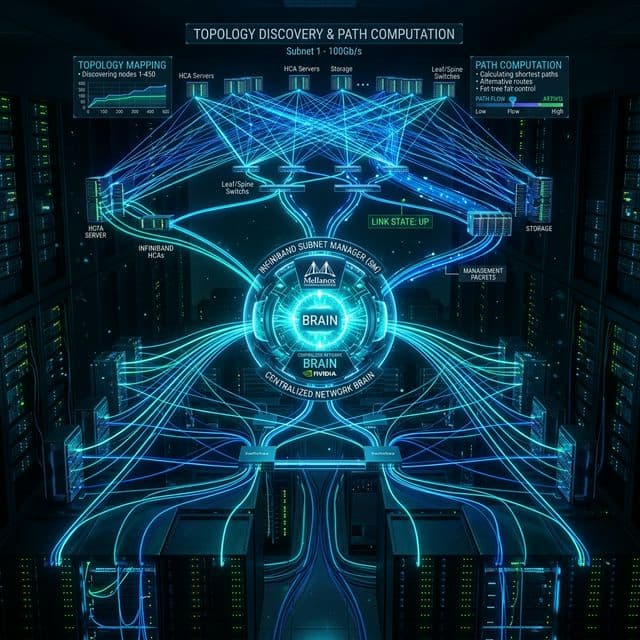
The Role of the IB Subnet Manager
The Centralized Brain
In a traditional Ethernet network, every switch is autonomous, learning MAC addresses and building routing tables independently. InfiniBand (IB) takes the opposite approach. To achieve ultra-low latency and deterministic performance, IB uses a **Centralized Control Plane**. The software entity responsible for this is the **Subnet Manager (SM)**.
Topology Discovery
The SM sends Subnet Management Packets (SMPs) across the fabric to map every switch port, adapter, and cable. It builds a recursive graph of the entire network.
Path Calculation
Using algorithms like **Up/Down Routing** or **Fat-Tree specific logic**, the SM computes the dead-lock-free paths between every source and destination pair.
Key Components of Subnet Management
| Component | Function | Registry |
|---|---|---|
| Subnet Manager (SM) | Configuration and topology control. | IB Port 0 |
| Subnet Administrator (SA) | Informational queries from nodes. | Query Interface |
| LID (Local ID) | 16-bit address assigned by the SM. | Switch Tables |
| GUID (Global Unique ID) | Permanent 64-bit hardware address. | CHASSIS EEPROM |
Adaptive Routing & Performance
In modern InfiniBand switches (like Quantum-3), the SM works in tandem with **Hardware-Based Path Selection**. While the SM provides the global map, the switch silicon performs granular local decisions to avoid congested links.
- Deadlock Avoidance: The SM ensures that the cyclic dependencies that cause network deadlocks are mathematically impossible in its calculated path.
- Centralized Policy: QoS, partitioning, and security keys are all pushed from the SM, ensuring a single source of truth for the cluster security.