
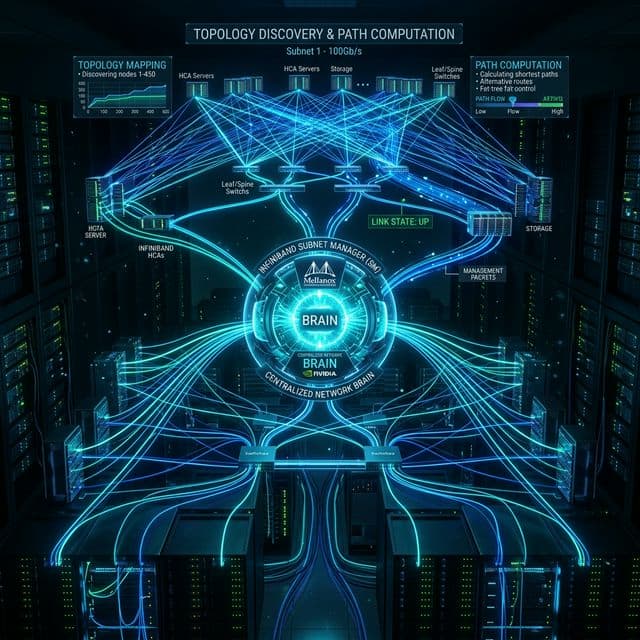
The Role of the IB Subnet Manager
The Centralized Brain
In a traditional Ethernet network, every switch is autonomous, learning MAC addresses and building routing tables independently. InfiniBand (IB) takes the opposite approach. To achieve ultra-low latency and deterministic performance, IB uses a **Centralized Control Plane**. The software entity responsible for this is the **Subnet Manager (SM)**.
Topology Discovery
The SM sends Subnet Management Packets (SMPs) across the fabric to map every switch port, adapter, and cable. It builds a recursive graph of the entire network.
Path Calculation
Using algorithms like **Up/Down Routing** or **Fat-Tree specific logic**, the SM computes the dead-lock-free paths between every source and destination pair.
Key Components of Subnet Management
| Component | Function | Registry |
|---|---|---|
| Subnet Manager (SM) | Configuration and topology control. | IB Port 0 |
| Subnet Administrator (SA) | Informational queries from nodes. | Query Interface |
| LID (Local ID) | 16-bit address assigned by the SM. | Switch Tables |
| GUID (Global Unique ID) | Permanent 64-bit hardware address. | CHASSIS EEPROM |
Adaptive Routing & Performance
In modern InfiniBand switches (like Quantum-3), the SM works in tandem with **Hardware-Based Path Selection**. While the SM provides the global map, the switch silicon performs granular local decisions to avoid congested links.
- Deadlock Avoidance: The SM ensures that the cyclic dependencies that cause network deadlocks are mathematically impossible in its calculated path.
- Centralized Policy: QoS, partitioning, and security keys are all pushed from the SM, ensuring a single source of truth for the cluster security.
LID Assignment Tables and Path Computation Complexity in Multi-Rail Fabrics
The Subnet Manager assigns a 16-bit Local Identifier (LID) to every HCA port and switch port in the fabric. The LID space ranges from 0x0001 to 0xBFFF (49,151 usable addresses), with the remaining range reserved for multicast and management. In a 32,000-GPU cluster with 2 ports per GPU (dual-rail) plus 1,000 switches, the SM must assign approximately 65,000 LIDs. Each LID assignment triggers a SetNodeInfo SMP transaction and requires the SM to validate that no duplicate LIDs exist — a linear scan becomes O(n) per assignment, or O(n) overall.
Path computation uses Dijkstra's algorithm applied to the switch port graph where edge weights represent hop count or available bandwidth. A naive implementation on a 1,000-switch fabric with 64 ports each (64,000 vertices) would require O(E log V) = O(64,000 log 64,000) per source-destination pair. With 65,000 HCA ports, full-mesh path computation produces O(65,000 x 64,000 log 64,000) operations — computationally intractable for a single SM instance. Real implementations use **linear-reduction trees** and **pre-computed routing tables** based on topology class: for a k-ary n-tree (Fat-Tree), the SM can compute paths in closed form without per-pair shortest-path searches.
The IBTA specification mandates that an SM must complete its initial sweep within 10 seconds for a fabric of 1,000 switches. OpenSM and NVIDIA UFM achieve this by parallelizing the discovery across multiple threads and using batched SMP transactions (up to 64 outstanding MADs per port). The path record cache (SA database) stores computed paths indexed by (source LID, destination LID) and is invalidated only when topology changes are detected through trap handling.
In high-availability configurations, the standby SM maintains a synchronized copy of the forwarding database via checkpointing. When the primary SM fails, the standby must verify its database consistency before taking over — a process that involves re-sweeping the fabric. The failover time is bounded by the trap propagation delay plus the sweep time, typically under 2 seconds for a properly configured dual-SM deployment.
Subnet Manager Heartbeat and Dead Path Detection Timers
The Subnet Manager's heartbeat mechanism is the fabric's first line of defense against silent failures. Every switch and HCA port in an InfiniBand fabric must receive periodic **SMP (Subnet Management Packet) Heartbeats** from the active SM. If a port misses three consecutive heartbeats (default: 3 x 100 ms = 300 ms), it declares the SM dead and transitions to a **Fallback State** where it uses pre-configured static routing tables until a new SM is elected. This 300 ms window is the maximum time the fabric operates without active management — in an AI training cluster, this is enough time for 3,000 All-Reduce iterations to complete, meaning the training loop may not even notice the SM failure if the static routes are correctly provisioned.
The heartbeat interval is tunable through the SM configuration parameter `heartbeat_interval_ms` (default 100 ms). Reducing this to 20 ms allows faster SM failure detection (60 ms for three missed heartbeats) but increases the SMP traffic overhead on the fabric. Each heartbeat generates a 64-byte SMP that must traverse the management network, consuming approximately 0.5% of the management channel bandwidth at 20 ms intervals on a 10,000-GPU cluster. The increased SMP rate also creates additional CPU load on the SM server — at 20 ms intervals, the SM must process 50 heartbeats per second per switch, or 50,000 SMPs per second for a 1,000-switch fabric. This is well within the capacity of a modern SM running on a 64-core server (which can handle 500K SMPs/second), making the 20 ms interval the recommended setting for production AI clusters.
**Dead Path Detection (DPD)** extends beyond SM heartbeats to individual data paths. Each HCA maintains a **Path Record Cache** that stores the most recently used paths along with their path verification timestamps. When a GPUDirect RDMA transfer fails (detected through a missing ACK or a timeout on the completion queue), the HCA requests a path verification from the SM. The SM sends a **Sweep SMP** along the suspect path to verify that all intermediate switches have valid forwarding table entries. If the sweep reveals a broken path — due to a misconfigured switch port or a failed cable — the SM marks that path as "dead" and re-routes all traffic using that path to an alternative LID. The sweep completes within 500 microseconds for a 5-hop path, and the new route is distributed via the Forwarding Table Update (FTU) mechanism within an additional 1 millisecond.
The DPD timeout must be aligned with the RDMA transport timeout (typically 10x the fabric RTT, or approximately 500 microseconds for a 50-microsecond cross-cluster RTT). If the DPD completes before the RDMA timeout fires, the retransmitted RDMA packet automatically takes the new path, and the training step proceeds without visible disruption. If DPD is slower than the RDMA timeout, the RDMA layer generates a transport-level error that propagates to NCCL as a collective failure, potentially aborting the training step. Ensuring DPD completes within 450 microseconds — the RDMA timeout margin — requires the SM to prioritize DPD sweeps over routine path computations. NVIDIA's UFM achieves this by dedicating 4 of its 16 processing threads exclusively to DPD handling, with the remaining 12 threads handling periodic sweeps and routing optimizations.
Subnet Manager State Machine and Master Election Protocol
The Subnet Manager is not a single monolithic daemon; it is a state machine defined by the InfiniBand Architecture specification Volume 1. Every SM instance on the subnet transitions through a well-defined lifecycle: DISCOVERING, STANDBY, MASTER, and (in managed deployments) BACKUP and DISABLED states. On boot, an SM enters DISCOVERING and performs a full subnet sweep, issuing SubnGet(NodeInfo) SMPs to every known port to reconstruct the switch, HCA, and cable adjacency graph. Until that sweep completes and forwarding tables are programmed, the SM does not assume MASTER ownership, and switches forward data using the default LID 0xFFFE path. This is why a fresh SM startup on a large fabric is deliberately conservative: an incomplete topology view applied prematurely would route GPU-to-GPU traffic into black holes.
Master election is the mechanism by which a fabric running two or more SM instances converges on exactly one active manager. Every SM advertises an SM priority (the SMpriority field, 0-15) and its 64-bit port GUID. When two SMs encounter each other during a sweep, they exchange SubnGet(SMInfo) SMPs, and the SM holding the numerically higher (SMpriority, GUID) tuple wins; the loser transitions to STANDBY and becomes the passive master, still receiving subnet change traps but never modifying forwarding state. In a production DGX SuperPOD the recommended deployment is two SMs on two physically independent management servers or on the two redundant management switches, with SMpriority 15 and 14 respectively. Because a lost election on a mis-configured server can silently disable the entire fabric, the election logic is deliberately simple and deterministic — there is no tie-breaker ambiguity, only the lexicographic (priority, GUID) comparison.
The failover path is asymmetric and worth internalizing. When the active SM fails, the standby first detects the missed heartbeats (the 300 ms three-miss window), then re-runs the discovery sweep before assuming MASTER. The total switchover time is the heartbeat window plus one full sweep, which is why the IBTA mandates that initial sweeps on a 1,000-switch fabric complete within 10 seconds — bounding worst-case failover to roughly 10.3 seconds. During that window the fabric relies on the static forwarding tables the previous master pushed, which is exactly why the standby must run the identical topology model: any divergence between the standby's cached routing state and the live switch forwarding tables will surface as silent misrouting the moment gradient synchronization traffic resumes at full bandwidth.
One subtlety that escapes most operators is that a single HCA port can hold multiple LIDs via LMC (LID Mask Control). Setting LMC on a port grants it a block of consecutive LIDs (2^LMC), which the SM can use to advertise multiple paths to the same destination — the basis of multipath routing and faster failover. In dual-rail fabrics each HCA port participates in a separate path domain, so the SM sees two independent forwarding graphs; the HCA driver interleaves traffic across both, and the SM must keep both graphs deadlock-free simultaneously. The routing cost of maintaining these parallel views is exactly why production SMs on large fabrics are co-scheduled with dedicated management links rather than sharing the data-plane switches' uplinks.
State transitions are also the SM's answer to a changed fabric. When a switch or cable is added mid-operation, the SM receives a subnet change notification, re-sweeps the affected region, recomputes only the affected paths, and pushes incremental LinearForwardingTable updates. When a switch is removed, the SM must re-sweep the entire subtree behind it and reassign any LIDs that became orphaned. Keeping these incremental reconfigurations fast is the difference between a fabric that absorbs a rack repair transparently and one that stalls 10,000 GPUs for minutes. For fabrics whose shape changes often — for example, reconfiguring a Fat-Tree to Dragonfly layout for a new workload — the SM's reconfiguration path becomes a first-class capacity-planning input rather than an afterthought.
Subnet Management Packet Anatomy and the Trap Storm Problem
Every subnet management action travels in a Management Datagram (MAD) wrapped in the IB transport headers. An SMP MAD is 256 bytes: a Local Routing Header, an optional Global Routing Header when the SM must reach a port on a remote subnet, and a 24-byte Base MAD header. The Base MAD header encodes the 32-bit M_Key (the management key that authenticates control-plane writes), the opcode (SubnGet, SubnSet, SubnGetTable, or their responses), the AttributeID selecting the managed object (NodeInfo, PortInfo, SwitchInfo, LinearForwardingTable, SMInfo), a 32-bit AttributeModifier, and a 64-bit TransactionID. SMPs run on Service Level 0 against QP0 in every port — a queue pair isolated from application traffic, so management never competes with GPUDirect RDMA data for the same buffers.
Because every SMP is a request-response transaction, the SM maintains a TransactionID-indexed table of in-flight requests. The specification caps outstanding SMPs per port at 64, and a well-tuned SM keeps that window full during a sweep, pipelining SubnGet requests across ports in parallel instead of serializing them. After computing routes, the SM pushes the LinearForwardingTable to each affected switch in a single burst, then validates the result by sampling a subset of ports with SubnGet(PortInfo). Any validation failure drops the SM back into DISCOVERING — a conservative design that favors correctness over raw control-plane speed, because a wrong forwarding entry corrupts gradient data far more expensively than a delayed sweep.
Traps are the SM's inbound notification channel. Ports raise trap 128 on any link up/down transition, trap 129 for switch errors, and trap 144 to request path recomputation. A single failed switch module can flap hundreds of links at once, generating thousands of traps in under a second. If the SM processed every trap synchronously, its MAD receive queue would saturate exactly when the control plane is most needed. Production SMs (OpenSM, NVIDIA UFM) therefore coalesce: they accumulate all link-state traps received within a 100 ms window, deduplicate repeated notifications for the same port, and issue one batched re-sweep. This trap-storm backpressure is the reason a 32,000-GPU fabric can absorb a rack-wide power event without requiring an SM restart or a full fabric re-convergence.
The M_Key deserves special attention because it is the trust boundary of the entire control plane. Every SMP carrying SubnSet writes must present a valid M_Key; a mismatched key is silently rejected, and an SM that rotates its M_Key must re-key every switch and HCA in the fabric. Partition keys (P_Keys) extend the same idea to the data plane — each partition is a 16-bit key, and a port can only exchange data with ports sharing its P_Key membership. When the SM computes paths it must respect partition membership: it cannot assign a route that would allow traffic to hop between partitions at a switch, because that would violate the isolation multitenant GPU clouds rely on. This is the reason fabrics are almost always partitioned at the SM layer before job schedulers are allowed to pack workloads.
Finally, the SM's selective-update capability is what ties the control plane to realistic convergence budgets. Because InfiniBand forwarding is switch-based, rerouting a dead path only requires updating the switches that lie on the replacement path — the SM computes exactly which ones from its topology graph and issues only those ForwardingTable writes. Combined with batched SMPs and coalesced traps, this keeps a 1,000-switch fabric converging in the tens of milliseconds that NCCL's transport timeouts demand. You can model those convergence windows against your own switch count, radix, and routing policy with the fabric topology builder, which applies the same linear-reduction routing math to your proposed layout before you buy hardware.