
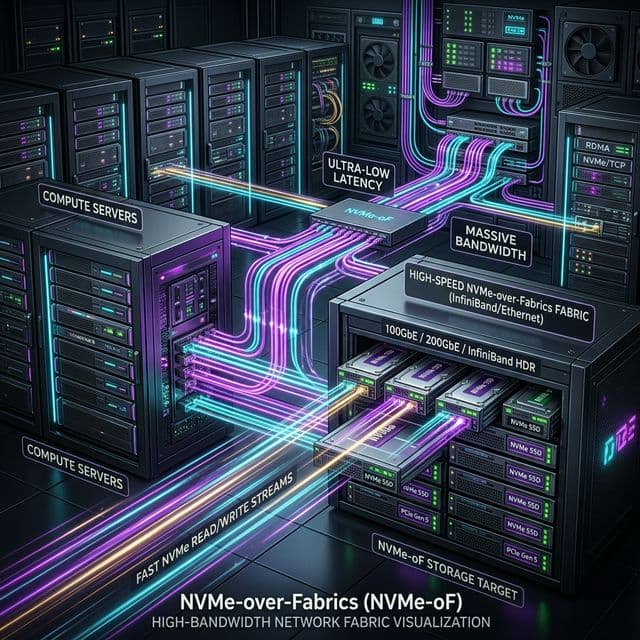
NVMe-oF: The Protocol of AI Data
Bypassing the OS Kernel.
Traditional network storage (NFS, iSCSI) relies on a heavy stack of OS kernel drivers, context switches, and memory copies. For AI data loaders (like PyTorch DataLoader), these legacy protocols become the primary bottleneck back-pressuring the GPUs.
**NVMe-over-Fabrics (NVMe-oF)** extends the NVMe protocol across the network. By using RDMA (RoCE or InfiniBand), it performs "Direct Memory Access" from the storage target's controller to the host's memory, achieving millions of IOPS with sub-10μs latency overhead.
Infinite Queues
NVMe supports 64,000 I/O queues, each with 64,000 commands. NVMe-oF preserves this incredible parallelism across the wire.
GDS Integration
When combined with NVIDIA GPUDirect Storage (GDS), data travels from the remote NVMe drive to the GPU HBM3 without ever touching a CPU core.
The Transport Layer Decision.
NVMe-oF over RDMA
- — Requires RoCE V2 or InfiniBand
- — Zero-Copy Performance
- — Lowest Latency (~5-8μs)
NVMe-oF over TCP
- — Works on Standard Ethernet
- — Easy to Deploy
- — Uses CPU for Transport Logic