
DNSSEC Chain of Trust: Cryptographic Anatomy
Forensic Anatomy of DNSSEC Mechanics
Prerequisites
This article assumes familiarity with DNS resolution mechanics, the hierarchical domain structure, and basic public-key cryptography concepts. For a foundation, read DNS Mechanics: From Root to Resolver and Cryptography Math: RSA & ECC.
1. The Existential Crisis: Why DNSSEC?
The original DNS protocol, designed in the 1980s, was built for an era of mutual trust. It lacks any mechanism to verify the authenticity of a response. This inherent weakness led to the discovery of DNS Cache Poisoning, most notably the Kaminsky Vulnerability discovered in 2008.
In a Kaminsky attack, an adversary sends a flood of queries for non-existent subdomains (e.g., 1.example.com, 2.example.com) to a recursive resolver. Simultaneously, the attacker sends spoofed responses claiming to be the authoritative server. If the attacker guesses the 16-bit Query ID correctly before the real server responds, the resolver accepts the malicious data—usually a redirection of the entire domain to an IP under the attacker's control.
The probability of a successful cache poisoning attack scales with the number of concurrent spoofed responses .
DNSSEC was developed to solve this not by hiding the data (encryption), but by signing it (authenticity). It ensures that the record you receive is exactly what the zone owner published.
2. The Four Pillars: DNSSEC Resource Records
DNSSEC introduces four primary resource record (RR) types that form the foundation of the signed infrastructure:
RRSIG (Resource Record Signature)
The digital signature for a set of records (RRSET). It contains the signature data, expiration time, and the key tag used to sign the record.
DNSKEY (Public Key)
Contains the public part of the cryptographic key used to verify the RRSIG. Zones typically have two: the ZSK and the KSK.
DS (Delegation Signer)
Resides in the Parent Zone. It is a hash of the child's KSK, providing the cryptographic link between the parent and child.
NSEC/NSEC3
Used for "Authenticated Denial of Existence." They prove that a specific domain does NOT exist by signing the "gap" between existing names.
3. The Chain of Trust Mechanics
Validation in DNSSEC is recursive. A resolver doesn't just trust a signature; it verifies the key used to create that signature, then verifies the key used to verify that key, and so on, until it reaches a Trust Anchor (the Root Zone).
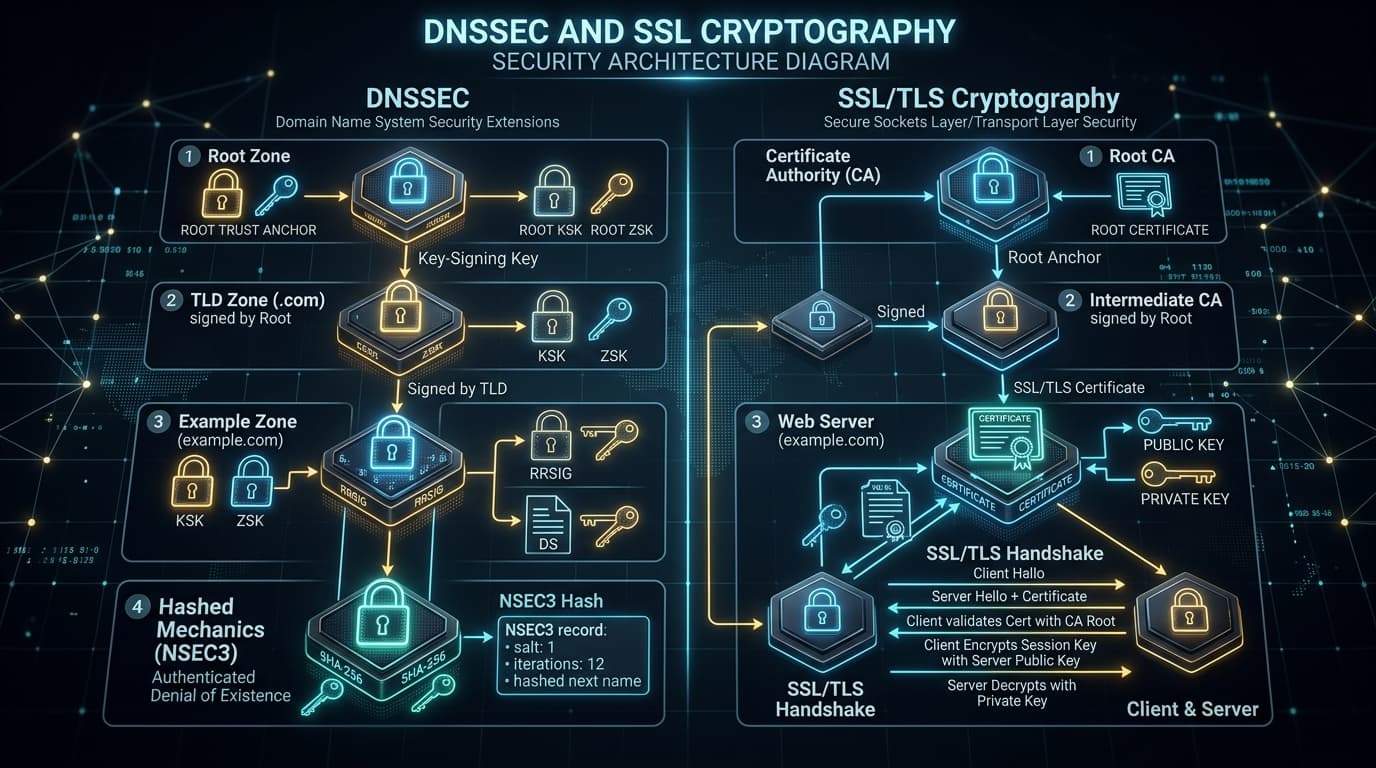
Figure 1: The Cryptographic Handshake from Root to Leaf
Visualizing the DS-to-DNSKEY linkage across administrative boundaries.
When you query www.example.com, the validation path is as follows:
- The resolver gets the A record and its RRSIG from
example.com. - It verifies the RRSIG using the DNSKEY found in
example.com. - To trust the DNSKEY, it asks the
.comTLD for the DS record ofexample.com. - It verifies that the DS record is a valid hash of the DNSKEY.
- It then verifies the
.comDNSKEY using the DS record found in the Root (.) zone. - Finally, it verifies the Root's DNSKEY against a locally stored Trust Anchor.
4. Key Management: ZSK vs KSK
To balance security with operational efficiency, DNSSEC typically utilizes two distinct classes of keys:
- Zone Signing Key (ZSK): A shorter, frequently rotated key used to sign the actual resource records (A, MX, etc.) in the zone. Rotation happens every 1-3 months.
- Key Signing Key (KSK): A longer, more secure key used only to sign the DNSKEY set. Because the KSK's hash (the DS record) must be published in the parent zone, it is rotated much less frequently (annually or longer).
The KSK acts as the anchor for the local zone, while the ZSK handles the high-volume operational signing.
5. Authenticated Denial: NSEC vs NSEC3
How do you sign something that doesn't exist? This is the unique challenge of DNSSEC. If a resolver asks for ghost.example.com and it doesn't exist, the server cannot sign a "No" on the fly without having the private key on the nameserver (which is a security risk).
Instead, DNSSEC uses NSEC (Next Secure) records. These records say: "The names between apple.example.com and zebra.example.com are empty." Because the server knows all names in the zone, it pre-signs these gaps.
NSEC3 (RFC 5155) solves this by hashing the domain names before linking them. Instead of pointing to admin.example.com, it points to the hash of admin.
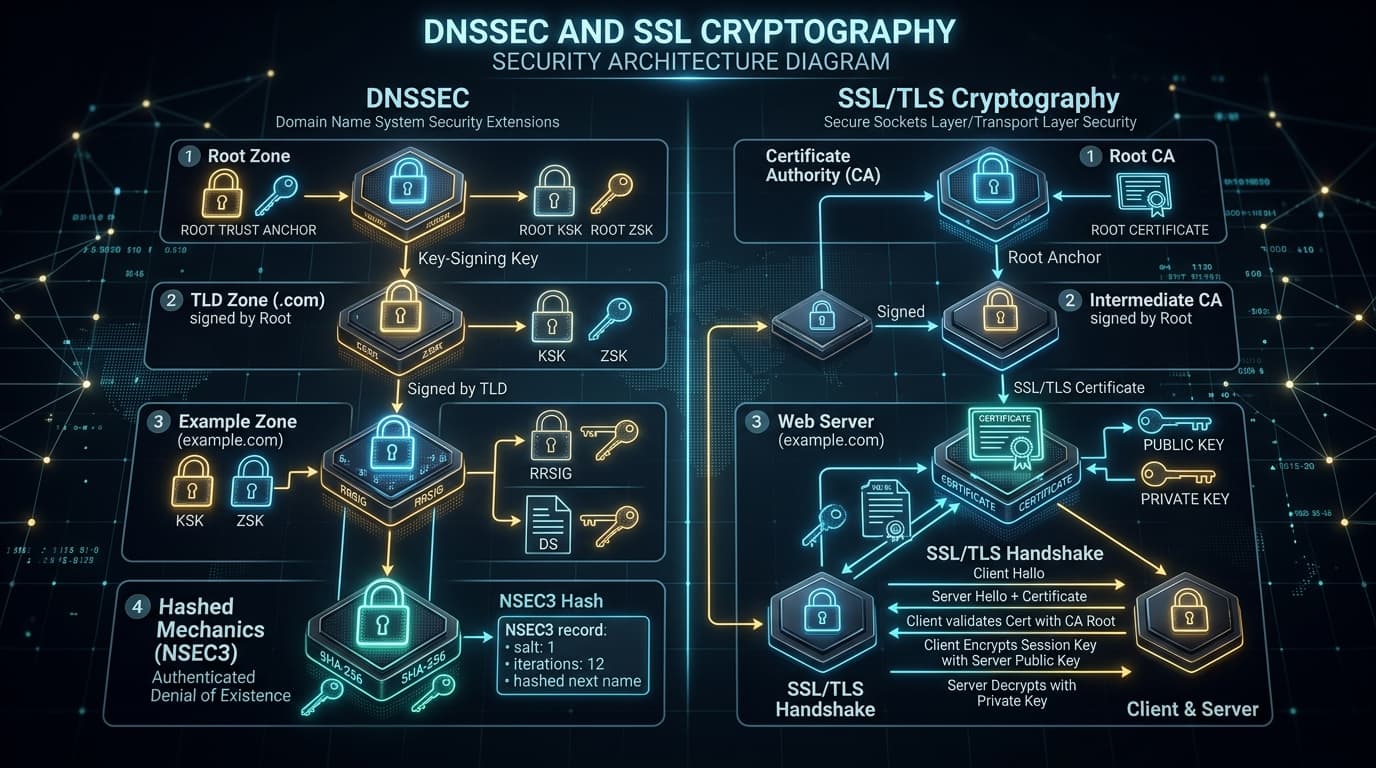
Figure 2: The NSEC3 Hashing Gap
Visualizing salt iterations and the protection of zone content from enumeration.
6. The Forensic Lab: Debugging SERVFAIL
For a client, a DNSSEC failure looks like a SERVFAIL. To an engineer, this is the start of a forensic investigation. The three most common causes of DNSSEC breakage are:
- Clock Skew: DNSSEC signatures have an absolute expiration timestamp. If your server's clock is off by a few minutes, it might reject perfectly valid signatures thinking they have expired (or aren't yet valid).
- Missing DS Record: You signed your zone and added DNSKEYs, but forgot to give the DS record to your registrar. The chain of trust is broken at the TLD level.
- Algorithm Mismatch: The resolver supports RSA but you used Ed25519 (or vice-versa).
Practical: Signing a Zone with BIND
# Step 1: Generate Zone Signing Key (ZSK) — 2048-bit RSA
dnssec-keygen -a RSASHA256 -b 2048 -n ZONE example.com

# Step 2: Generate Key Signing Key (KSK) — 4096-bit RSA
dnssec-keygen -a RSASHA256 -b 4096 -n ZONE -f KSK example.com

# Step 3: Sign the zone file
dnssec-signzone -A -o example.com -t example.com.db

# Step 4: Verify the signed zone
dnssec-verify -o example.com -t example.com.db.signed

# Step 5: Check your DS record matches registrar
dnssec-dsfromkey Kexample.com.+008+KSK.*.key
The -A flag in dnssec-signzone generates NSEC3 records automatically. Always verify DS record hashes with your registrar before publishing.
7. The Kaminsky Gap: Complexity vs Security
Implementing DNSSEC adds significant complexity to DNS operations. Larger UDP packets (often > 1232 bytes) can trigger fragmentation issues or ICMP "Packet Too Big" errors, leading to "Silent DNS Failures" where queries simply time out.
8. Future Horizon: Quantum-Resistant DNSSEC
Current DNSSEC rely primarily on RSA and Elliptic Curve (ECDSA) algorithms. In a post-quantum world, these algorithms could be cracked. The engineering community is currently evaluating Post-Quantum Cryptography (PQC) for DNSSEC, such as Falcon or Dilithium.
The challenge is signature size. PQC signatures are massive compared to ECDSA. A single DNSSEC response might exceed 10KB, requiring a transition from UDP to TCP or even QUIC for all DNS traffic—a fundamental shift in how the internet's core directory operates.
Technical Encyclopedia
Technical Encyclopedia
- Trust Anchor
- A pre-configured public key used by a resolver as the starting point for a chain of trust. The Root Zone (.) trust anchor is managed by IANA.
- Key Tag
- A 16-bit integer used to quickly identify a specific DNSKEY without performing a full cryptographic hash check.
- Zone Walking
- The technique of using NSEC records to map every active subdomain in a target zone.
- ZSK (Zone Signing Key)
- The key used to sign the operational resource records (A, AAAA, MX) within a zone.
- KSK (Key Signing Key)
- The key used to sign the DNSKEY set, forming the bridge to the parent zone's DS record.
- Glue Records
- A records provided by the parent zone to prevent circular dependencies when nameservers reside within the zone they serve.
References & Technical Sources
- [1]R. Arends et al. (2005). DNS Security Introduction and Requirements. IETF RFC 4033."The primary architectural document for DNSSEC."Source Document
- [2]R. Arends et al. (2005). Resource Records for the DNS Security Extensions. IETF RFC 4034."Defines the RRSIG, DNSKEY, DS, and NSEC resource records."Source Document
- [3]B. Laurie et al. (2008). DNS Security (DNSSEC) Hashed Authenticated Denial of Existence. IETF RFC 5155."Introduced NSEC3 to prevent zone walking."Source Document
- [4]Dan Kaminsky (2008). The Kaminsky Vulnerability: A Retrospective. Black Hat Briefings."The seminal research that accelerated global DNSSEC adoption."Source Document
Related Engineering Resources
9. Key Rollover Strategies: Pre-Publish vs. Double-Signature Models
Key rollover — the process of replacing an existing DNSSEC key pair with a new one — is the most operationally risky task in DNSSEC management. A failed rollover can break the chain of trust, causing all signed domains to become unreachable for DNSSEC-validating resolvers. Two primary rollover models exist: the **Pre-Publish** method (RFC 6781, Section 4.1.1) and the **Double-Signature** method (RFC 6781, Section 4.1.2). Each model has distinct operational characteristics, risk profiles, and DNS traffic implications.
The Pre-Publish rollover is the most commonly used method for Zone Signing Key (ZSK) rollovers. In this model, the new public key (DNSKEY_new) is added to the zone alongside the existing public key (DNSKEY_old) before the signing transition occurs. The zone is still signed with DNSKEY_private_old during the "introduction" phase. After the introduction period (typically equal to the TTL of the DNSKEY record set, usually 1-24 hours), the zone switches to signing with DNSKEY_private_new, and DNSKEY_old is removed. The advantage of Pre-Publish is that the DNSKEY set never has a moment where it lacks a valid key — at any point during the rollover, at least one key can verify the RRSIG signatures. The disadvantage is that the DNSKEY set doubles in size during the rollover, increasing the DNS response size by approximately 200-400 bytes.
The Double-Signature rollover is the preferred method for Key Signing Key (KSK) rollovers. In this model, the zone is simultaneously signed with both the old and new ZSKs during the transition period. All RRSIG records in the zone are duplicated — one set signed with ZSK_old and one set signed with ZSK_new. A validating resolver can use either signature to verify the records. This eliminates the timing dependency between the DNSKEY publication and the RRSIG signing transition. The cost is a 100% increase in zone file size and a corresponding increase in DNS response sizes because each RRSET now carries two RRSIGs. For a zone with 10,000 records, the zone file size increases from approximately 2 MB to 4 MB during the rollover period.
The rollover timing is governed by two critical parameters: the TTL of the DNSKEY RRSET and the Maximum Zone TTL (the longest TTL of any record in the zone). The Pre-Publish model requires the new DNSKEY to be present in the zone for at least the DNSKEY TTL duration before signing transitions begin, ensuring that all cached copies of the DNSKEY set include the new key. Similarly, after the signing transition, the old DNSKEY must remain in the zone for at least the Maximum Zone TTL duration to ensure that all cached RRSIG records have expired and been refreshed with signatures from the new key. The total rollover duration for a KSK rollover using the Double-Signature model is typically 2 × (max TTL + propagation delay) = 4-8 days. Automated rollover tools such as `dnssec-keymgr` (BIND) and `kdnssec-keymgr` (Knot DNS) manage this timing automatically, but operators must understand the underlying timing constraints to diagnose rollover failures.
The root zone KSK rollover in 2018 provides a real-world case study. The root KSK had been in use since 2010, and its replacement required extensive coordination across the 13 root server operators. The Pre-Publish phase ran from July to October 2018 (3 months, far longer than the minimum timing to ensure 100% resolver compatibility), the signing transition occurred in October 2018, and the old KSK was revoked in January 2019. During this period, ICANN observed a 0.1% increase in SERVFAIL responses for DNSSEC-validating resolvers — mostly from legacy resolvers that did not support the RFC 5011 key rollover process. The lesson for zone operators is that a KSK rollover should be planned for a minimum of 60 days, with dedicated monitoring of DNS validation failure rates through services like DNSSEC-Tools or dnsviz.
10. DNSSEC Response Size: EDNS0, TCP Fallback, and Fragmentation
DNSSEC fundamentally changes the size profile of DNS responses. A standard DNS response for an A record is approximately 100-200 bytes. A DNSSEC-signed response for the same query includes the A record, its RRSIG, the DNSKEY set, the DS record chain, and potentially NSEC records for authenticated denial — totaling 2,000-4,000 bytes. This 10-20x increase in response size creates significant operational challenges for the UDP-based DNS protocol, which is traditionally optimized for small, fast responses.
The EDNS0 (Extended DNS) option allows DNS clients and servers to negotiate a maximum UDP response size larger than the standard 512 bytes. The client includes an OPT pseudo-record in its query with a UDP payload size field (the "EDNS0 buffer size"). Modern resolvers typically advertise a buffer size of 1232 bytes (recommended by DNS Flag Day 2020) or 4096 bytes. If the response exceeds the advertised buffer size, the DNS server sets the Truncation (TC) flag in the response header, signaling the client to retry the query over TCP. This UDP-to-TCP fallback mechanism is the primary mitigation for large DNSSEC responses, but it adds a full RTT to the DNS resolution time (typically 10-50ms).
The 1232-byte buffer size recommendation was driven by a critical observation: many network devices (routers, firewalls, load balancers) fragment or drop UDP packets larger than 1232 bytes due to MTU constraints or security policies. An EDNS0 buffer size of 4096 bytes causes DNSSEC responses to be fragmented into 2-3 UDP packets. If any fragment is lost (which happens at a 1-5% rate on the public internet), the entire DNS response is lost, and the resolver must wait for the UDP timeout (typically 5-15 seconds) before retrying over TCP. By capping the buffer at 1232 bytes — which is the IPv6 minimum MTU (1280 bytes) minus the IP and UDP header overhead — the response fits in a single unfragmented UDP packet, eliminating the fragmentation failure mode.
The TCP fallback path introduces its own performance considerations. TCP-based DNS queries must complete the three-way handshake (1.5 RTT) before the query can be sent. For a DNSSEC response that is 3000 bytes, the TCP connection time dominates the total resolution time: 75ms for the handshake plus 15ms for the data transfer equals 90ms, compared to 15ms for a single UDP query (no fragmentation). At scale, the DNSFlagDay 2020 study found that 5-8% of all DNSSEC-signed queries to authoritative servers result in TCP fallback, adding an average of 72ms to those specific resolutions. For a recursive resolver handling 100,000 queries per second, the TCP fallback traffic represents 5,000-8,000 TCP connections per second, which requires significant resolver resources (file descriptors, memory, and CPU).
The industry is transitioning toward TCP as the primary transport for DNSSEC traffic. DNS-over-TLS (DoT) and DNS-over-HTTPS (DoH) use TCP natively, eliminating the UDP fragmentation concern entirely. QUIC-based DNS (DoQ, RFC 9250) provides 0-RTT connection establishment, reducing the TCP handshake overhead. In a DoQ environment, a DNSSEC-signed response of 4000 bytes is transmitted in a single QUIC stream within 0-RTT (saving 75ms compared to TCP). The remaining challenge is the authoritative-to-resolver path: while the resolver-to-client path is increasingly encrypted (DoT/DoH), the resolver-to-authoritative path still relies on traditional UDP/TCP DNS. The DPRIVE (DNS PRIVate Exchange) working group is standardizing DoT for authoritative servers, which would provide encryption and eliminate fragmentation on all segments of the DNS resolution path. Until then, zone operators should minimize DNSSEC response sizes by using shorter key lengths (ECDSA P-256 instead of RSA 2048) and limiting the number of NSEC records in authenticated denial responses. For propagation timing analysis, see DNS Propagation Science.
Key Takeaways
Every signed DNS record carries a cryptographic signature (RRSIG). The public key (DNSKEY) that verifies it is itself signed by a parent zone's DS record — forming the chain of trust.
Authenticated denial of existence requires proving a domain does not exist. NSEC3 hashes domain names to prevent zone walking while still providing cryptographic proof of non-existence.
DNSSEC responses are 10-20x larger than standard DNS. The 1232-byte EDNS0 buffer recommendation prevents fragmentation failures — exceeding it forces TCP fallback.
Next Steps
Test your own domains with DNS Lookup and check DNSSEC validation status. Learn about Anycast Routing for high-availability DNS infrastructure, or explore TLS Handshake mechanics for the next layer of cryptographic security.