
The Physics of Wave Propagation and Temporal Smearing
In a classical vacuum, light of all wavelengths travels at the constant speed . However, an optical fiber is a dense dielectric medium composed of silica () doped with varying concentrations of germania (). Inside this core, the effective speed of light is reduced by the refractive index . The critical performance issue arises because is not a constant; it is a complex function of the optical frequency , the polarization state, and the core geometry. This frequency-dependent velocity is known as Dispersion.
When a pulse (a collection of different frequency components) travels down the fiber, the components at the "blue" end of the spectrum travel slower than those at the "red" end (in the anomalous dispersion regime). After 100km, the pulse that started as a sharp 10ps spike has spread to 500ps. This is not just a loss of signal strength; it is a loss of temporal resolution. In high-speed networking, where bits are spaced just picoseconds apart, this spreading causes bits to overlap, creating Inter-Symbol Interference (ISI).
The Taylor Expansion of the Propagation Constant
To rigorously model how a signal evolves, we expand the propagation constant in a Taylor series around the carrier frequency :
Each term in this expansion represents a specific physical degradation that must be managed by the performance engineer:
- (Phase constant): Determines the absolute phase. Critical for coherent systems where the phase carries the data (QPSK/QAM).
- (Group Delay): Determines the absolute latency of the signal. In AI clusters, is the enemy of GPU synchronization.
- (GVD): Group Velocity Dispersion. Measured in . This is the primary driver of pulse broadening and the "eye closure" seen on oscilloscopes.
- (TOD): Third-Order Dispersion. Becomes critical as bandwidth increases, causing the pulse to develop an asymmetric "ringing" tail.
Pulse Broadening & ISI Simulation
Observe how Chromatic Dispersion causes optical pulses to overlap over distance.
1. Select Fiber Profile
2. Link Distance50 km
I. Chromatic Dispersion (CD): The Wavelength Race
Chromatic Dispersion is the primary pulse-broadening mechanism in single-mode fiber (SMF). It is a deterministic, linear effect caused by the interaction of Material Dispersion and Waveguide Dispersion.
1. The Sellmeier Foundation of Material Dispersion
Material dispersion arises from the resonant behavior of silica molecules. The refractive index changes because the electrons in the glass respond differently to different frequencies of light. This is governed by the Sellmeier Equation, which relates the refractive index to the absorption peaks of the material.
For standard silica, material dispersion crosses zero at approximately . At this "Zero Dispersion Wavelength" (ZDW), pulses experience minimal broadening. However, most modern networks operate in the C-Band (1530-1565nm) where the glass is most transparent but material dispersion is significant (~20 ps/nm/km).
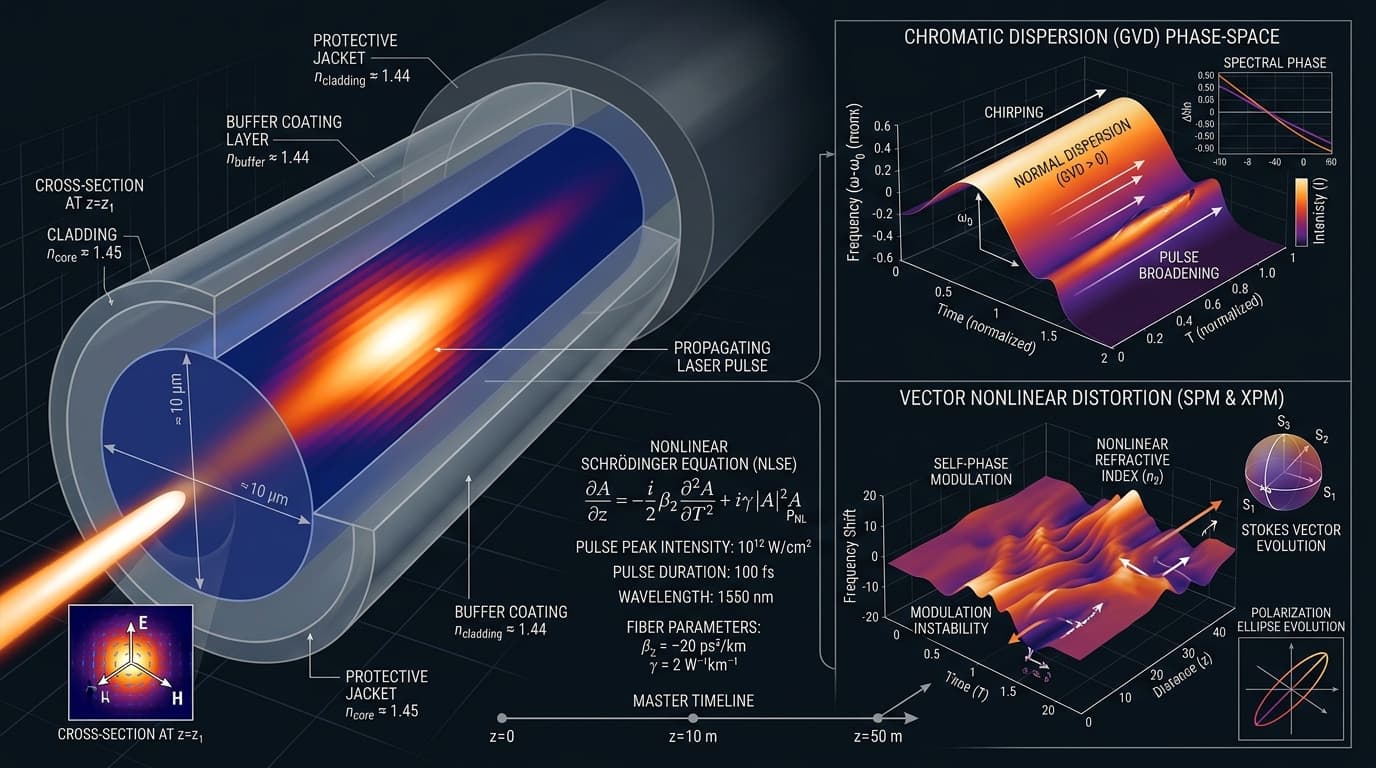
Figure 1: Pulse evolution in phase space. As the pulse travels (Z-axis), the chromatic dispersion induces a frequency gradient (chirp), causing the temporal width to broaden.
2. Waveguide Dispersion: Engineering the Profile
Waveguide dispersion occurs because the optical field is not perfectly confined to the core. A portion of the power (the "evanescent tail") travels in the cladding. Since the core has a higher index than the cladding, the light in the cladding travels faster.
The distribution of power between core and cladding is wavelength-dependent. At longer wavelengths, the mode field diameter (MFD) increases, more power leaks into the cladding, effectively speeding up the long-wavelength components. Crucially, waveguide dispersion is usually negative, allowing it to partially offset the positive material dispersion.
3. Mathematical Derivation: Gaussian Pulse Broadening
For a Gaussian pulse with initial width , the broadened width after distance is given by:
If the pulse is initially chirped (e.g., from a direct-modulated laser), the broadening is even more severe:
Where is the chirp parameter. This formula reveals a critical performance insight: if , the pulse will initially compress before broadening. This "pre-chirping" is a forensic trick used to extend the reach of 10G links beyond the standard 80km limit.
II. Polarization Mode Dispersion (PMD): The Stochastic Nightmare
While CD is predictable and deterministic, PMD is a random, statistical effect that becomes the ultimate bottleneck for 400G+ systems. It arises because no fiber core is a perfect circle. Manufacturing variances, physical bends, and thermal stress break the radial symmetry, creating Birefringence.
1. The Poincaré Sphere and Birefringence Vectors
We represent the polarization state of light as a vector on the Poincaré Sphere. In a perfectly circular fiber, the vector stays put. In a real fiber, the birefringence causes the vector to rotate as it propagates.
A birefringent fiber has two orthogonal axes: the Fast Axis and the Slow Axis. Light polarized along the fast axis travels faster than light on the slow axis. The difference in arrival time is known as Differential Group Delay (DGD).
2. Random Mode Coupling and the Maxwellian Limit
A long fiber link consists of thousands of concatenated birefringent segments, each with a random orientation. As light passes through these segments, the polarization state is constantly "shuffled." This is known as Random Mode Coupling.
Because the birefringence is random, the total DGD of a long link follows a Maxwellian probability distribution.
This stochastic nature makes PMD the "transient killer." A link might work perfectly for weeks and then fail for 10 minutes because a vibration (e.g., a train passing near the fiber vault) shifted the PMD into the "failure tail" of the Maxwellian curve. For 400G systems, we design for an "outage probability" of .
III. Solving Physics with Math: The Coherent DSP Pipeline
For the first 30 years of fiber optics, we fixed dispersion with more glass (DCMs). In the modern era, we fix it with silicon and complex algorithms.
1. Electronic Dispersion Compensation (EDC)
Modern 100G/400G/800G transceivers use Coherent Detection to recover the full electric field (Amplitude and Phase) of the signal. Once the signal is in the digital domain, we can apply the inverse transfer function of the fiber.
2. 2x2 MIMO Equalization for PMD
To solve PMD, the receiver uses a Butterfly Filter. This structure consists of four adaptive FIR filters that jointly process the two polarization states ( and ):
These filters "un-mix" the polarization states and align the timing between the fast and slow axes. The coefficients are updated in real-time using the Constant Modulus Algorithm (CMA), which seeks to minimize the amplitude fluctuations caused by PMD and ISI.
3. Digital Back Propagation (DBP)
As we push toward the Shannon Limit, the interaction between Dispersion and Nonlinearity (Self-Phase Modulation) becomes the final barrier. Digital Back Propagation is an advanced technique where the DSP simulates the fiber propagation in reverse, solving the NLSE step-by-step.
While computationally expensive (often adding 5-10W to transceiver power), DBP can extend the reach of a link by 20-30% by jointly nullifying both dispersive and nonlinear distortions.
IV. Infrastructure Evolution: Beyond Silica
As we reach the limits of silica fiber, the industry is pivoting toward new physical architectures to bypass dispersion entirely.
1. Hollow Core Fiber (HCF): The Near-Vacuum Limit
In HCF, light travels through an air-filled core. This provides three massive performance advantages:
- Zero Material Dispersion: Air has almost no refractive index variance in the NIR, eliminating the primary source of CD.
- Ultra-Low Latency: Light travels at instead of . This is the "Gold Standard" for High-Frequency Trading and AI Back-Ends.
- No Nonlinearity: Without silica, the Kerr Effect is absent, allowing for much higher launch powers without triggering the "Nonlinear Shannon Limit."
2. Space Division Multiplexing (SDM) and Multi-Core Fiber
Instead of cramming more data into a single core (and fighting dispersion/nonlinearity), we use fibers with multiple cores (MCF) or multiple modes (FMF). The challenge here is Inter-Core Crosstalk, which acts like a form of spatial dispersion. Solving this requires massive MIMO-DSP similar to 5G wireless but at optical frequencies.
| Fiber Type | Standard | CD @ 1550nm | Typical Use Case |
|---|---|---|---|
| Standard SMF | G.652.D | ~17 ps/nm/km | General Purpose / Metro |
| Non-Zero DSF | G.655 | ~4 ps/nm/km | Stochastic & Dynamic |
| Ultra-Low Loss | G.654.E | ~20 ps/nm/km | 800G Long-Haul / Subsea |
| Hollow Core | Experimental | < 1 ps/nm/km | Low-Latency AI / HFT |
V. Forensic Case Study: The 1.6T Coherent Transition
As the industry moves toward 1.6 Terabits per wavelength, the "Dispersion Budget" is effectively zero.
The Problem: A 1.6T signal using 160 Gbaud symbol rates has a symbol period of just 6.25 picoseconds. Even 1km of standard fiber will cause the symbols to overlap completely.
The Solution: This forces a move away from traditional Intensity Modulation (IM-DD) and toward Coherent detection even for intra-data center links (800G-LR / 1.6T-ZR). The extra cost of the coherent DSP is now cheaper than the power penalty of trying to fix dispersion in the optical domain.
The Forensic Insight: When testing 1.6T prototypes, engineers often see a "BER Floor" (errors that won't go away regardless of power). This is typically caused by Clock Phase Noise in the high-speed ADCs interacting with the dispersion compensation filter. If the sampling clock has even 100fs of jitter, the FFT-based CD compensation will "smear" that jitter across the entire pulse, creating an unrecoverable noise floor.
Frequently Asked Questions
Dispersion-Uncompensated Links: The DSP-Only Paradigm
Before the era of coherent detection, chromatic dispersion (CD) in fiber was compensated using Dispersion Compensating Fiber (DCF)—a special fiber with high negative dispersion that was spliced into the link at each amplifier site. DCF added 10-20% to the total link cost, introduced 1-2 dB of additional loss, and increased the nonlinearity because of its small effective area (~20 μm²). Modern coherent receivers eliminate DCF entirely by performing dispersion compensation in the digital domain using a Frequency Domain Equalizer (FD-CDC). The received signal is transformed to the frequency domain via FFT, multiplied by the inverse fiber transfer function, and transformed back:
A 2000 km link at 1550 nm accumulates approximately of dispersion. The FD-CDC compensates for this in a single FFT operation of 1024-4096 points (depending on the accumulated dispersion), consuming approximately 1 pJ/bit in the ASIC. The FFT length must be chosen such that the filter spans the entire dispersion-broadened pulse; for 34,000 ps/nm at 64 Gbaud, the required filter length is approximately taps, which becomes computationally prohibitive for time-domain equalization but efficient in the frequency domain. The DSP-only paradigm reduces the optical amplifier cost by 20-30% (eliminating DCF modules) and improves the OSNR by 1-2 dB (less insertion loss), enabling 400G transmission over 2000+ km on standard G.652 fiber that was previously limited to 1000 km.
PMD Dynamics: The Statistical Nature of Polarization Drift
While chromatic dispersion is deterministic ( is a fixed property of the fiber), Polarization Mode Dispersion (PMD) is a stochastic process governed by the random birefringence of the fiber. Manufacturing imperfections and mechanical stress cause the two orthogonal polarization axes of the fiber to have slightly different refractive indices, resulting in a Differential Group Delay (DGD) between the polarizations. Because the birefringence changes with temperature, vibration, and even the Earth's magnetic field, the DGD at any instant is a Maxwellian-distributed random variable:
The mean DGD scales as the square root of the fiber length: . For modern G.652 fiber, the PMD coefficient is approximately 0.1 ps/√km, so a 10,000 km link has a mean DGD of . However, the instantaneous DGD can exceed the mean by a factor of 3-4 (the Maxwellian tail), reaching 30-40 ps during worst-case conditions. At 64 Gbaud (15.6 ps symbol period), a 40 ps DGD would completely separate the two polarizations, causing the polarizations of neighboring symbols to overlap and creating unrecoverable errors. The coherent receiver's 2x2 MIMO Equalizer (based on the Constant Modulus Algorithm) tracks the polarization rotation and DGD on a timescale of microseconds, applying a matrix inversion every symbol to undo the polarization mixing and time delay. The CMA convergence time is approximately 100-200 microseconds, during which burst errors may occur. Modern transponders use a "flywheel" mode where the CMA parameters are frozen during sudden polarization transients (caused by line maintenance or cable vibration), preventing the equalizer from diverging and maintaining error-free operation throughout the event.
🔍 Engineering Metadata
- Primary Keyword: Fiber Optics Dispersion
- Standards: ITU-T G.652, G.654, G.657
- Target Baud Rate: 128 Gbaud - 192 Gbaud
- DSP Algorithms: FD-CDC, CMA, 2x2 MIMO, DBP