
Understanding Latency Dynamics
Master Class: The Physics of Synchronization and Round-Trip Time
How to measure Network Stability? Understanding the Propagation Constant
In its most reductionist form, network latency is a function of the speed of light. Even in a perfect vacuum, signal propagation cannot exceed m/s. In fiber-optic media, this velocity is reduced by the refractive index of glass, typically yielding a speed roughly 30% slower than .
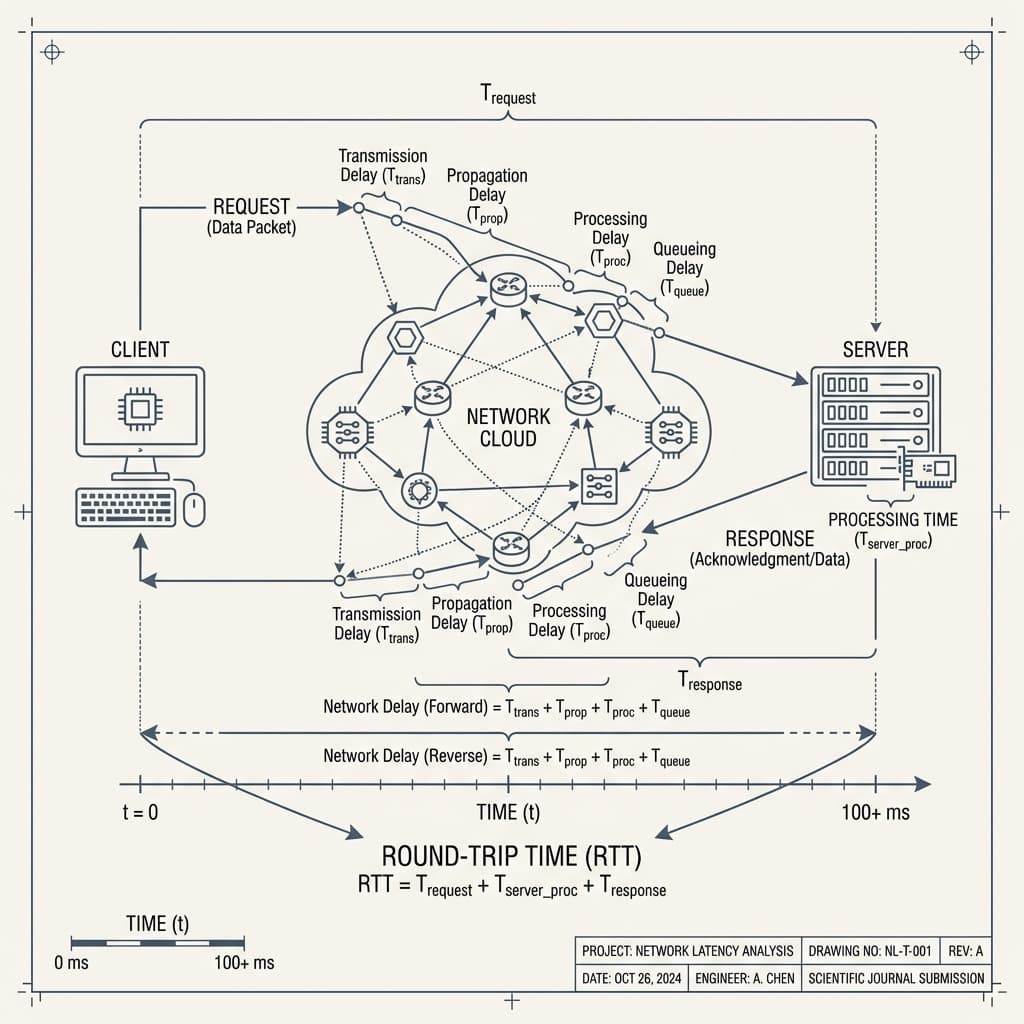
What are the main RTT Components? Deconstructing cumulative latency
While distance is the primary driver, real-world Round-Trip Time () is an aggregate of four distinct variables:
- Processing Delay (): The time taken by routers to examine the packet header and determine where to direct it. This is typically on the order of microseconds ($\mu s$) in modern FPGA-based hardware.
- Queuing Delay (): The time a packet waits in a router's buffer before it can be transmitted. This is the most variable component and the primary source of Jitter.
- Transmission Delay (): Also known as "Serialization Delay," this is the time required to push all the packet's bits onto the wire.
- Propagation Delay (): The time required for the signal to travel from the sender to the receiver through the physical medium.
2. The "Fat Pipe" Misconception: Bandwidth vs. Latency
A common myth is that increasing bandwidth decreases latency. This is only partially true. Bandwidth only reduces Transmission Delay (), not Propagation Delay ().
Serialization Math: 1500 Byte Packet
56 kbps Modem
1 Gbps Fiber
As you can see, once you exceed roughly 10 Mbps, the Serialization Delay becomes negligible compared to the Propagation Delay, which is fixed by physics.
3. The Physics of Fiber: Why Light Slows Down
In a vacuum, light travels at km/s. Inside a fiber optic cable, the glass core has a refractive index () of approximately . This slows the signal down significantly.
Real-World Example (New York to London): The distance is approx. 5,500 km.
- Vacuum Limit:
- Fiber Physics Limit:
- Real World (Routing + Queues): Typically 65ms - 75ms.
3. The Impact on Human Perception
Human cognitive response times are generally around ms. However, in interactive applications like cloud gaming or high-frequency trading, even ms of latency can be perceived as "lag." This is because latency doesn't just delay the content; it disrupts the feedback loop between action and observation.
Always use wired Ethernet for critical diagnostic measurements. Wi-Fi introduces an inherent ms to ms of additional "Airtime" latency and is highly susceptible to interference.
When using Pingdo's Diagnostics, you are measuring the synergy of these four components across the public internet. High variance in these numbers often indicates a problem in the Queuing Delay phase, commonly known as Jitter.