
Deconstructing Jitter
Root Causes and Mitigation in Real-Time Systems
1. Defining Jitter: The Mathematics of Instability
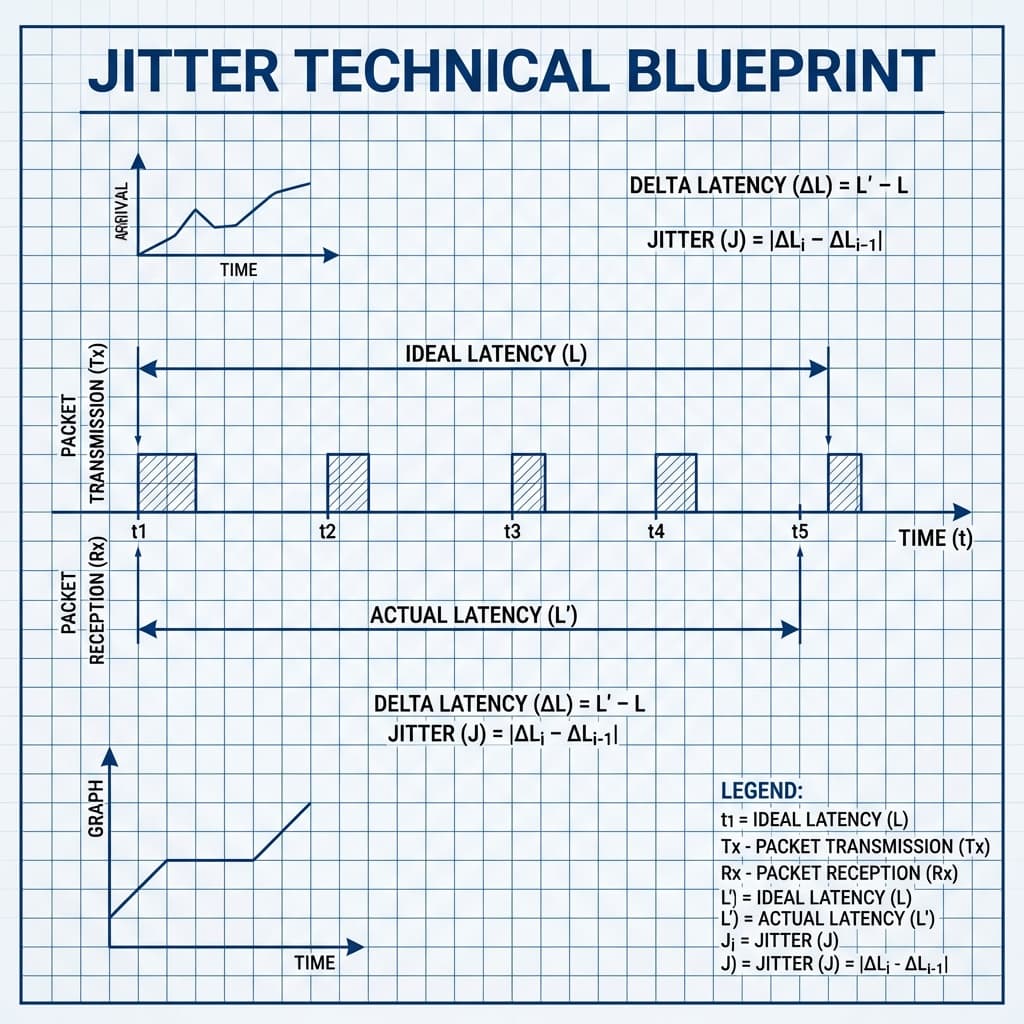
In signal processing and network engineering, Jitter (specifically Packet Delay Variation or PDV) is the variance in latency between sequential packets. While latency is a measure of speed, jitter is a measure of stability.
For a stream of packets, if represents the latency of the -th packet, the instantaneous jitter is defined as the absolute difference in latency between the current packet and the previous one:
Equation 1: Instantaneous Packet Delay Variation
However, single-packet variation is noisy. In professional analysis (per RFC 3393), we look at the Smoothed Jitter, which uses an exponentially weighted moving average (EWMA) to provide a stable metric for buffer sizing:
Equation 2: RFC 1889 / TCP Smoothed Jitter Calculation
2. The Taxonomy of Jitter: Deterministic vs. Random
Not all jitter is created equal. In high-speed serial links (like PCIe or SerDes) and network engineering, we decompose Total Jitter () into two primary components: Deterministic Jitter (DJ) and Random Jitter (RJ).
Deterministic Jitter (DJ)
Deterministic jitter is bounded and predictable. It has a specific cause and does not grow indefinitely over time.
- Data-Dependent Jitter (DDJ): Caused by the specific pattern of bits being transmitted (Inter-Symbol Interference).
- Periodic Jitter (PJ): Caused by external frequencies, such as switching power supplies or EMI from nearby machinery (as seen in the factory example above).
- Bounded Uncorrelated Jitter (BUJ): Crosstalk from adjacent lanes in a cable bundle.
Random Jitter (RJ)
Random jitter is unbounded and follows a Gaussian distribution. It is typically caused by thermal noise in electronic components or semiconductor physics. Because it is unbounded, we define it by standard deviation (). To ensure a Bit Error Rate (BER) of , the multiplier in the total jitter equation is typically 14.
3. Root Causes: Bufferbloat and Queuing
In modern packet networks, the most common source of jitter is Bufferbloat. This occurs when network buffers are too large and blindly hold packets instead of dropping them.
When a large download (like a 4K video stream) fills the router's buffer, a small VoIP packet gets stuck behind hundreds of large frames. This is Queuing Delay. If the queue drains at a constant rate, latency increases but jitter remains low. However, queues drain stochastically based on TCP window scaling and acknowledgments, causing the waiting time for each packet to vary wildly.
Mitigation Strategies
- Active Queue Management (AQM): Algorithms like RED (Random Early Detection) or CoDel (Controlled Delay) that proactively drop packets before the buffer fills, signaling TCP to slow down.
- QoS / DSCP Tagging: Prioritizing small, real-time packets (EF - Expedited Forwarding) so they bypass the bulk data queue entirely.
- Bandwidth Shaping: Artificially capping the upload speed slightly below the physical link rate to ensure the bottleneck is managed by your router's smart scheduler, not the ISP's dumb FIFO buffer.
4. Conclusion: Designing for Stability
Jitter cannot be eliminated, only managed. In high-frequency trading (HFT) and industrial automation, we minimize jitter by using cut-through switching and fiber optics to remove electromagnetic interference. In VoIP and consumer networks, we accept some level of random jitter and mask it with adaptive jitter buffers.
The goal of the network engineer is not just speed, but determinism. A connection with 10ms latency and 0ms jitter is far superior to a connection with 5ms latency and 20ms jitter for almost every real-time application.