
Packet Loss Dynamics
Analysis of Signal Degradation and Retransmission Overhead
How to measure Network Stability? Mechanics of Packet Loss
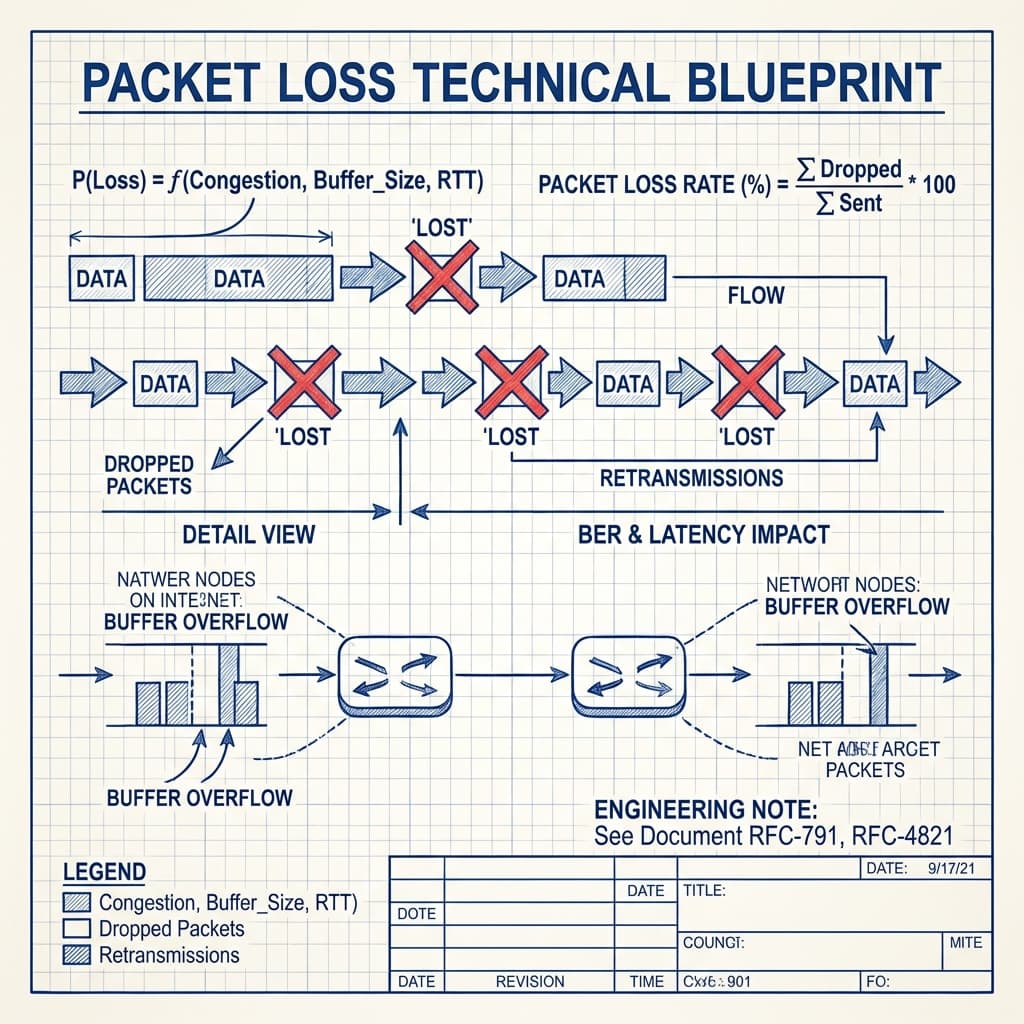
In any network, routers have finite buffer space. When a router receives more data than it can process, it is forced to discard incoming packets—a process known as Tail Drop. This is a primary indicator of network congestion and bufferbloat.
Packet Loss & Retransmission
Simulating TCP-style recovery on a lossy link.
Engineering Insight: Packet loss in high-reliability networks is often caused by Interference or Buffer overflows. While TCP handles recovery via retransmission, this introduces significant Tail Latency which can disrupt real-time operations.
1. The Mechanics of Congestion: TCP Reno vs. Cubic
Packet loss is not just an error; it is a signal. In the design of the Transmission Control Protocol (TCP), packet loss is the primary feedback mechanism for Congestion Control.
When a router drops a packet (Tail Drop), the sender must reduce its transmission window. The aggressiveness of this reduction depends on the algorithm:
- TCP Reno: Uses Additive Increase/Multiplicative Decrease (AIMD). Upon packet loss, it cuts the Congestion Window (cwnd) by 50%. This "sawtooth" pattern is efficient but slow to recover on high-bandwidth networks.
- TCP Cubic: Used by Linux and modern Windows versions. It uses a cubic function for window growth, allowing it to recover bandwidth faster in high-latency (high BDP) environments, maintaining better network stability.
2. Head-of-Line Blocking: The Silent Killer
One of the most severe consequences of packet loss in HTTP/1.1 and HTTP/2 is Head-of-Line (HOL) Blocking. Because TCP guarantees order, if Packet A is lost, Packet B and C must wait in the buffer until A is retransmitted, even if they arrived successfully.
Protocol Vulnerability to Packet Loss
| Protocol | HOL Blocking Risk | Impact on UX |
|---|---|---|
| HTTP/1.1 | Severe | Entire connection halts. |
| HTTP/2 | High (TCP level) | All streams on the connection halt. |
| HTTP/3 (QUIC) | None | Only the affected stream halts. |
3. The Physics of Signal Failure (BER)
Beyond congestion, packet loss is often rooted in physical infrastructure failure and signal degradation.
The probability of a packet being dropped due to physical errors is a function of the Bit Error Rate (BER) and the packet size ( bits). The probability of a successful packet transmission () is:
This defines the Goodput limit. If your fiber optic cable has a BER of , transmitting 1500-byte packets (12,000 bits) results in a ~1.2% packet loss rate purely from physics, regardless of router congestion.
- Electromagnetic Interference (EMI): Unshielded cables near power lines or faulty Wi-Fi environments affecting network stability.
- Fiber Attenuation: Signal loss over long distances or due to physical damage in the glass.
- Hardware Decay: aging router circuitry causing periodic transmission failure.
4. Diagnostic Thresholds & Quality of Service
For web browsing, 1% packet loss is tolerable. For high-fidelity diagnostic tools and industrial maintenance monitoring, even 0.1% loss can lead to erroneous data interpretation. In VOIP, packet loss manifest as "digital silence" or audio gaps that the human brain cannot easily reconstruct.