
Asset Lifecycle & Spares Optimization
Mastering the Total Cost of Ownership (TCO) Throughout the Asset Journey
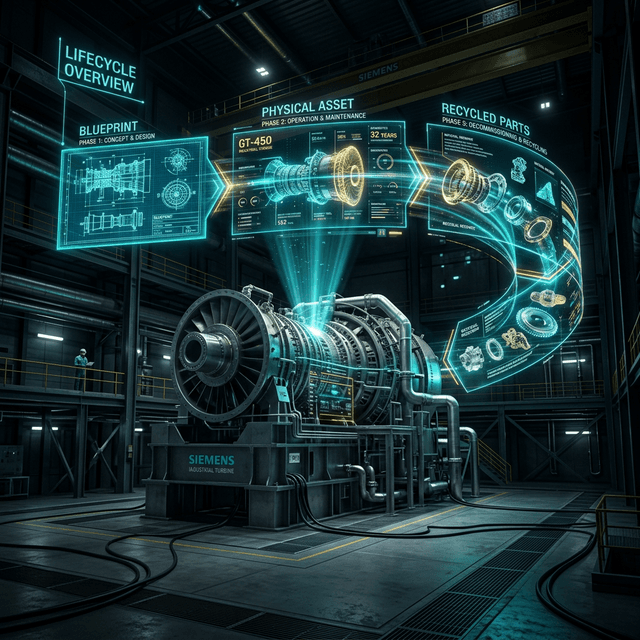
An industrial asset is like an iceberg. The **Purchase Price** is the 10% visible above the water. The remaining 90% is the **Total Cost of Ownership (TCO)** ΓÇö maintenance, energy, spare parts, and eventual disposal. Mastering Asset Lifecycle Management (ALM) means optimizing the whole iceberg.
1. The Asset Life Cycle (ALC) Phases
A strategic lifecycle approach follows ISO 55001 standards, ensuring that decision-makers consider the downstream maintenance implications during the design phase.
The Asset Life Cycle (ALC)
Thinking beyond the purchase price to Total Cost of Ownership.
Acquisition Management
"Design, Specifying, and Purchase of the asset based on ROI analysis."
2. Lifecycle Costing (LCC) Equation
Engineering decisions should be based on the Net Present Value (NPV) of all future costs.
LCC = Acquisition + Σ (Operation + Maintenance + Energy) - Residual Value 3. Critical Spares Management
If you stock EVERYTHING, you waste capital. If you stock NOTHING, you risk catastrophic downtime. We use **FNS / XYZ Analysis** and Asset Criticality to determine stocking levels.
Critical Spares (Insurance)
Items with a low probability of failure but catastrophic impact (e.g., a custom PLC backplane or a bespoke gearbox). These are often kept as "Insurance Spares" and never depreciated.
Consumable Spares
Fast-moving items like bearings, seals, filters, and belts. Optimized using **Min-Max** levels or Just-In-Time (JIT) vendor contracts.
4. The Bathtub Curve and Strategy
An asset's probability of failure shifts through its life.
- Infant Mortality: Caused by poor manufacturing or installation errors. (Strategy: Commissioning checks and warranty claims).
- Useful Life: Constant failure rate. (Strategy: Predictive Maintenance / PdM).
- Wear-out: Rapidly increasing failures. (Strategy: Decommissioning and Replacement planning).
5. Disposal & Sustainability
In a circular economy, disposal is no longer just "Scrapping." It involves harvesting working sub-assemblies for other machines, material recycling (REACH/RoHS standards), and environmental cleanup.