
Asset Lifecycle & Spares Optimization
Mastering the Total Cost of Ownership (TCO) Throughout the Asset Journey
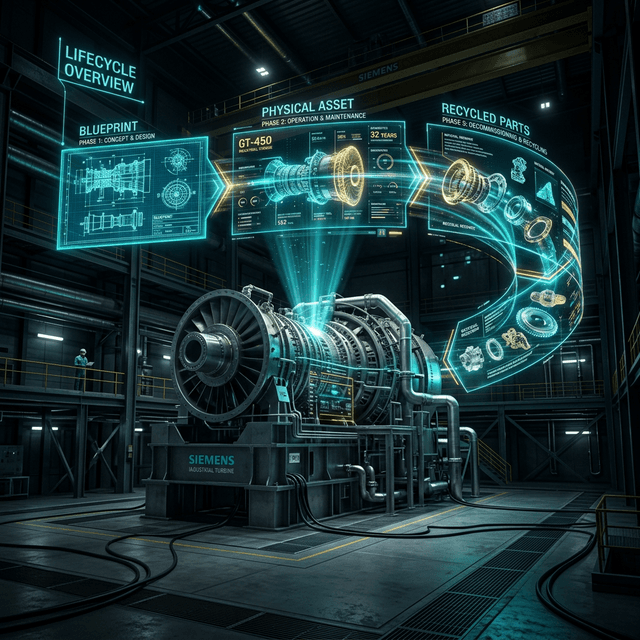
"The purchase price of an industrial asset represents only the visible tip of a massive financial iceberg. To manage an asset is to manage its entire temporal existence—from the first conceptual drawing to its eventual molecular decommissioning."
The ALM Paradox
In many industrial organizations, there is a fundamental disconnect between CAPEX (Capital Expenditure) and OPEX (Operational Expenditure). Procurement teams are incentivized to minimize the purchase price, while Maintenance teams inherit the long-term consequences of those savings. Asset Lifecycle Management (ALM) is the discipline that bridges this gap, enforcing a unified financial and technical vision across the asset's lifespan.
Impact Ratio
Decisions made in the first 5% of an asset's life (Design & Procurement) lock in over 85% of its total lifetime maintenance costs. Retrofitting reliability is 10x more expensive than designing it in.
1. ISO 55000: The Strategic Foundation
ISO 55000 is not a maintenance standard; it is a business management standard. It defines asset management as the "coordinated activity of an organization to realize value from assets." This realization of value requires a shift from technical silos to organizational integration. The standard is built upon four foundational pillars, often referred to as the "Big Four" of Asset Management.
Value (Realization)
Assets exist to provide value to the organization and its stakeholders. Value is not purely financial; it includes safety, reputation, and environmental sustainability. Asset management does not focus on the asset itself, but on the value that the asset can provide.
Alignment (The Line of Sight)
Asset management decisions (technical, financial, and operational) must be aligned with the organizational objectives. This "Line of Sight" ensures that a technician tightening a bolt on a Wednesday afternoon can trace the importance of that task directly to the company's annual profit or safety goals.
Leadership (Culture)
Leadership and workplace culture are central to ISO 55000. Without a top-down commitment to asset management, the SAMP becomes "shelf-ware"—a document that exists but is never implemented. Leaders must provide the resources and the mandate for cross-departmental collaboration.
Assurance (Audit)
Asset management must provide assurance that the assets will fulfill their required purpose. This involves monitoring, auditing, and continuous improvement (the PDCA cycle: Plan-Do-Check-Act). It is the feedback loop that proves the system is working.
The SAMP & AMP Hierarchy
The hierarchy of asset management documentation is designed to ensure consistency across the enterprise:
- 1. Organizational Strategic Plan:The "What"—the highest level corporate goals.
- 2. SAMP:The "How"—the high-level methodology for translating goals into asset actions.
- 3. AMP (Asset Management Plan):The "Where/When"—specific life-plans for individual asset classes (e.g., Fleet AMP, Transformer AMP).
2. Lifecycle Costing (LCC) Forensic Math
Lifecycle Costing (LCC) is the process of estimating the total cost of ownership over the life of an asset. It is a predictive tool used to compare competing alternatives, often revealing that the "cheapest" asset is, in fact, the most expensive when viewed over a 15-year horizon.
The Master LCC Equation (NPV Basis)
The CAPEX Fallacy: A Case Study
Consider two industrial air compressors, Option A and Option B, for a high-volume manufacturing facility:
Option A (The "Budget" Choice)
- • Purchase Price: $120,000
- • Annual Maintenance: $15,000
- • Annual Energy Cost: $45,000
- • Design Life: 10 Years
Total Undiscounted Cost: $720,000
Option B (The "Reliable" Choice)
- • Purchase Price: $180,000 (50% higher)
- • Annual Maintenance: $6,000
- • Annual Energy Cost: $32,000
- • Design Life: 15 Years
Total Undiscounted Cost: $750,000 (at 15 yrs)
When adjusted for the Net Present Value (NPV) using a 7% discount rate, Option B often wins despite the $60,000 higher entry price. Furthermore, when the Cost of Downtime () is factored in—where Option A has a 4% higher failure rate—the LCC for Option A can balloon by an additional $500,000 over its life.
Lifecycle Cost Drivers Table
| Category | Variable | Impact Profile |
|---|---|---|
| Procurement | Acquisition, Delivery, Commissioning | Immediate, one-time. |
| Reliability | MTBF, Preventive Intervals, Spares | Exponentially increasing with age. |
| Operational | Energy, Labor, Consumables | Steady-state, subject to inflation. |
3. Crow-AMSAA Growth Modeling
During the initial phases of an asset's life (Commissioning and Early Operation), the reliability is rarely constant. The Crow-AMSAA (NHPP) model is used to track the "Reliability Growth" or degradation over time.
Where is the cumulative number of failures at time .
Beta () Analysis
- β < 1:Reliability Growth. We are fixing infant mortality and learning.
- β = 1:Stable Reliability. The asset is in its useful life phase.
- β > 1:Degradation. The asset is entering the wear-out phase. Replacement planning must begin.
4. Spares: The Insurance of Reliability
Spare parts management is a balancing act between the Cost of Holding and the Cost of Not Having. For critical assets, the latter is often several orders of magnitude higher. Optimization requires both deterministic models (EOQ) and probabilistic models (Safety Stock).
Economic Order Quantity (EOQ)
The EOQ model determines the order quantity that minimizes total inventory costs.
D: Annual Demand
S: Ordering Cost per Order
H: Holding Cost per Unit per Year
Safety Stock Math
Safety stock accounts for variability in lead time and demand.
Z is the service level factor (e.g., 1.65 for 95%).
Obsolescence Management (Type 1-3)
Managing the lifecycle of spares is as critical as managing the asset. Obsolescence is the greatest risk to long-term RUL (Remaining Useful Life).
Type 1: Technical
The part is still available, but a better, more efficient alternative exists. Transitioning requires a business case based on energy or performance.
Type 2: Logistical
The original manufacturer has ceased production. Parts are available only via secondary markets or "Last Time Buy" (LTB) events.
Type 3: Functional
The part is no longer available anywhere. Requires reverse engineering, 3D printing, or a full system retrofit.
The Asset Life Cycle (ALC)
Thinking beyond the purchase price to Total Cost of Ownership.
Acquisition Management
"Design, Specifying, and Purchase of the asset based on ROI analysis."
5. DfM: Engineering the Future OPEX
80% of maintenance costs are "baked in" before the asset even arrives on site. Design for Maintainability (DfM) is the practice of ensuring that the asset can be inspected, serviced, and repaired with minimal effort and risk.
Accessibility Standards
Ensuring human-sized access to lubrication points, filters, and drive belts. If it's hard to reach, it won't be maintained.
Modularity
Designing systems with "Line Replaceable Units" (LRUs). Minimize the need for complex on-site machining or precision alignment.
Standardization
Reducing the variety of components. If one motor model fits 20 machines, the spares inventory is drastically reduced.
6. ISO 19650: The Digital Twin Handover
In the era of Industry 4.0, the physical asset is secondary to the data that defines it. ISO 19650 provides the framework for managing information across the lifecycle using Building Information Modeling (BIM). This process transitions from the Project Information Model (PIM) during construction to the Asset Information Model (AIM) during operation.
The Common Data Environment (CDE)
A centralized digital repository where all project and asset data resides. The CDE ensures that there is only one "Source of Truth" for technical drawings, maintenance manuals, and sensor telemetry. This eliminates the "as-built" discrepancies that plague brownfield sites.
COBie Data Exchange
The Construction Operations Building information exchange (COBie) is a non-proprietary data format that allows contractors to export asset data (warranties, model numbers, parts lists) directly into the client's EAM/CMMS system. A successful COBie handover can save 12 months of manual data entry for a new plant.
Asset Information Requirements (AIR)
Before the asset is even purchased, the organization must define its AIR. What data do we need to manage this asset? If you don't ask for the digital parameters during the tender process, you will pay 3x for them later.
7. Strategic Decommissioning & Disposal
The final phase of the lifecycle is often the most neglected. Decommissioning is not just about turning off the power; it is about risk mitigation, environmental compliance, and knowledge harvesting.
NIST 800-88: Data Sanitization
Modern industrial assets (PLCs, Smart Sensors, Servers) contain massive amounts of operational data. We follow the NIST 800-88 guidelines:
- • Clear: Overwrite data to prevent keyboard-level recovery.
- • Purge: State-of-the-art physical or logical techniques to prevent lab-level recovery.
- • Destroy: Physical shredding or incineration of the media.
The Knowledge Audit
"What did this asset teach us before it died?"
Before disposal, perform a final failure mode autopsy. Did the asset live to its design MTBF? If not, why? Feed this data back into the Procurement criteria for the replacement asset.
Strategic Asset Management Plan. The high-level alignment document.
Weighted Average Cost of Capital. Used as the discount rate in LCC.
Remaining Useful Life. The predicted time until the asset reaches wear-out.
Operations and Maintenance. The longest and most expensive phase.
Building Information Modeling. The digital framework for ALM.
Mean Time Between Failures. The key metric for reliability benchmarking.
Total Cost of Ownership. The sum of all costs across the lifecycle.
Enterprise Asset Management. The software used to manage the lifecycle.
The ALM Mandate
Asset Lifecycle Management is the final frontier of industrial profitability. By shifting the focus from the price tag to the lifecycle cost, and by integrating reliability engineering into the procurement cycle, organizations can unlock millions in hidden value. Don't just buy a machine; manage a legacy.
CMMS Implementation →
The technical substrate required to track every lifecycle event, spare part, and maintenance cost.
RCM Methodology →
The forensic engine used to determine which spare parts are vital and which maintenance tasks are optimized.
9. Life Cycle Cost (LCC) Modeling and Net Present Value
Life Cycle Cost (LCC) analysis per ISO 15686-5 is the financial framework that translates asset management decisions into economic terms. The LCC of an asset is the sum of all costs incurred over its planned life, discounted to present value using the organization's weighted average cost of capital (WACC). The five cost categories are: acquisition cost (purchase, installation, commissioning), operating cost (energy, consumables, operator labor), maintenance cost (labor, parts, contractor services), downtime cost (lost production during failures and scheduled maintenance), and disposal cost (decommissioning, environmental remediation, salvage value). For a 500kW industrial chiller with a 20-year life, acquisition cost is ,000, annual operating cost is ,000 (energy at .10/kWh × 500kW × 8,000 hours/year × 85% load factor = ,000), annual maintenance cost is ,000, expected downtime cost per failure is ,000 with 0.5 failures per year, and disposal cost is ,000. At WACC = 8%, the total LCC = ,000 + ,000 (PV of annual operating) + ,500 (PV of maintenance) + ,600 (PV of downtime) + ,070 (PV of disposal) = ,170.
The LCC model is most valuable when used to compare alternatives. An energy-efficient chiller with acquisition cost ,000 but annual energy cost of ,000 (15% more efficient) would have total LCC = ,000 + ,600 + ,500 + ,600 + ,070 = ,770, a savings of ,400 (9%) despite the ,000 higher purchase price. The payback period for the premium is ∆C_acquisition / ∆C_annual = ,000 / ,000 = 3.6 years, well within the 20-year asset life. The sensitivity analysis must vary the WACC (±2%), energy escalation rate (default 3%/year, range 0-5%), and failure rate (±50%) to determine the confidence interval of the LCC estimate. The Monte Carlo simulation (10,000 trials) of the chiller LCC comparison shows that the energy-efficient chiller has an 83% probability of lower total LCC, with a 90% confidence interval of ,000 to ,000, compared to ,000 to ,000 for the standard unit. A 2025 review of 32 capital project bids in the chemical industry found that only 6 included LCC analysis, and those 6 projects achieved an average 12% lower total cost of ownership over 10 years compared to the lowest-bid projects that minimized acquisition cost.
10. Asset Disposal Strategy and Replacement Optimization
The decision to replace an asset requires comparing the cost of keeping it (increasing maintenance, declining reliability, higher energy consumption) against the cost of replacing it. The economic life of an asset (the age at which replacement is optimal) is the point where the average annual cost of ownership is minimized. The average annual cost = (acquisition cost - salvage value) / n + average annual maintenance cost at age n, where n is the age in years. For a CNC machine tool with acquisition cost ,000 and salvage value declining at 15% per year, the annual maintenance cost increases at 12% per year as the machine ages. The total cost curve is U-shaped: initially high due to depreciation, declining as the depreciation is spread over more years, then rising as maintenance costs escalate. The minimum point on the U-curve (the economic life) occurs at 8 years for this machine, where the average annual cost is ,500. Replacing at year 7 (,200/year) or year 9 (,100/year) would increase the total cost of ownership by 1.9% and 0.7% respectively.
The replacement decision must also account for technological obsolescence. A machine's technical life (the period during which its output quality and speed meet current market requirements) is often shorter than its physical life (the period before catastrophic failure). For a packaging line, the introduction of a new servo-driven wrapper that operates at 150 packs/minute with 0.5% waste compared to the existing pneumatic machine's 90 packs/minute with 3% waste creates a technological replacement pressure independent of the old machine's condition. The replacement analysis must calculate the equivalent annual cost (EAC) of the new machine and compare it to the EAC of keeping the old machine for one more year (the "defender" analysis). EAC = (NPV of all costs) / annuity factor at WACC for the machine's life. If the new machine's EAC (,000/year) is lower than the old machine's cost of keeping for one more year (,000 including the imminent major overhaul and higher energy cost), the replacement is economically justified. A fleet-level asset management strategy must use this analysis for every asset in the portfolio annually, prioritizing replacements by the ratio of (old EAC - new EAC) / capital investment required. A 2024 implementation of this methodology for a mining company's fleet of 45 haul trucks generated a replacement prioritization schedule that reduced fleet maintenance cost by 18% over 3 years while maintaining production capacity.