
Predictive Maintenance Guide
Transitioning from Reactive to Proactive Asset Reliability
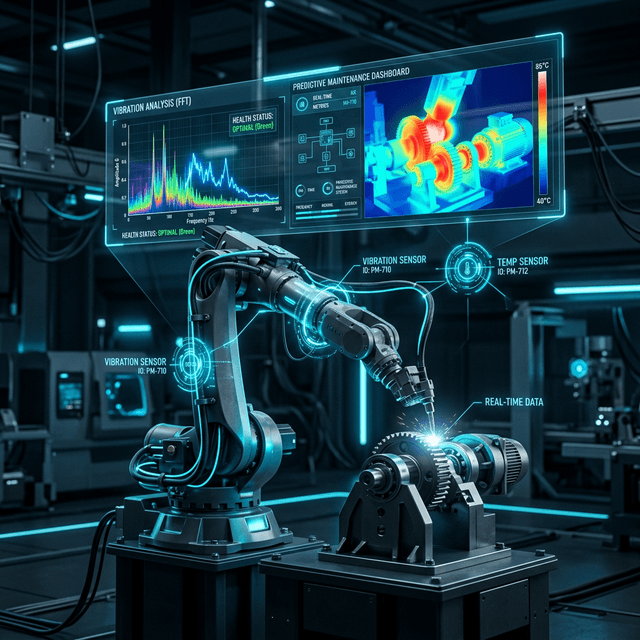
Predictive Maintenance (PdM) is the pinnacle of the maintenance maturity model. Unlike Preventive Maintenance, which is scheduled by time or cycles (often leading to over-maintenance), PdM relies on **Condition Monitoring** (CM) to determine the actual health of an asset.
1. The P-F Interval: The Window of Opportunity
The P-F Interval is the time between a **Potential Failure** (P) and a **Functional Failure** (F). Identifying the failure at the point where lead time is highest allows for planning, spare parts procurement, and scheduled shutdown, rather than an emergency crash.
P-F CURVE SIMULATOR
Predictive Analytics & Failure Proximity
The Golden Rule of Reliability
"Maintenance success is defined by how early on the P-F curve you can detect the potential failure (P). The longer the P-F Interval, the more time you have to plan, order parts, and prevent catastrophic downtime (F)."
2. Core PdM Technologies
Effective PdM requires a multi-modal approach. Different physics reveal different failure modes.
Vibration Analysis
Used primarily for rotating equipment (motors, pumps, gearboxes). Using FFT (Fast Fourier Transform), we identify unbalance, misalignment, and bearing race defects early in their lifecycle.
Infrared Thermography
Crucial for electrical systems (MCCs, switchgear) and thermodynamics. Detects hot-spots that indicate loose connections, overloaded circuits, or thermal insulation breakdown.
Ultrasonic Testing
Used for leak detection (air, steam, gas) and identifying early friction. Can hear high-frequency noise that the human ear misses, locating issues precisely in loud environments.
Oil & Fluid Analysis
Analyzing particle count and chemical composition of lubricants. Like a "blood test" for machinery, revealing internal component wear through the type of metals found in the oil.
3. PdM 4.0: Machine Learning & Cloud Integration
Legacy PdM involves manual measurements (the technician with a vibration pen). **PdM 4.0** (Industry 4.0) uses automated sensors that transmit high-frequency data (20kHz+) to the cloud for AI analysis.
4. ROI of PdM Implementation
A typical PdM program can deliver:
- 10x Return on Investment: The cost of the sensors is often paid off by preventing a single major gearbox failure.
- 25-30% Reduction in Maintenance Costs: By eliminating time-based tasks that aren't actually needed.
- 70-75% Reduction in Breakdowns: Moving from emergency reaction to planned execution.
Reliability Mapping:
Learn how PdM fits into the Reliability Centered Maintenance (RCM) logic of choosing the right task for the right asset.
RCM Methodology Guide →Digital Asset Hub:
Where to store your condition monitoring data and how to trigger automated work orders.
CMMS Implementation Guide →