
TPM Framework Strategy
Engineering the Transition from Reactive Repair to Total Asset Ownership
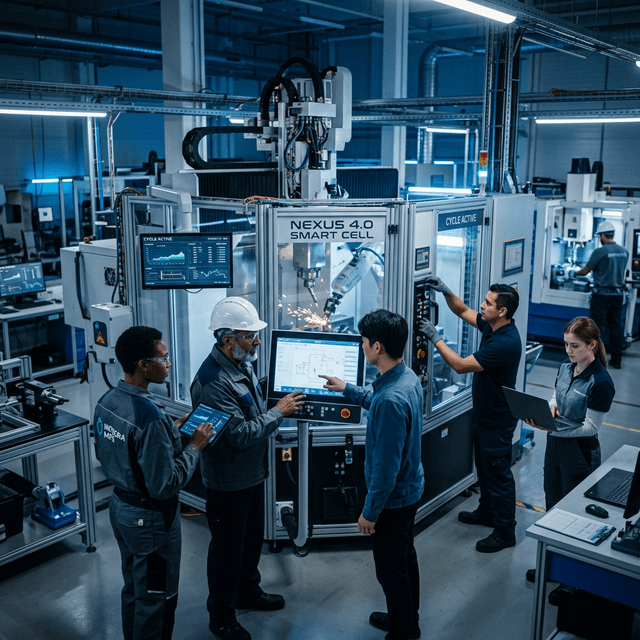
Total Productive Maintenance (TPM) is a holistic approach to equipment maintenance that strives to achieve perfect production: no breakdowns, no small stops or slow running, no defects, and no accidents. Unlike traditional maintenance programs where technical teams are solely responsible for asset health, TPM distributes the burden of asset care across the entire organization—from shop-floor operators to senior management.
Zero Breakdowns
Eliminating unplanned downtime through proactive intervention and operator ownership.
Zero Defects
Integrating quality management into the maintenance cycle to prevent process variation.
Zero Accidents
Creating an environment where equipment reliability and safety are inextricably linked.
1. The Genesis of TPM: From PM to TPM
TPM emerged from the post-WWII Japanese industrial landscape, pioneered by **Nippon Denso** (a key Toyota supplier) in the early 1970s. While the West focused on *Preventive Maintenance (PM)*—periodically checking and servicing machines to prevent failures—Nippon Denso realized that the increasing complexity of automation required more than just periodic checks.
Seiichi Nakajima, known as the "Father of TPM," introduced the concept that operators (those closest to the machine) should be the first line of defense. This shift marked the transition from "I produce, you fix" to "We are all responsible for our equipment."
2. The 5S Foundation: Engineering the Environment
Before any of the eight pillars can be implemented, the organization must establish a foundation of **5S**. In an engineering context, 5S is not about "cleaning up"; it is about **Visual Control and Signal Identification**.
Seiri (Sort)
Removing all "Ghost Inventory" and obsolete tools. In the maintenance shop, this means disposing of parts for decommissioned machines that still occupy shelf space.
Seiton (Set in Order)
Applying the **30-Second Rule**: Any tool or part required for a standard task must be retrievable within 30 seconds. This minimizes "Motion Waste" during critical repairs.
Seiso (Shine)
**Cleaning is Inspection.** By manually wiping down a hydraulic press, an operator detects a micro-leak that a remote sensor might miss. Seiso is the primary method of early failure detection.
3. The 8 Pillars of TPM: A Deep Dive
The TPM framework is traditionally represented as a temple, with eight pillars supporting the goal of Asset Excellence.
The TPM Architecture
Eight tactical pillars built on a foundation of 5S.
Autonomous Maintenance
"Equipping operators to perform basic maintenance (CIL: Clean, Inspect, Lubricate)."
Pillar 1: Autonomous Maintenance (Jishu Hozen)
Autonomous Maintenance (AM) is the heart of TPM. It involves training operators to perform basic maintenance tasks such as lubrication, bolt tightening, and inspection. AM is typically rolled out in seven disciplined steps:
- Initial Cleaning: Deep cleaning of the machine to expose hidden defects (leaks, cracks, loose bolts).
- Eliminate Contamination Sources: Identifying why the machine got dirty and implementing "Hard-to-Access" (HTA) improvements.
- Standardize CIL: Establishing clear Clean, Inspect, and Lubricate (CIL) standards.
- General Inspection: Training operators in the technical functions of the machine (Pneumatics, Hydraulics, Electrical).
- Autonomous Inspection: Operators develop their own inspection checklists based on their learned expertise.
- Workplace Organization: Standardizing the 5S environment around the asset.
- Full Autonomy: The operator "owns" the asset and performs continuous Kaizen.
Pillar 2: Focused Improvement (Kobetsu Kaizen)
Focused Improvement teams are cross-functional squads tasked with eliminating the **16 Major Losses** in manufacturing. Unlike routine maintenance, Kobetsu Kaizen is project-based.
The Loss Tree Analysis
Engineering teams must map every minute of downtime to a specific loss category. This allows for data-driven prioritization.
Solution: Root Cause Analysis (RCA)
Solution: SMED (Single Minute Exchange of Die)
Pillar 3: Planned Maintenance
The goal of Planned Maintenance is to achieve a state of **Zero Unplanned Downtime**. This pillar focuses on the transition from reactive to proactive maintenance using technical strategies:
- Preventive Maintenance (PM): Time-based or cycle-based replacement of parts.
- Predictive Maintenance (PdM): Using vibration analysis, thermography, and oil analysis to predict failure.
- Corrective Maintenance: Redesigning components that fail prematurely to increase their MTBF.
Pillar 4: Education and Training
TPM is a knowledge-intensive strategy. Pillar 4 focuses on closing the **Skill Gap** between the requirements of modern machinery and the current capabilities of the workforce. This is not merely about "how to use the machine," but rather "how the machine works."
The Multi-Skill Map (Skills Matrix)
Organizations must develop a competency matrix where every operator is graded from 1 (Novice) to 4 (Expert/Trainer). The goal is to have no "Single Point of Failure" in human knowledge. If only one person knows how to calibrate a specific sensor, the system is fragile.
Pillar 5: Quality Maintenance (Hinshitsu Hozen)
Quality Maintenance aims for **Zero Customer Complaints** by identifying the specific machine conditions that lead to defects. While traditional Quality Control (QC) focuses on inspecting the product, Hinshitsu Hozen focuses on **Inspecting the Process**.
This is achieved through **4M Analysis** (Man, Machine, Material, Method). If a defect occurs, the team must identify which component of the machine (e.g., a worn guide rail or a fluctuating voltage) caused the variation.
Pillar 6: Early Equipment Management
Up to 80% of an asset's lifecycle cost is determined during the design phase. The Early Management pillar ensures that maintenance experience is "fed back" to equipment manufacturers.
MP (Maintenance Prevention)
Designing machines that don't require lubrication, or that have easy-access panels for inspection. If it takes 2 hours to remove a cover to check a belt, the belt won't be checked.
LCC (Life Cycle Costing)
Moving away from "Lowest Initial Price" procurement toward "Total Cost of Ownership" (TCO), accounting for energy, spare parts, and disposal costs over 15 years.
Pillar 7: Office TPM
TPM is not restricted to the factory floor. Administrative functions (Procurement, Logistics, HR) also impact OEE. If the procurement team buys low-quality bearings to save cost, they are causing equipment failure. Office TPM aims to eliminate "Transaction Waste" and improve the efficiency of support functions.
Pillar 8: Safety, Health, and Environment (SHE)
The ultimate goal of TPM is **Zero Accidents**. A machine that is poorly maintained is a dangerous machine. By ensuring equipment is in its "Optimal Condition," we naturally eliminate the risks associated with fluid leaks, electrical shorts, and mechanical failures.
4. The Mathematics of TPM Success: OEE & Reliability
In the TPM framework, we cannot manage what we do not measure. The primary metric for TPM success is **Overall Equipment Effectiveness (OEE)**.
Reliability Mathematics
The OEE Equation is the product of three ratios:
To measure the stability of the system, we track **Mean Time Between Failure (MTBF)**:
Note: A high MTBF indicates a stable process, while a high **MTTR (Mean Time to Repair)** indicates poor maintenance efficiency or lack of spare parts.
5. The 12-Step JIPM Implementation Roadmap
The Japan Institute of Plant Maintenance (JIPM) prescribes a rigorous 12-step process for a successful TPM deployment. This roadmap typically spans 3 to 5 years.
Step 1-5: The Preparation Phase
Management announces the decision to introduce TPM, followed by introductory education and the creation of a promotional organization (TPM Steering Committee). This phase concludes with the establishment of basic TPM policies and goals (The Master Plan).
Step 6: The TPM Kick-off
A formal announcement to internal and external stakeholders. This signals the transition from planning to execution.
Step 7-11: The Implementation Phase
Execution of the eight pillars. This is where the heavy lifting occurs: Initial cleaning (AM), loss tree analysis (Focused Improvement), and the development of the Planned Maintenance system.
Step 12: Consolidation & Award Application
Sustaining the gains and applying for the JIPM Excellence Award. This step ensures that TPM becomes part of the company's DNA.
6. The Six Big Losses: A Forensic Deconstruction
To improve OEE, we must first understand the enemies of productivity. TPM identifies the **Six Big Losses** that degrade equipment performance:
Equipment Failures
Unexpected downtime due to mechanical or electrical breakdowns.
Setup & Adjustments
Downtime during product changeovers or tooling adjustments.
Idling & Minor Stops
Short stops (usually < 5 mins) caused by jams or sensor errors.
Reduced Speed
Operating the machine at a speed lower than its design capacity.
Process Defects
Scrap or rework produced during steady-state operation.
Reduced Yield
Defects produced during machine startup or warm-up periods.
7. TPM 4.0: The Digital Evolution
In the era of Industry 4.0, TPM is undergoing a digital transformation. The "Human-Centric" pillars are now augmented by data science and automation.
Augmented Reality (AR) for Autonomous Maintenance
Operators equipped with AR headsets see "Digital Overlays" on the machine. As they perform their CIL routines, the headset highlights exactly which bolt to tighten and displays the required torque setting in real-time. This eliminates human error and drastically reduces training time.
AI-Driven Kobetsu Kaizen
Machine Learning algorithms now perform "Pattern Recognition" on the Six Big Losses. Instead of a human team manually reviewing downtime logs, the AI identifies subtle correlations between ambient humidity and bearing failures, triggering a Kaizen project automatically.
8. Forensic Case Study: The High-Speed Bottling Failure
The Scenario
A high-speed carbonated beverage bottling plant was experiencing a 15% loss in OEE due to "Minor Stops" on the filler machine. The maintenance team performed weekly PMs, but the issues persisted.
The TPM Intervention
- AM Step 1: Operators deep-cleaned the filler and found a loose bracket that vibrated only at full speed.
- Kobetsu Kaizen: A 5-Why analysis revealed the bracket design was insufficient for the torque of the new, lighter plastic bottles.
- Early Management: The engineering team redesigned the bracket with a dual-locking nut and updated the procurement spec for future fillers.
Result: OEE increased from 72% to 89% within 6 months.
Conclusion: The Culture of Asset Stewardship
Implementing TPM is not a project; it is a permanent shift in how an organization perceives its physical assets. By breaking down the silos between production and maintenance, companies create a culture of **Asset Stewardship**. The cost of implementation—in training hours and initial cleaning time—is rapidly offset by the elimination of the "Hidden Factory": the capacity lost to defects, breakdowns, and inefficiencies.
Technical Encyclopedia
- Jishu Hozen
- The Japanese term for Autonomous Maintenance. It refers to the practice of operators performing their own maintenance tasks to prevent deterioration.
- Kobetsu Kaizen
- Focused Improvement. A systematic approach to identifying and eliminating the 16 major manufacturing losses.
- MTBF (Mean Time Between Failure)
- A reliability metric representing the average time a system operates before a failure occurs. Higher is better.
- MTTR (Mean Time To Repair)
- The average time required to repair a failed component and return it to service. Lower is better.
- OEE (Overall Equipment Effectiveness)
- The gold standard for measuring manufacturing productivity, calculated as Availability × Performance × Quality.
- P-F Interval
- The time between when a potential failure is first detectable and when the functional failure occurs. TPM aims to maximize this window.
OEE Optimization Guide →
Deep dive into the math and strategies for maximizing equipment effectiveness.
Materials Management →
How to manage the spare parts inventory that supports your TPM pillars.
8. Kaizen and Focused Improvement: TPM's 8th Pillar
While TPM's formal structure recognizes eight pillars, the Kaizen pillar (focused improvement) is the engine that drives year-over-year performance gains. Kaizen in the TPM context is not a suggestion box system; it is a structured problem-solving methodology using the DMAIC cycle (Define, Measure, Analyze, Improve, Control) applied to chronic loss reduction. The Kaizen selection process uses the "loss tree" decomposition from the OEE data: the plant's overall loss tree identifies the top three loss categories (by time lost), and a Kaizen event is chartered for each. A Kaizen event follows a 5-day structure: Day 1 (Define) — map the current process and quantify the loss using 30 days of OEE data; Day 2 (Measure) — collect high-frequency data from the PLC historian at 100ms intervals to identify the exact moment of each loss event; Day 3 (Analyze) — use fishbone (Ishikawa) diagrams and 5-Why analysis to identify root causes; Day 4 (Improve) — implement countermeasures using PDCA (Plan-Do-Check-Act) cycles; Day 5 (Control) — standardize the new process and create control charts to sustain the gain.
The effectiveness of a Kaizen event is measured by the reduction in the targeted loss category. A typical Kaizen on "minor stoppages" in a packaging line targets a reduction from 45 minutes per shift to 15 minutes per shift over a 90-day sustainment period. The standard work document for the new process must specify: the operator response to each sensor fault code (the specific corrective action and the time limit for execution before escalation), the visual standard for the machine area (floor marking, tool shadow boards, label placement), and the daily audit checklist. The control chart (X-chart of daily minor stoppage minutes) must have a data point plotted by the shift supervisor at the end of each shift, with the upper control limit set at 20 minutes. Any point above 20 minutes triggers a corrective action within the same shift. A 2025 meta-analysis of 180 Kaizen events across 24 manufacturing plants found that the average sustained improvement was a 62% reduction in the targeted loss category, but 28% of Kaizen events had lost the gain within 6 months due to inadequate control (lack of daily review of the control chart). The TPM coordinator must conduct a monthly "sustainment audit" of each completed Kaizen using a 20-point checklist that verifies the standard work documents are current, the control charts are being updated, and the corrective action log is being maintained.
9. Early Equipment Management (EEM): Maintenance by Design
The cost of a maintenance problem is minimized when it is eliminated during the design phase of new equipment. Early Equipment Management (EEM), the sixth pillar of TPM, applies the MP (Maintenance Prevention) design philosophy: eliminate the need for maintenance by designing out failure modes at the conceptual stage. The EEM process is structured as: (1) capture the MP information from existing equipment (what fails, what is difficult to maintain, what causes quality defects), (2) translate MP information into design specifications for the new equipment, (3) conduct a design review using the "3P" methodology (Production, Preparation, Process) to evaluate the new design's maintainability, and (4) verify during commissioning that the MP requirements have been met. The MP information database is populated from CMMS failure code history: if the CMMS data shows that "bearing failure due to lubricant contamination" is the top failure mode for the existing gearbox, the design specification for the new gearbox must include: sealed-for-life bearings (eliminating the lubrication task), a desiccant breather on the oil fill port (preventing moisture ingress), and a magnetic drain plug (capturing wear debris).
The maintainability design review must calculate the Mean Time To Repair (MTTR) for each critical component of the new equipment using the formula MTTR = (access time + diagnosis time + part replacement time + verification time). The design target is MTTR ≤ 2 hours for any component that can fail and stop production. For a motor-pump assembly, the motor replacement MTTR is calculated as: access time = 30 minutes (remove guard, disconnect coupling guard, disconnect conduit), diagnosis time = 10 minutes (megger test, verify power), part replacement time = 45 minutes (unbolt, lift, install, align, reconnect), verification time = 15 minutes (run test, check current, check vibration). Total = 100 minutes, below the 120-minute target. If the motor were installed in a tight corner requiring partial disassembly of adjacent equipment, the access time would increase to 90 minutes, exceeding the target and triggering a design change (relocate the pump to a serviceable location). The EEM review also specifies the one-point lesson (OPL) that must be created for each maintenance task on the new equipment, documenting the procedure, safety precautions, and required tools. A 2025 study of 14 greenfield manufacturing projects found that those using EEM achieved 34% lower maintenance costs in the first year of operation compared to projects that did not, and their CMMS data showed 28% fewer "infant mortality" failures (failures occurring within the first 6 months of operation).