
The Physics of Propagation Delay
Velocity Factor and Signal Speed
What is the Velocity Factor (Vf)?
The velocity of an electromagnetic wave in a vacuum is approximately meters per second. However, when data travels through a medium like glass or copper, it is slowed down by the material's properties. The Velocity Factor is the ratio of this speed to the speed of light in a vacuum.
For standard single-mode fiber optic cable, the Vf is approximately 0.67. This means information travels at only 67% of the speed of light, or roughly 200,000 km/s.
How do Refractive Indices Affect Latency?
In fiber optics, light is contained within the core through Total Internal Reflection. The core glass has a specific refractive index (). The relationship between the refractive index and the speed of light in that medium is inverse:
As increases, the signal slows down. Modern engineering aims to minimize this index, but the physical limitations of purified glass maintain a fundamental latency barrier of roughly 5 microseconds per kilometer.
Fiber Optic Refraction Simulator
Total Internal Reflection & Signal Velocity
Snell's Law: When light enters a denser medium (higher n), it slows down and bends toward the normal. In fiber optics, if the incident angle exceeds the critical angle (θc = arcsin(n₂/n₁)), total internal reflection occurs, trapping light within the core. This is the foundation of optical fiber transmission.
Calculating the Theoretical RTT Floor
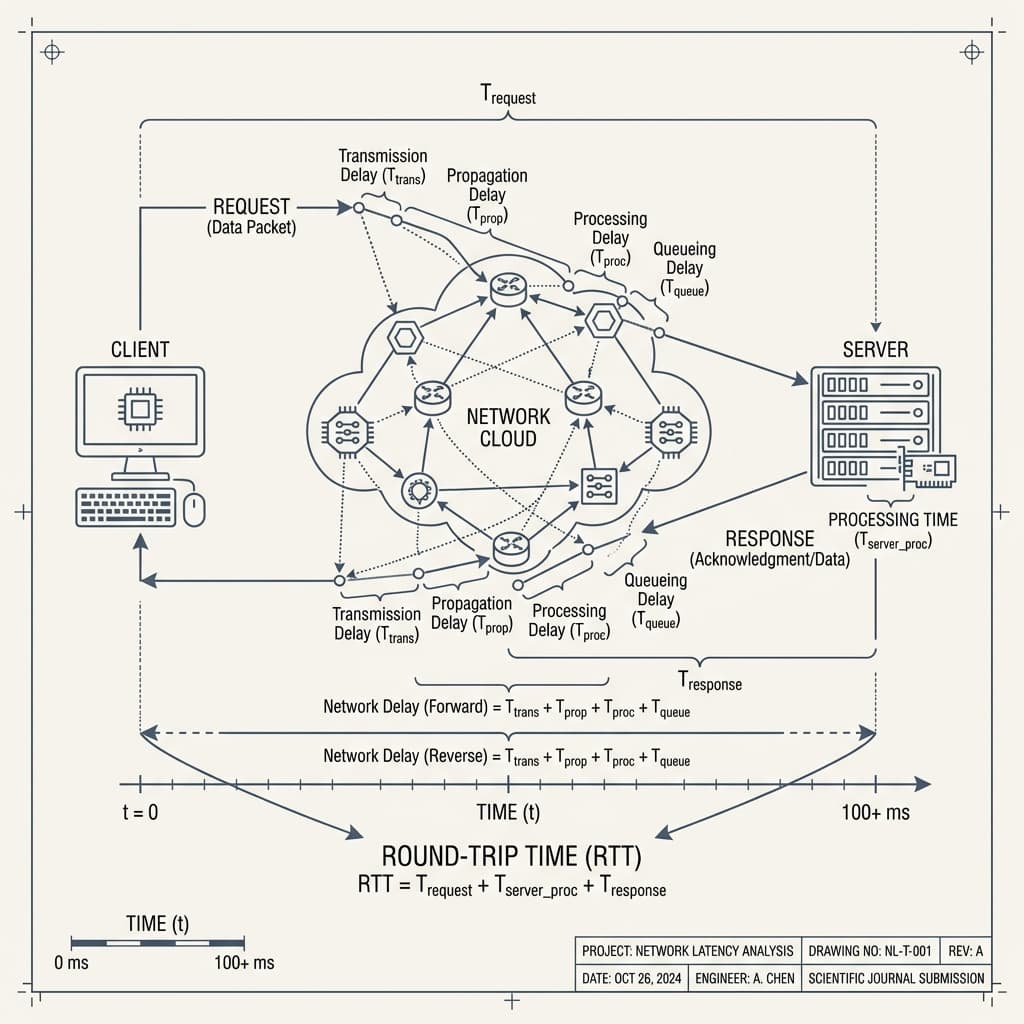
When designing high-frequency trading networks or critical infrastructure, we calculate the 'Minimum Theoretical RTT' based on the physical path. If you are 1,000km away from a data center, your theoretical minimum RTT is:
- Fiber Path: one way.
- Round Trip: 10ms absolute minimum.
Understanding the physics of propagation is the first step in mastering Network Reliability and setting realistic performance targets for digital infrastructure.