
Firewall Performance Forensics
The Physics of Deep Packet Inspection & TLS Decryption
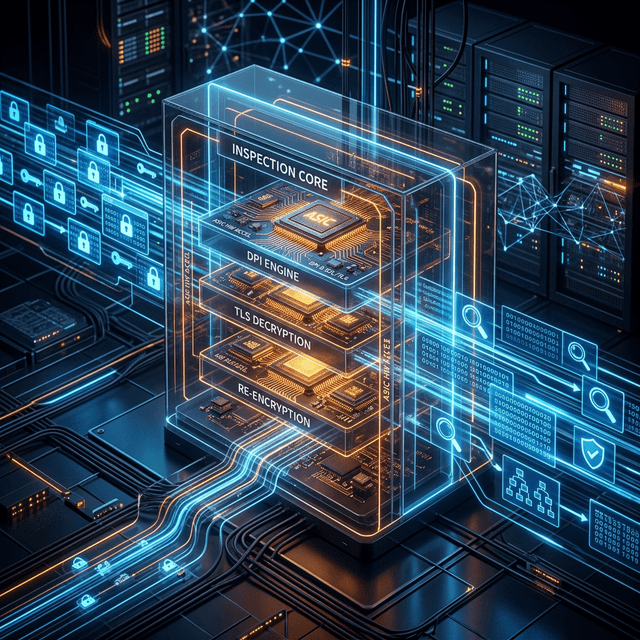
1. The Inspection Hierarchy: The Per-Packet Tax
Modern firewall performance is governed by the Principle of Increasing Entropy. As a packet moves from the physical layer (L1) to the application layer (L7), the amount of state that must be maintained and the number of logical operations required to validate it grows non-linearly. In a 2026 enterprise core, we must model latency as a multi-stage function:
Where is the primary variable, often dominated by the DPI (Deep Packet Inspection) engine. For a standard 1518-byte packet on a 400G link, the serialization time is only ~30 nanoseconds, but the security inspection can take anywhere from 5 microseconds (ASIC Fast Path) to 5 milliseconds (x86 Slow Path with full decryption).
L3/L4 Stateful
The Silicon Path: Validation of 5-tuple headers against a hardware session table.
- Mechanism: ASIC/TCAM
- Latency:
- Throughput: Wire-speed
L7 App-ID
The Flow Path: Identification of protocol behavior and metadata (e.g., HTTP/3 vs QUIC).
- Mechanism: NP/FPGA
- Latency:
- Throughput: Flow-limited
Full DPI/TLS
The Compute Path: Cryptographic proxying and signature-based payload scanning.
- Mechanism: x86/ARM + Crypto-Offload
- Latency:
- Throughput: Compute-bound
2. Hardware Architecture Forensics: The Silicon Pipeline
To survive the 2026 data tsunami, firewall architectures have bifurcated into Deterministic Silicon (ASIC) and Probabilistic Compute (x86). A forensic understanding of the "Packet Walk" inside the chassis is essential for identifying bottlenecks.
2.1 The ASIC Handoff: TCAM vs. Hash Tables
High-performance firewalls (e.g., Fortinet NP7, Palo Alto SPU) use specialized silicon to handle the L4 stateful layer. This hardware executes a 4-stage pipeline:
- Stage 1: L2/L3 Validation (O(1)): Verification of checksums, TTL, and MTU. If a packet is malformed, it is dropped at the ingress buffer before hitting the security engines.
- Stage 2: State Lookup (Hash Mapping): The 5-tuple is hashed to find an existing entry in the Session Table.If the hash produces a Collision, the ASIC must crawl a linked list in HBM2e memory, doubling the latency for that session.
- Stage 3: Policy Match (TCAM): If no state exists (a "First Packet"), the ASIC queries the TCAM (Ternary Content Addressable Memory). TCAM allows matching against wildcards (e.g., 10.0.0.0/8) in a single clock cycle. However, TCAM is power-hungry and expensive; if your policy set exceeds the TCAM capacity, the firewall "punts" the lookup to the x86 CPU, leading to a 100x increase in latency.
- Stage 4: Enforcement/Handoff: If permitted, the ASIC either forwards the packet (Fast Path) or tags it for DPI (Slow Path).
2.2 The x86 "Livelock" Phenomenon
In software-defined firewalls (Virtual Appliances, SD-WAN edges), the CPU handles every packet. This leads to the Interrupt Context Switch bottleneck. In standard Linux-based kernels, every packet triggers an IRQ (Interrupt Request).
Under heavy PPS load, the CPU spends more time switching between "User Mode" (Security App) and "Kernel Mode" (Packet Buffer) than actually inspecting traffic. This state, known as Livelock, results in 100% CPU usage even when throughput is near zero. Modern high-performance software firewalls use DPDK (Data Plane Development Kit) to bypass the kernel, using "Polling Mode" where the CPU stays active on the NIC ring buffer 100% of the time, eliminating the interrupt tax.
Stateful Inspection Engine
Connection Tracking System
Traffic Generator
STATE TABLE
3. Deep Packet Inspection (DPI): The Signature Gauntlet
Deep Packet Inspection requires "uncurling" the packet stream. While L3/L4 firewalls look at the envelope, DPI looks at the letter inside. This requires TCP Stream Reassembly—the firewall must buffer out-of-order packets and wait for the entire segment before scanning.
3.1 Pattern Matching Algorithms: Aho-Corasick vs. Hyperscan
Scanning for 50,000+ threat signatures simultaneously is a massive computational challenge.
- Aho-Corasick (Classic): Constructs a finite state machine (FSM) from the signature set. As packet data arrives, it walks the FSM. While complexity, the FSM for modern signature sets can be several gigabytes, leading to L3 Cache Misses.
- Hyperscan (Modern): Developed by Intel, it uses bit-parallelism (SIMD instructions like AVX-512) to match multiple regular expressions at once. Hyperscan can process data at 10Gbps+ per core, but requires specialized x86 instructions not available in older or ARM-based architectures.
# Simulating a "Straggler Attack" on a DPI engine
# Send Packet 1 (Seq 1), Packet 3 (Seq 3), Delay Packet 2
Buffer Status: [1] [ ] [3] ... WAITING FOR [2]
# Result: CPU Core 0 is PINNED to this session, holding 64KB in L3 cache.
# If Eve sends 10,000 'Straggler' sessions, the DPI buffer exhausts RAM.
4. The TLS 1.3 Decryption Physics
TLS 1.3 is the ultimate challenge for security infrastructure. By encrypting the Server Hello and using Encrypted Client Hello (ECH), it removes the ability for firewalls to "peek" at hostnames (SNI) or certificates. Passive inspection is dead; 2026 security requires a full MITM (Man-in-the-Middle) Proxy.
4.1 The Cryptographic "Tax" Breakdown
When a firewall intercepts a TLS 1.3 session, it effectively becomes two endpoints:
The resource cost is broken down into three physical phases:
- Asymmetric Handshake (Math Heavy): The firewall must compute the ECDHE (Elliptic Curve Diffie-Hellman) shared secret twice. This taxes the Control Plane. In 2026, PQC (Post-Quantum Cryptography) ciphers like Kyber increase this overhead by 5x-10x.
- Symmetric Bulk Transfer (Sustained): Decrypting and re-encrypting every byte using AES-GCM or ChaCha20. While hardware-accelerated (AES-NI), the sheer volume of data at 100Gbps+ consumes massive thermal headroom.
- The Memory Copy (Memcpy) Killer: Moving data from the NIC buffer to the Decryption engine, then to the DPI scanner, then back to the Encryption engine often requires multiple memory copies. This "Buffer Juggling" is the primary cause of Tail Latency in security appliances.
| Protocol / Level | Latency Delta | Throughput Efficiency | Forensic Bottleneck |
|---|---|---|---|
| Cleartext L4 | +2\mu s | 99% | SerDes/ASIC Line Rate |
| TLS 1.2 RSA | +150\mu s | 60% | RSA Modular Exponentiation |
| TLS 1.3 ECDHE | +450\mu s | 30% | Dual Handshake Proxy Overhead |
| TLS 1.3 + Full DPI | +1.5ms - 5ms | 10-15% | Context Swapping & Memcpy Tax |
5. State Table Forensics: The Physics of Exhaustion
A firewall's capacity is defined not just by bits per second, but by Concurrent Sessions. Every entry in the state table consumes a slice of high-speed memory (SRAM or HBM).
5.1 The Memory Math
A single session entry in a high-end firewall (e.g., Cisco Firepower or Juniper SRX) is approximately 2KB.
- 5-Tuple: ~40 bytes
- TCP Window Scaling: ~16 bytes
- NAT Mapping: ~32 bytes
- Security Engine Metadata: ~1.5KB (pointers to AV/IPS/DLP buffers)
To support 10 million concurrent sessions, the firewall requires of dedicated, low-latency memory. If this table fills, the firewall must either drop new connections (Fail Closed) or bypass inspection (Fail Open).
5.2 Forensic Analysis: The SYN Flood State Crawl
In a SYN flood attack, the attacker sends thousands of initial handshake requests but never completes them. The firewall must create a "Half-Open" state for each.
If the handshake timeout is 60 seconds and the attacker sends 100,000 SYNs/sec, the firewall requires 6 million state entries just for the attack traffic. Modern firewalls mitigate this using SYN Cookies, where the state is encoded into the sequence number sent back to the client, requiring zero memory until the final ACK arrives.
6. Parallelism Bottlenecks: The Elephant Flow Problem
As we move to 128-core and 256-core firewall processors, we hit the wall of Amdahl's Law. Because TCP is a sequence-sensitive protocol, all packets for a single session must be processed by the same CPU core to maintain packet order.
6.1 Receive Side Scaling (RSS) Hashing
To distribute traffic across cores, the NIC uses RSS. It hashes the 5-tuple and uses the result as an index to assign the packet to a core.
Forensic observation of "Polarized Cores" (where one core is at 100% and others at 5%) usually indicates a failure of the RSS hash—often due to encapsulated traffic (like GRE or VXLAN) where the "Outer IP" is the same for all flows, blinding the NIC to the underlying sessions.
7. 2026 Hardware Pillar: 800G & CPO Physics
At 800Gbps, the physical copper traces on a PCB behave like antennas, radiating signal into the air. This signal degradation increases the BER (Bit Error Rate), which forces the firewall's ingress controller to use extra compute cycles for FEC (Forward Error Correction).
- CPO (Co-Packaged Optics): To eliminate PCB loss, 2026 firewalls move the optical transceivers directly onto the ASIC package. This reduces "SerDes Power" but increases the thermal density of the security processor, often requiring Direct-to-Chip Liquid Cooling.
- 224G SerDes: Modern firewalls use 224Gbps lanes. At these speeds, a single speck of dust on a fiber connector can trigger a "Security Soft-Fail" where the firewall drops packets due to perceived payload corruption rather than a security violation.
8. Maintenance & SRE Strategy: Forensic Monitoring
Traditional "Average CPU" monitoring is a trap. In a high-performance firewall, the "Average" hides the "Burst." An SRE must monitor the Micro-Metrics.
8.1 The "Punt Rate" Leading Indicator
Monitor the rate of packets being sent from the ASIC to the CPU. A sudden spike in the Punt Rate (even if CPU % is low) indicates that traffic has bypassed the "Fast Path." Common causes:
- Fragmented IP packets (which ASICs cannot reassemble).
- IPv6 packets with too many Extension Headers.
- Options in the TCP header (e.g., TFO or experimental timestamps).
8.2 tail Latency & eBPF Observability
Using eBPF (Extended Berkeley Packet Filter), engineers can measure the exact nanosecond a packet enters and leaves the firewall pipeline.
Conclusion: The Future of Transparent Security
Firewall performance is no longer a software problem; it is a multi-dimensional physics problem. It requires balancing the raw silicon speed of 800G ASICs with the complex heuristic logic of x86 CPUs and the cryptographic opacity of TLS 1.3. As we move toward AI-driven threat hunting, the firewall will evolve into a "Security ASIC" embedded directly into the network fabric itself, making the perimeter both impenetrable and, finally, truly wire-speed.
A high-fidelity 3D visualization showing a "Dirty Packet" (red/glitchy) entering a futuristic laboratory pipeline.
- Step 1 (The Sorter): The packet hits an ASIC gate. 5-tuple is hashed instantly. Entry created in a holographic HBM2e state table.
- Step 2 (The Prism): The packet enters the SSL/TLS chamber. A laser (representing the decryption key) hits the packet, "unwrapping" it to reveal clear text.
- Step 3 (The Multi-Scanner): The packet moves through a "Single-Pass" ring. Multiple scanners (AV, IPS, App-ID) beam onto it simultaneously using SIMD parallelism.
- Step 4 (The Re-Wrapper): The packet is re-encrypted with a new TLS 1.3 header and ECH protection.
- Step 5 (The Exit): The packet turns green (clean) and is propelled out at 800Gbps.