
70V/100V Audio Distribution Architecture
Engineering mission-critical PA and voice alarm systems. Model voltage drop, optimize amplifier loading, and ensure acoustic clarity across enterprise facilities.
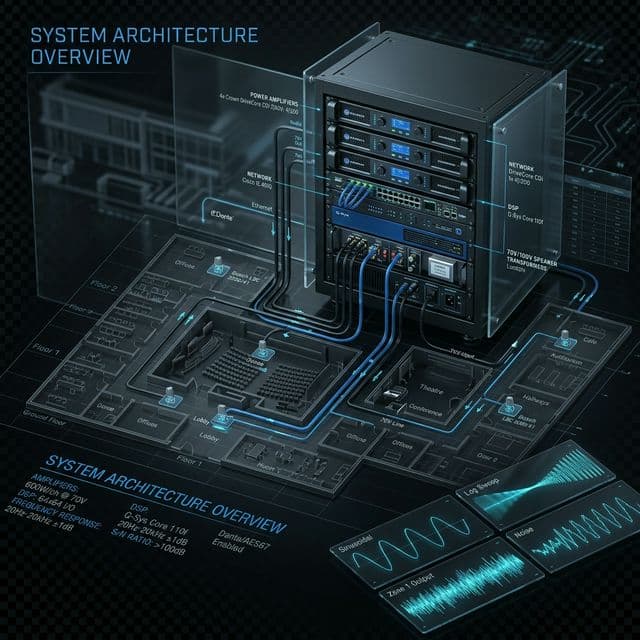
Industrial Audio Distribution Simulator
Design enterprise-grade audio infrastructures. Model speaker taps, wire insertion loss, and amplifier thermal headroom in real-time.
70V/100V Audio Distribution
Constant Voltage Sound System Calculator
Speaker Inventory
Voltage Drop Exceeds Limit
Constant Voltage Topology
Parallel Distribution System (70V/100V)
System Load
Includes 20% Headroom
Voltage Drop Warning
At 70V, line current is significantly lower than low-Z systems. Use 16AWG for runs up to 150m.
Power Amp
Designer Tip: Unlike 8Ω systems, you don't calculate impedance here. You simply sum the wattage of all taps. Ensure the total is 20% lower than the amplifier's maximum rated output for reliable operation.
The Physics of Constant-Voltage Distribution
In traditional residential audio systems (low-impedance), speakers typically operate at 4Ω or 8Ω. At these low resistances, even a small increase in cable length introduces significant series resistance, leading to massive power dissipated as heat in the wires rather than sound in the speakers. This is governed by the basic power equation:
Constant-voltage distribution (70V or 100V) bypasses this limitation by utilizing the same principle as the electrical grid: High Voltage, Low Current. An amplifier with a step-up transformer increases the output voltage. By raising the voltage, the current required to deliver a specific wattage drops proportionally:
As current () is reduced, the power lost in the cable () drops exponentially. Each speaker in the system then uses a small step-down "tap" transformer to convert that high-voltage signal back to the low-impedance level required by the driver.
Transmission Loss and Line Regulation
While transmission loss is minimized, it is never zero. In high-power stadium arrays or multi-kilometer airport campus paging systems, voltage drop still impacts the dynamic range and frequency response of the outermost speakers. We calculate the percentage of voltage drop using:
Where is the distance in meters and is the resistance per meter for a given wire gauge. A voltage drop exceeding 10% (roughly 1dB loss) is typically considered the threshold for noticeable audible degradation. However, for voice evacuation applications, life safety standards strictly mandate a 3% maximum drop across the primary trunk to ensure intelligibility.
70V vs. 100V: Comparative Architecture
The 70-Volt Standard (USA/CA)
Originally codified during the mid-20th century in US building codes, 70.7V remains the dominant standard in North America. It was selected as a safe voltage that often didn't require the cabling to be run in conduit (though this varies by local jurisidiction). It provides an ideal balance for standard office buildings, schools, and hospitals where runs are rarely longer than 150-200 meters.
The 100-Volt Standard (EU/Asia)
100V is the standard in Europe and most international markets. The slightly higher voltage allows for roughly 2x further distanceor half the copper cross-sectional area for the same power density. In modern industrial facilities like oil refineries or massive logistics hubs, 100V is almost always preferred despite stricter insulation requirements.
Operational Maintenance & Reliability Strategy
Managing a campus with 5,000+ speakers requires more than a reactive "walk-and-listen" test. Modern SRE-inspired infrastructure management utilizes the following automated auditing techniques:
Pilot Tone Monitoring (18-22 kHz)
Continuous supersonic tones are injected into the line by the amplifier. If a speaker transformer fails or a wire is cut, the amplifier detects the change in impedance/return and flags a trouble signal instantly.
Automated Impedance Curve Analysis
By plotting impedance across frequency, engineers can detect "soft failures" like transformer core saturation or moisture ingress in outdoor speakers before they cause a full system short-out.
A/B Circuit Interleaving
In life-safety zones (stairwells, evacuation routes), even-numbered speakers are on Line A and odd-numbered on Line B. This ensures that a single physical failure leaves the space with at least 50% coverage.
Transformer Core Saturation and Insertion Loss
A hidden "performance killer" in budget-grade constant voltage systems is Insertion Loss. Every transformer in the chain absorbs a small amount of energy as heat (). High-quality audio transformers typically have an insertion loss of 0.5dB to 1dB, meaning you actually receive roughly 80-90% of the dialed-in power.
Furthermore, low-frequency response (bass) requires physically larger transformer cores. Undersized transformers suffer from magnetic saturation at low frequencies, causing high Total Harmonic Distortion (THD) and clipping the signal. For high-fidelity paging, it is mandatory to specify high-permeability silicon steel cores to maintain a linear frequency response between 50Hz and 15kHz.
Cable Selection & Regulatory Matrix
| Standard | Requirement | Enforcement Context |
|---|---|---|
| NFPA 72 | Survivability Level 1, 2, or 3 | Fire alarm integration in high-rise buildings (US). |
| EN 54-16 | Supervised Control Lines | Mandatory voice evacuation for European airports & public malls. |
| UL 1480 | Fire Protective Signaling | Certification required for speakers used in emergency circuits. |
| IEC 60849 | Intelligibility (STI) ≥ 0.5 | Global standard for sound systems used in life-safety evacuation. |
Note: Designing for fire-safety applications may require plenum-rated, flame-retardant (CMP/FPLP) cabling depending on the air handling configuration of the facility.
Future Horizons: Constant Voltage vs. AoIP
While 70V/100V remains the king of analog distribution due to its reliability and low cost per point,Audio over IP (AoIP) standards like Dante and AES67 are making inroads for complex multi-zone campuses. The future of audio infrastructure is likely a hybrid model: AoIP at the backbone (silo-to-silo) and legacy 100V distribution for the final edge speaker zones where cost-efficiency and passive reliability are paramount.
"You are our partner in accuracy. If you spot a discrepancy in calculations, a technical typo, or have a field insight to share, don't hesitate to reach out. Your expertise helps us maintain the highest standards of reliability."
Contributors are acknowledged in our technical updates.