
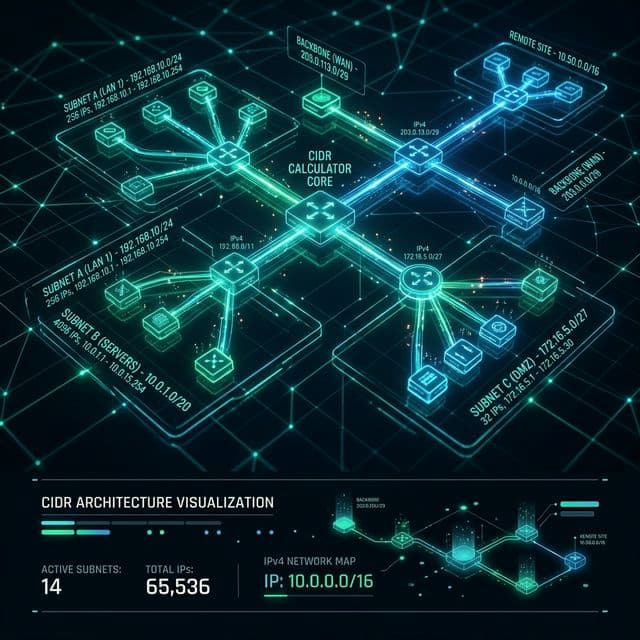
CIDR Subnet Calculator
Precision IP address planning. Calculate broadcast addresses, usable ranges, and wildcard masks for cloud VPCs and global routing clusters.
1. The Death of Classful Addressing
In the 1980s, an organization needing 300 IP addresses was forced to take a Class B block of 65,536 addresses, wasting over 99% of the allocated space.
The host Calculus
The subtraction of 2 is non-negotiable in standard routing: the 'Network Address' (Host bits = 0) and the 'Broadcast Address' (Host bits = 1) are reserved. For a /24 subnet, this results in usable IP addresses.
2. Subnetting: Broadcast Isolation
Subnetting is the process of breaking a large Network ID into smaller, manageable chunks. This is critical for Broadcast Domain isolation and security segmentation.
Segmentation
Smaller subnets limit the 'Blast Radius' of broadcast storms. A /28 subnet keeps ARP noise localized to just 14 hosts.
Security Ingress
By dividing networks, you can apply ACLs between subnets. Users in the 'Guest' /24 subnet cannot reach servers in the 'Admin' /28 subnet.
3. Supernetting: Global Table Efficiency
The global BGP routing table now exceeds 900,000 prefixes. Without **Supernetting (Route Aggregation)**, the internet's core routers would collapse under the weight of specific routes.
Aggregate Logic
Bit-Mask Matching
Combine multiple /24 prefixes into a single /22 advertisement. This reduces the 'Route Churn' seen by upstream ISP peers.
Longest Prefix Match
Routers always pick the most specific route. You can advertise a /16 aggregate but 'punch hole' a /24 for a specific data center failover.
4. The VPC Blueprint: VPC Planning at Scale
VPC address space is a finite resource. Follow the **Industrial Standard** for cloud connectivity.
RFC 1918 Standard
Use 10.0.0.0/8 for large-scale enterprise VPCs. Avoid 192.168.0.0/16 as it often overlaps with home-office consumer gear in VPNs.
AZ Segmentation
Allocate subnets per Availability Zone. Use /20 blocks for subnets to allow for internal scaling of Load Balancers and K8s nodes.
Non-Overlapping Sets
Ensure VPC Peerings never overlap. A collision in CIDR space prevents cross-account communication without complex NAT gateways.
Frequently Asked Questions
Technical Standards & References
Related Engineering Resources
"You are our partner in accuracy. If you spot a discrepancy in calculations, a technical typo, or have a field insight to share, don't hesitate to reach out. Your expertise helps us maintain the highest standards of reliability."
Contributors are acknowledged in our technical updates.