
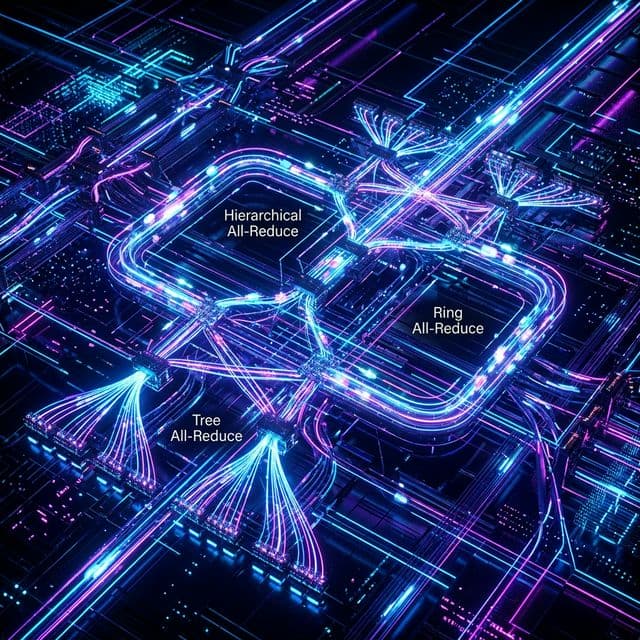
Collective Communication Dynamics in Distributed AI
Mathematical Modeling of Multi-GPU Gradient Synchronization
The Synchronization Bottleneck
In modern distributed training, particularly for Large Language Models (LLMs), the efficiency of the training run is directly proportional to the network's ability to minimize "Sync Wait" time. When GPUs finish computing gradients for a mini-batch, they must participate in a collective All-Reduce operation to average these gradients before updating the model weights. During this phase, the massive TFLOPS of compute power sit idle, waiting for the fabric to resolve the data exchange.
The collective communication primitives—All-Reduce, All-Gather, and Reduce-Scatter—are not just network protocols; they are the thermodynamic limit of how fast an AI model can learn. Optimizing these operations requires a deep understanding of the intersection between topological radix, bisection bandwidth, and serialization latency.
The Hierarchy of Connectivity
Connectivity in an AI cluster is multi-tiered. Intra-node communication typically leverages proprietary high-bandwidth interconnects like NVIDIA NVLink or AMD Infinity Fabric, while inter-node communication relies on scale-out fabrics like InfiniBand or RoCE v2.
Intra-Node (NVLink)
Bandwidths exceeding 900 GB/s per GPU. At this scale, the bottleneck shifts from link bandwidth to memory controller overhead and PCIe lane contention.
Inter-Node (InfiniBand/RDMA)
Bandwidths ranging from 100G to 800G per NIC. Here, the network topology (Fat-Tree, Dragonfly) and routing algorithms (Adaptive vs. ECMP) determine the collective efficiency.
COLLECTIVE OPERATIONS MODELER
NCCL Communication Patterns
All-Reduce
Sum values across all nodes, distribute result
Performance Model: Ring vs. Tree
Collective operations use different algorithms depending on the message size and the number of GPUs ().
1. Ring All-Reduce
Efficiency is maximized by breaking the message into chunks. Each GPU sends one chunk to its neighbor while receiving another.
Where is link bandwidth and is per-hop latency. In large clusters, the latency term () becomes dominant, making rings unscalable.
2. Binary Tree All-Reduce
Reduces the latency footprint by using a logarithmic structure. However, it can leave up to 50% of link capacity idle during the reduction phase.
Tree algorithms are preferred for small messages where latency sensitivity is highest.
Primitive Analysis
| Primitive | Description | Bandwidth Scaling |
|---|---|---|
| All-Reduce | Sum values across all nodes; distributed back. | |
| All-Gather | Collect unique values from all nodes to every node. | |
| Reduce-Scatter | Sum values and scatter unique results to each node. | |
| All-to-All | Each node sends unique data to every other node. | (High Stress) |
The Role of NCCL and RCCL
Low-level libraries like NVIDIA's NCCL (Collective Communications Library) and AMD's RCCL are the invisible orchestrators. They automatically select the optimal topology—choosing between Ring and Tree binaries—based on the cluster size and the perceived bisection bandwidth of the fabric.
Adaptive Routing (AR)
Modern InfiniBand NDR switches use Adaptive Routing to dynamically re-route collective traffic around congested links. Without AR, static hashing (ECMP) can cause "hotspotting" where two GPU pairs accidentally share a single physical uplink while others remain idle.
Bisection Bandwidth & Oversubscription
When designing an AI cluster, the Oversubscription Ratio of the fabric determines the "All-to-All" performance limit. A 1:1 ratio (unblockable) ensures that every GPU can communicate at full wire speed simultaneously.
Required for massive scale training (Llama 3, GPT-4). Provides maximum deterministic performance during the gradient averaging phase.
Common in inference clusters where communication is less bursty. Results in a 50% drop in synchronization throughput during peaks.
Summary: Engineering for the Peak
Optimization of collective operations is a game of marginal gains. Reducing a 10ms sync window to 8ms across a year-long training run can save millions in power and hardware lease costs. By leveraging this modeler, engineers can accurately predict how changes in fabric radix (e.g., transitioning from 400G to 800G) or topology will impact the ultimate metric: Time to Convergence.