
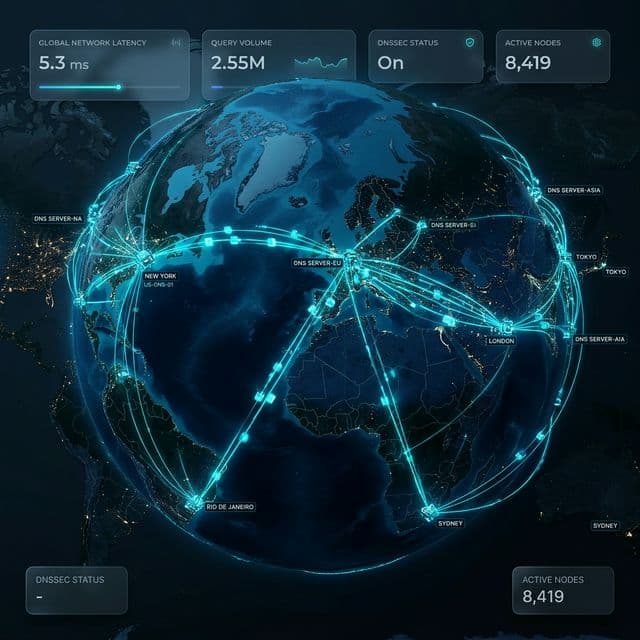
Domain DNS Analysis
Perform global recursive lookups across A, AAAA, MX, TXT, and CNAME records.
DNS Lookup Analytics
Query authoritative name servers to inspect A, MX, CNAME, and TXT records. Validate propagation and troubleshoot global resolution inconsistencies.
Decoding the Domain Name System: Resolution Mechanics
The Domain Name System (DNS) is often described as the "phonebook" of the internet. It is a hierarchical, decentralized naming system for computers, services, or other resources connected to the internet or a private network. While humans use manageable domain names (like google.com), computers communicate using numerical IP addresses. DNS acts as the translator, converting human-readable strings into the machine-readable identifiers required for Layer 3 routing.
1. The DNS Hierarchy: From Root to Leaf
DNS is structured like an inverted tree. At the very top are the Root Servers (managed by IANA). Below them are TLD (Top-Level Domain) servers for extensions like .com, .org, or .net. Finally, there are Authoritative Name Servers, which are the official source of record for a specific domain.
When you perform a lookup, your query typically flows through a Recursive Resolver (provided by your ISP or a public service like Cloudflare 1.1.1.1), which talks to all these layers on your behalf.
Engineering Insight: Recursive vs. Iterative Queries
In a Recursive Query, the client asks the resolver to "give me the answer, whatever it takes." The resolver then performs Iterative Queries—it asks the Root server where to find .com, then asks the .com server where to find example.com, and so on. This architecture reduces the load on the Root servers by ensuring only resolvers, not billions of individual devices, are talking to them directly.
2. Common DNS Record Types
A DNS zone file contains several types of resource records (RR). Understanding these is critical for network configuration:
| Record | Function | Example Value |
|---|---|---|
| A | Maps domain to IPv4 | 142.251.32.78 |
| AAAA | Maps domain to IPv6 | 2607:f8b0:4002:c07::66 |
| CNAME | Alias for another domain | lb.example.com |
| MX | Identifies Mail Servers | 10 aspmx.l.google.com |
| TXT | Data strings (SPF/DKIM) | v=spf1 include:_spf... |
3. TTL and Caching: The Speed vs. Consistency Tradeoff
TTL (Time to Live) is a numerical value in a DNS record that tells resolvers how long to cache the record before asking the authoritative server again.
- High TTL (e.g., 86400s / 24h): Reduces server load and improves site loading speed, but makes it difficult to change servers quickly.
- Low TTL (e.g., 300s / 5m): Essential during migrations or for Load Balancing (GSLB) to ensure users see changes almost immediately.
4. DNS Security: DNSSEC and Encryption
Legacy DNS traffic is sent in cleartext over UDP port 53, making it vulnerable to "Man-in-the-Middle" (MITM) attacks and cache poisoning. Modern standards aim to solve this:
- DNSSEC (DNS Security Extensions): Adds a cryptographic signature to records, ensuring they haven't been tampered with.
- DoH (DNS over HTTPS): Wraps DNS queries in an encrypted HTTPS session (Port 443), hiding your browsing habits from ISPs.
- DoT (DNS over TLS): Similar to DoH but uses a dedicated port (853) for encrypted transport.
Case Study: The BGP/DNS Cascade
A global social media company experienced a multi-hour outage when they accidentally withdrew their BGP routes for their own data centers. Because their Authoritative Name Servers lived inside those same data centers, DNS resolvers around the world could no longer reach them. As TTLs expired, the domain "vanished" from the internet.
Lesson: Always host secondary authoritative name servers in a geographically and network-distinct environment.
Frequently Asked Questions
Q: Why does DNS take time to propagate?
A: Propagation is the time it takes for recursive resolvers around the world to expire their old cached copies of your records (based on the TTL) and fetch the new version from your authoritative server.
Q: What is a Reverse DNS lookup?
A: It is the process of looking up the domain name associated with an IP address (using PTR records). It is primarily used for email verification and security logs.
Q: What are the Root Servers?
A: There are 13 logical root server addresses (named a.root-servers.net to m.root-servers.net), though they are physically distributed across hundreds of locations worldwide using Anycast technology.
This analytics engine utilizes IETF RFC 1035 compliant library for resolution analysis. For enterprise propagation monitoring, check our Propagation Suite. Last updated March 2026.
1. The Architecture of Global Resolution: Recursive vs. Iterative Resolvers
The Domain Name System (DNS) is not a single database; it is a globally distributed, hierarchical partition of authority. When you request a domain name like `pingdo.net`, your machine initiates a multi-stage journey known as **Recursive Resolution**. This process involves a chain of decentralized servers, each holding a specific piece of the naming puzzle. The hierarchy is rooted in the "Root Zone" (.), managed as a single logical entity but physically split across hundreds of sites via Anycast.
A standard query lifecycle begins at the **Recursive Resolver** (often managed by an ISP or a public provider like 1.1.1.1, 8.8.8.8, or 9.9.9.9). If the answer isn't in the resolver's local cache, it begins the **Iterative Query** loop, moving from the most general authority to the most specific:
- The Root (.): The resolver queries one of the 13 root server IP addresses (A through M). The root server doesn't know the IP of `pingdo.net`, but it points the resolver to the **TLD (Top-Level Domain)** server for `.net`. This step is critical; without "hints" of where the root servers are (usually stored in a
root.hintsfile), a resolver is blind. - The TLD (.net): The TLD server (e.g., managed by Verisign for .com/.net) points the resolver to the specific **Authoritative Nameservers** listed at the registry level for the domain. This is where **Glue Records** become vital—if your nameservers are
ns1.pingdo.net, the TLD must provide their IPs directly to prevent a circular dependency loop. - The Authority: The authoritative nameserver (e.g., Cloudflare, Route53, or a custom BIND cluster) returns the actual **A**, **AAAA**, or **CNAME** record to the resolver. This server is the "Source of Truth" for the domain's records.
The final step is the resolver delivering the answer back to your computer and storing it in its local cache for a duration determined by the **Time To Live (TTL)**. Any subsequent requests for the same domain within that window are served instantly from the resolver's RAM, bypassing the hierarchy entirely.
Mathematical Modeling of Resolution Latency
In a purely recursive environment (cold cache), the total latency ($L_{total}$) perceived by the end-user is a function of the network round-trip time (RTT) to each tier of the hierarchy and the internal processing time of each node ($\delta$).
To optimize this, infrastructure providers use **BGP Anycast** to minimize $RTT_{res o i}$ by placing nameserver instances in every major Internet Exchange (IX). Furthermore, the use of **Negative Caching** ($NXDOMAIN$ caching) ensures that the summation doesn't re-execute for repeated queries to non-existent subdomains, a behavior governed by the `MINIMUM` field in the **SOA Record** (Start of Authority).
2. Binary Protocol Forensics: The Anatomy of a DNS Packet
According to **RFC 1035**, every DNS message—whether a simple A-record query or a complex DNSSEC response—shares a standardized 12-byte header followed by four variable-length sections: **Question, Answer, Authority, and Additional**.
In the **Question Section**, labels are encoded as a series of length-prefixed octets. For example, www.example.com is encoded as [3] w w w [7] e x a m p l e [3] c o m [0]. This zero-byte terminator is the signal that the name is fully qualified. Modern extensions like **EDNS0 (RFC 6891)** append an "OPT" pseudo-RR to the **Additional Section** to handle larger UDP payloads and provide metadata like the **Client Subnet (ECS)**.
3. RDATA Forensics: Analyzing Resource Record Types
Every entry in a DNS zone file is a **Resource Record (RR)**. The structure of the RDATA (Record Data) field defines the behavior of the service it represents. Beyond the basic A and MX records, modern networking relies on specialized types for security and service discovery.
A & AAAA (The IPv4/v6 Points)
**A records** map hostnames to 32-bit IPv4 addresses, while **AAAA** (Quad-A) maps to 128-bit IPv6 addresses. In a "Happy Eyeballs" (RFC 8305) browser implementation, both are requested simultaneously, and the first to respond establishing a fast connection wins.
MX (Mail Exchange Protocols)
MX records include a **Priority** field ($P$). Smaller values represent higher priority. MTAs attempt delivery to $P_{min}$ first; if unreachable, they fall back to $P_{next}$, providing innate redundancy for enterprise mail infrastructure.
TXT (The Forensic Metadata Layer)
TXT records house the critical trio of email security: **SPF** (authorized senders), **DKIM** (public keys for cryptographic signatures), and **DMARC** (disposition policy). They are also the standard mechanism for site ownership verification (e.g., Google Search Console).
CNAME & ALIAS (Aliasing Logic)
A CNAME creates a pointer. **The Apex Constraint:** Per RFCs, a CNAME cannot coexist with other records, meaning you cannot place a CNAME on `pingdo.net` because it clashes with the SOA record. Vendors solve this via **CNAME Flattening**, which dynamically resolves the alias and serves the result as an A-record.
SRV (Service Discovery)
SRV records (RFC 2782) specify the port and protocol for a service (e.g., SIP, LDAP). This allows clients to find available servers even if they are not running on standard ports, essential for Kubernetes internal networking.
CAA (Certificate Authority Auth)
CAA records (RFC 6844) list which Certificate Authorities (like Let's Encrypt or DigiCert) are allowed to issue SSL certificates for your domain. This provides an extra layer of defense against fraudulent certificate issuance.
4. BGP Anycast: Scaling Global DNS at the Edge
The performance of DNS is ultimately governed by the physics of light. To provide sub-10ms resolution, infrastructure providers like Google, Cloudflare, or Akamai use **BGP Anycast**. In this configuration, the exact same IP address (e.g., 8.8.8.8) is announced to the internet from hundreds of physical data centers simultaneously across the globe.
The **Border Gateway Protocol (BGP)** naturally directs a user's packets to the "topologically closest" data center. "Topologically closest" doesn't always mean physically nearest—it refers to the shortest AS-path in the router's lookup table. This architecture provides three major benefits for AI-scale infrastructure:
- Deterministic Low Latency:
Users in London are served by a node in a London-based Internet Exchange, while users in Tokyo hit a Tokyo node, despite using the exact same destination IP. This eliminates cross-continental "hairpinning."
- Regionalized DDoS Isolation:
An attack targeting a resolver from a botnet in Paris will only impact the local PoPs (Points of Presence) in western Europe. The Anycast boundary prevents the malicious traffic from traversing into the US or Asian nodes, keeping 80% of the global network functional during a massive flood.
- Automated Disaster Recovery:
If a data center goes offline unexpectedly, the BGP session drops, and the IP is no longer announced from that site. The global internet routers automatically reroute traffic to the next-closest node within seconds, with zero manual intervention required.
5. DNSSEC: Establishing the Cryptographic Chain of Trust
DNS was originally an unauthenticated protocol, making it susceptible to **Cache Poisoning** (or "DNS Spoofing") where an attacker injects a fake IP into a resolver's memory. **DNSSEC (DNS Security Extensions)** resolves this vulnerability by adding digital signatures to existing resource records.
When a recursive resolver queries a DNSSEC-enabled domain, it receives the requested record plus a **RRSIG** (Resource Record Signature). The resolver verifies this signature against the domain's **DNSKEY** (public key). This verification is anchored in a hierarchical "Chain of Trust":
This recursive verification continues all the way up to the **Root Trust Anchor**, managed by IANA in a highly secured key-signing ceremony. If any link in this chain fails—due to an expired signature or a mismatched DS record—the resolver will return a **SERVFAIL**, protecting the user from a potentially malicious redirection.
ZSK vs KSK Management
ZSKs are rolled frequently (e.g., monthly) to minimize the impact of a compromised key, while KSKs are long-lived and require an update to the parent registry upon rotation.
NSEC3 WALK Protection
NSEC3 provides "Authenticated Denial of Existence" using hashed domain names, preventing attackers from "walking" the zone to discover every private subdomain via sequential NXDOMAIN queries.
6. DNS Performance Engineering: RFC 8767 and Serve-Stale
In high-reliability architectures, a DNS timeout is equivalent to a service outage. Even with Anycast, the "Cold Start" penalty of traversing the hierarchy can take hundreds of milliseconds. Modern resolvers implement two critical optimizations to achieve ultra-low latency: **Prefetching** and **Stale-While-Revalidate**.
**DNS Prefetching** takes this further. If a popular record (like `google.com`) is approaching its TTL expiration, the resolver proactively initiates a refresh in the background *before* the record expires. This ensures that the cache is always warm, keeping the $L_{total}$ for 99.9% of users at exactly $RTT_{client o res}$ (typically < 20ms).
7. The Privacy Frontier: DoH, DoT, and DNS over QUIC
Traditional DNS is plaintext. Your ISP or any middleman on the network path can see every site you visit by simply snooping Port 53 traffic. To combat this and prevent "DNS Injection" attacks (where governments or ISPs redirect users to blocked sites), three modern encryption protocols have entered the field:
DoT (DNS over TLS) | Port 853
DoT wraps the standard DNS protocol in a dedicated TLS tunnel. It is simple and high-performance, but because it uses a dedicated port (853), it is easily identified and blocked by corporate firewalls. It is favored by Android (Private DNS) and performance-focused sysadmins.
DoH (DNS over HTTPS) | Port 443
DoH embeds DNS queries within standard HTTPS traffic. Because it shares Port 443 with normal web browsing, it is almost impossible for an ISP to selectively block without shutting down the entire web connection. This is the primary protocol used by modern browsers like Chrome and Firefox.
DoQ (DNS over QUIC) | Port 443/853
The newest evolution (**RFC 9250**). It provides the privacy of DoH/DoT but uses the QUIC (UDP-based) transport to eliminate **Head-of-Line Blocking** and support 0-RTT handshakes. It is mathematically the most superior delivery mechanism for high-latency or mobile-first environments.
Troubleshooting Global DNS Synchronization
When a domain doesn't resolve correctly, the root cause is usually one of three "Legacy Traps":
Lame Delegations
When the parent zone (.com) states that `ns1.example.com` is authoritative, but that server doesn't actually have the zone file loaded, the result is a "SERVFAIL." This usually happens after switching DNS providers without updating the Glue records at the registrar.
CNAME Loops
If domain A points to domain B, and domain B points back to A, a recursive resolver will eventually hit its "Hop Limit" and return an error. This is a common mistake when managing complex CDN configurations.
DNSSEC Non-Verification
If you enable DNSSEC but forget to update the **DS Record** at your registrar, all DNSSEC-validating resolvers (like Google and Cloudflare) will refuse to resolve your domain, as the chain of trust is broken.
9. Global Server Load Balancing (GSLB) Logic
In enterprise networking, DNS is the primary mechanism for Global Traffic Management (GTM). Unlike the "Round Robin" approach (where the server just cycles through a list of IPs), GSLB systems make resolution decisions based on the health and distance of the target cluster.
- Geo-Proximity Routing:
The authoritative server calculates the distance between the user's IP (via ECS) and the known edge locations, returning the $IP_{closest}$ to reduce propagation delay.
- Active Health Monitoring:
If the "US-EAST" cluster fails a health check (L7 probing), the DNS server immediately updates its zone to stop returning that cluster's IP, performing a global failover at the resolution layer.
- Weighting and Canarying:
Directing 10% of global traffic to a new "Experimental" infrastructure block while keeping 90% on the stable "Legacy" stack for A/B testing at the protocol level.
10. Enterprise DNS Maintenance & Lifecycle Management
DNS is often a "set and forget" system, which leads to **Technical Debt** and high-risk security vulnerabilities such as "Subdomain Takeover." A professional maintenance strategy includes:
Zone Health Audits
Monthly scans for orphaned CNAMEs pointing to expired external services (preventing subdomain takeovers where an attacker registers your old S3 bucket name).
TTL Staggering
Gradually lowering TTLs to 300 seconds (5m) exactly 48 hours before planned cutovers to ensure 100% traffic migration within minutes of a final update.
GitOps Integration
Managing zone files as code (via OctoDNS or DNSControl), enabling PR-based review cycles and automated linting before changes hit authoritative edge servers.
Without these protocols, domains eventually accumulate "Historical Noise"—records for long-deleted services that clutter the resolution path and increase the attack surface for internal infrastructure spoofing.
Engineering FAQ: DNS & Global Routing
Frequently Asked Questions
Technical Standards & Protocols
Technical Standards & References
"You are our partner in accuracy. If you spot a discrepancy in calculations, a technical typo, or have a field insight to share, don't hesitate to reach out. Your expertise helps us maintain the highest standards of reliability."
Contributors are acknowledged in our technical updates.