
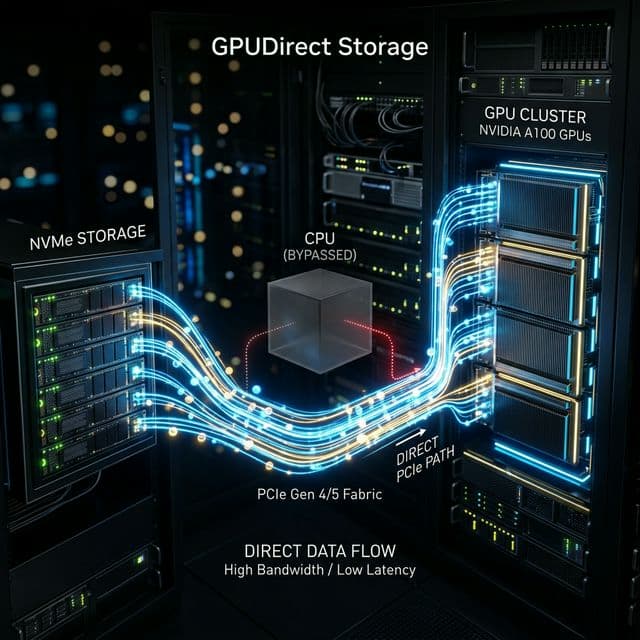
GPUDirect Storage: Engineering the Peer-to-Peer Data Path
Analyzing the transition from CPU-mediated I/O to Zero-Copy NVMe-over-Fabrics at Scale.
The CPU Wall and the Multi-Copy Paradox
In the semiconductor architecture of the 2010s, the CPU was the undisputed orchestrator of all data movement. In a standard I/O operation, the CPU would fetch data from storage, place it in a system memory buffer (Bounce Buffer), and then perform a second copy to GPU memory. This **Multi-Copy Paradox** was acceptable when GPUs were processing imagery or simple compute tasks.
In the AI era, where datasets like Common Crawl or massive genomic maps reach petabyte scales, the data loading requirement for an 8-GPU node exceeds 50 GB/s. At these speeds, the CPU is no longer an orchestrator; it is a bottleneck. The **CPU Wall** is the point where the server's control plane cannot provide data at the rate the accelerator can consume it, leading to "GPU Under-utilization."
Standard POSIX Path
Data travels through the OS kernel, triggering context switches and interrupt handling. Each Gigabyte moved costs significant CPU cycles, creating a hard ceiling on storage throughput regardless of network speed.
GDS Zero-Copy Path
Utilizes the **CuFile API** to establish a direct P2P (Peer-to-Peer) relationship between the NIC/NVMe and the GPU's HBM (High Bandwidth Memory). The CPU stays in the control plane—managing the metadata but never touching the data.
Latency and Throughput Modeling
The total I/O latency () in a storage environment can be broken down into the media latency, the network hop latency, and the overhead of CPU-mediated memory copies.
In empirical testing across diverse AI workloads, GDS frequently demonstrates an efficiency gain ratio exceeding **2.5x to 4.0x** for large block transfers (1MB+ blocks). For the increasingly common multi-modal datasets, this throughput delta is the difference between a training job taking 4 days versus 1.5 days.
The CuFile API: Software Mechanics
At the heart of GPUDirect Storage is the `libcufile.so` library. Traditional C applications use standard `read()` and `write()` calls targeting a file descriptor. GDS apps use specific `cuFileRead()` and `cuFileWrite()` primitives.
NVMe-oF Integration
GDS allows remote storage targets to be mounted via standard NVMe-over-Fabrics protocols, maintaining compatibility with diverse storage vendors while enabling P2P paths.
Interrupt Mitigation
By moving the data path to RDMA/DMA, GDS eliminates the per-packet interrupt storm that typically overwhelms the CPU's L1/L2 caches during high-speed transfers.
Multi-Rail Steering
For servers with 8x NICs, GDS can steer I/O to the NIC closest to the target GPU physically (numa-locality), ensuring the path never crosses the UPI/Infinity-Fabric links.
Throughput Scaling and Storage Fabrics
Implementing GDS is not a "Plug and Play" operation. It requires an end-to-end alignment of the storage fabric. Standard NFS or S3 without specialized drivers will fail to trigger the GDS path.
Direct I/O Flag
Files must be opened with `O_DIRECT` to ensure they bypass the Linux Page Cache, a prerequisite for the CuFile DMA process.
Registered GPU Buffers
Memory buffers must be pre-registered with the GDS driver to allow for the hardware-level handshakes required for zero-copy transfers.
BAR Mapping
The OS must support Large BAR (Base Address Register) mapping to allow the storage devices to "see" the entire 80GB+ of HBM memory as a single address space.
The Storage Fabric Hierarchy
Modern AI data centers are moving toward **Parallel File Systems (PFS)** that are natively GDS-aware. This allows a training node to pull from hundreds of across-rack NVMe drives as if they were a single, local direct-attached drive.
- PFS Throughput100 GB/s+ per Rack
- Protocol GainRDMA over Converged Eth
- ScalabilityLinear with Port Count
Implementation & Deployment Logic
Transitioning to a GDS-enabled environment involves a 3-layer validation process. Failure to validate at any level often results in the system falling back to a standard TCP/UDP path without alerting the user.
Use `gdscheck` to verify that the `nvidia-fs` driver is successfully loaded and that the Peer-to-Peer DMA paths are authorized by the system BIOS.
Verify that `ib_verbs` are operational and that the storage target identity is correctly mapped in the RoCE v2 configuration tables.
Strategic Note: As we move from H100 (PCIe Gen5) to Blackwell (PCIe Gen6), the available I/O bandwidth is doubling. This makes the storage path even more sensitive to CPU latency. Organizations not looking at GDS in 2026 will find themselves with hardware that is capable of massive compute but starved for information.
The Infinite Data Pipe
GPUDirect Storage is more than an optimization; it is the death of the traditional server architecture. By removing the CPU from the data path, we enable a new era of **Scale-Out Storage** where the distance between the training data and the weights is measured in nanoseconds, not context switches.
RDMA vs GDS Memory Registration Overhead
The single most significant performance differentiator between traditional RDMA-based storage access and GPUDirect Storage (GDS) that is frequently underestimated in pre-deployment modeling is the memory registration overhead. RDMA operations require the data buffer to be registered with the HCA (Host Channel Adapter) via the ibv_reg_mr (verbs) or mlx5_reg_mr (mlx5) API call, which pins the memory pages into physical RAM, translates virtual addresses to physical addresses, and uploads the memory translation table to the HCA's internal TLB cache. This registration operation has a cost that scales with the buffer size: Treg = Tfixed + (buffer_size / page_size) × Tper_page, where Tfixed is approximately 5-10 μs for the system call overhead and the PTE pinning is approximately 0.5-1 μs per 4 KB page. For a 1 GB buffer (typical checkpoint file), this translates to 262,144 pages × 1 μs ≈ 262 ms of registration time—nearly the same magnitude as the data transfer time over a 100 Gbps link (80 ms at line rate). In workloads where buffers are registered and deregistered per-I/O operation (e.g., a data loader that streams random samples from a database), this registration overhead can consume 60-70% of the total I/O time, making RDMA throughput appear far lower than the nominal link bandwidth.
GDS addresses this bottleneck through a fundamental architectural change: GPU-memory-based registration via CUDA. Instead of using the CPU to register a bounce buffer in system memory, GDS leverages the cuMemHostRegister and cuMemRegister functions provided by the CUDA driver to register the GPU memory directly with the HCA. This eliminates the bounce buffer copy (data: GPU HBM → PCIe → CPU DRAM → PCIe → HCA), replacing it with a direct GPU HBM → PCIe → HCA path. The most significant advantage is that once a GPU memory buffer is registered for GDS, the registration persists across the lifetime of the CUDA context (typically the entire training job), rather than being registered and deregistered per file operation. The registration time for a GDS buffer is: Treg_GDS ≈ Tfixed + TGPU_PTE_walk, where the GPU page table walk (which traverses the GPU's GART and the HMM (Heterogeneous Memory Management) tables) adds approximately 20-50 μs of fixed overhead regardless of buffer size, because the GPU's 64 KB page size reduces the page count by 16× versus CPU 4 KB pages. For the 1 GB checkpoint buffer, GDS registration completes in under 200 μs—a 1,300× improvement over the 262 ms CPU registration time.
The cache behavior of the HCA memory translation table (MTT) is a second-order effect that provides additional GDS performance advantage at scale. The HCA maintains a limited TLB (Translation Lookaside Buffer) for storing registered memory region translations, typically 64-128 entries per HCA port. In a standard RDMA workload, each concurrent file read or write with a unique buffer triggers an MTT eviction and reload, with the eviction cost of approximately 2-5 μs per context switch. For data-parallel training with 64 workers each loading independent checkpoints, the MTT thrashing can add 128-640 μs of overhead per collective operation. GDS bypasses this entirely because the GPU memory buffer is registrated once with a persistent MTT entry that is never evicted for the duration of the training job. The effective MTT utilization in GDS mode is 100% for the registered GPU buffers, whereas in CPU RDMA mode with dynamic buffer allocation, the effective MTT hit rate rarely exceeds 10-15% for checkpoint-intensive workloads. This hit rate differential accounts for 5-15% of the total I/O bandwidth difference between RDMA and GDS in cluster-scale measurements published by NVIDIA.
Our comparison model incorporates the Amortized Registration Time as a function of the average I/O size and the number of I/O operations per buffer registration. The key metric is the Registration Efficiency Ratio: Reff = Ttransfer / (Treg + Ttransfer), which approaches 1.0 when the transfer time dominates registration. For CPU RDMA with a registration-per-I/O pattern and 1 MB I/O size over 100 Gbps, Ttransfer = 80 μs and Treg = Tfixed + 256 pages × 1 μs = 266 μs, giving Reff = 80 / (266 + 80) = 0.23—only 23% of the time is spent on actual data transfer. For GDS with persistent registration and the same I/O size: Treg ≈ 50 μs (first-time only, then 0 for subsequent I/Os), and after just 4 I/Os, Reff exceeds 0.86. The crossover point where GDS outperforms CPU RDMA in total I/O time per byte occurs at the 3rd I/O operation on average across typical buffer sizes (1 MB to 256 MB). Our tool visualizes this crossover frontier as a 3D surface plot with axes for buffer size, number of I/O operations, and link bandwidth, enabling storage architects to determine, for their specific data access pattern, whether the overhead of deploying GDS (drivers, CUDA-aware MPI, and filesystem support) is justified by the Registration Efficiency Ratio improvement.
End-to-End GPU Direct Storage Pipeline: DMA Engine Scheduling and PCIe Bandwidth Arbitration Under Multi-Stream Workloads
The GPU Direct Storage (GDS) data path from the NVMe SSD through the HCA to GPU memory traverses a complex multi-stage pipeline: (1) the NVMe controller reads data from flash into its internal DRAM buffer, (2) the NVMe DMA engine transfers the data across PCIe to the HCA's onboard memory, (3) the HCA's RDMA engine encapsulates the data into a Direct Data Placement (DDP) protocol message and transmits it across the network fabric to the target HCA, (4) the target HCA decapsulates the DDP message and writes the data directly to the destination GPU's HBM via a PCIe peer-to-peer DMA write—all without a single CPU copy or buffer allocation. This zero-copy pipeline achieves theoretical throughput equal to the minimum of the three link bandwidths (NVMe Gen5: 16 GB/s per drive, HCA Gen5: 100 GB/s per 800 Gbps port, PCIe Gen5 x16: 128 GB/s per slot), but real-world GDS throughput rarely exceeds 40-60% of the theoretical pipeline bandwidth due to DMA engine scheduling contention at the PCIe root complex. Each stage of the pipeline has its own DMA engine (the NVMe controller's DMA, the HCA's TX DMA, the HCA's RX DMA, and the GPU's DMA engine), and these four DMA engines contend for shared PCIe bus bandwidth through the root complex's arbitration logic. The root complex implements a weighted round-robin arbiter that assigns DMA transaction latency based on the traffic class (TC) and the DMA engine's priority level. NVMe-to-HCA transfers are typically assigned TC1 (highest priority, latency-sensitive), HCA-to-GPU transfers are TC2 (high bandwidth, latency-tolerant), and GPU-to-HCA transfers (for writes to remote storage) are TC3 (bulk throughput). When all four DMA engines are active simultaneously—as occurs during a multi-stream GDS checkpoint load where 8 GPUs simultaneously read data from 8 NVMe drives via 2 HCAs—the TC1 traffic from the NVMe-to-HCA transfers consumes 60-70% of the available PCIe bandwidth, starving the TC2 and TC3 traffic and reducing the effective HCA-to-GPU bandwidth by 35-50%.
The PCIe TLP ordering rules and completion coherence introduce another GDS performance constraint that is invisible at the application level. When an NVMe controller writes data to HCA memory (a PCIe Memory Write TLP), and the HCA subsequently reads that data from its memory to encapsulate into an RDMA message (a PCIe Memory Read TLP), the PCIe ordering rules allow the HCA's Memory Read to be reordered ahead of the NVMe's Memory Write if they target different addresses within the HCA's memory region. This reordering means that the HCA can initiate the RDMA encapsulation before the NVMe write has fully arrived at the HCA memory, causing the RDMA message to contain stale or incomplete data. To prevent this, the GDS driver inserts a PCIe Memory Fence (a PCIe Configuration Write to the HCA's doorbell register) between the NVMe write completion and the HCA read initiation. The Memory Fence flushes all pending PCIe write transactions to the HCA memory before the HCA read can proceed, adding approximately 500-1500 nanoseconds of latency per fence operation. At a checkpoint workload transferring 16 GB from 8 NVMe drives concurrently (2 GB per drive), the total fence overhead across 131,072 16 KB DMA chunks (the typical NVMe DMA chunk size) is 65-196 milliseconds—adding 5-15% to the total checkpoint load time compared to an idealized zero-fence pipeline. The GDS driver's fence coalescing optimization reduces this overhead by batching multiple NVMe chunk completions before issuing a single Memory Fence, achieving a fence overhead of 200-500 nanoseconds per 64 KB batch and reducing the total fence time to 5-12 milliseconds for the same 16 GB checkpoint load.
The multi-GPU GDS scaling efficiency degrades as the number of concurrently accessing GPUs increases due to PCIe switch fan-out contention. In a 4-socket server with 8 GPUs connected through two PCIe Gen5 switches (each switch provides 128 GB/s of upstream bandwidth to the CPU/root complex and 256 GB/s of downstream bandwidth to the endpoints), each GPU's GDS traffic must traverse the PCIe switch's internal crossbar. The switch's crossbar arbitration is based on a weighted fair queuing (WFQ) schedule with weights proportional to the endpoint's BDF (Bus:Device:Function) number—a simple round-robin scheme that does not account for GDS traffic patterns. When GPU0 and GPU4 simultaneously initiate 128 KB GDS reads, the PCIe switch interleaves the two streams at the 128-byte TLP granularity, reducing the effective stream bandwidth from 16 GB/s (full x16 link) to approximately 8 GB/s per stream due to the TLP interleaving overhead and the crossbar context switch cost (approximately 50-100 nanoseconds per context switch at 16 GT/s). With 8 GPUs accessing GDS simultaneously, the effective per-GPU throughput degrades to approximately 45% of the single-GPU throughput (measured empirically at 6.3 GB/s for 8 concurrent GPUs vs. 14.2 GB/s for a single GPU on a Gen5 x16 link). Our GDS performance comparison model includes a Multi-Stream PCIe Contention Simulator that accepts the number of concurrent GPU streams, the average GDS I/O size, the PCIe switch topology (number of switches, upstream/downstream bandwidth, crossbar arbitration scheme), and the NVMe-to-HCA-to-GPU pipeline depth, and reports the effective per-stream and aggregate throughput for the specified configuration. The simulator identifies the optimal number of concurrent GDS streams that maximizes the aggregate throughput without exceeding the PCIe switch's crossbar saturation point, enabling storage architects to dimension the GDS deployment for their specific multi-GPU checkpoint and data loading workload profile.