
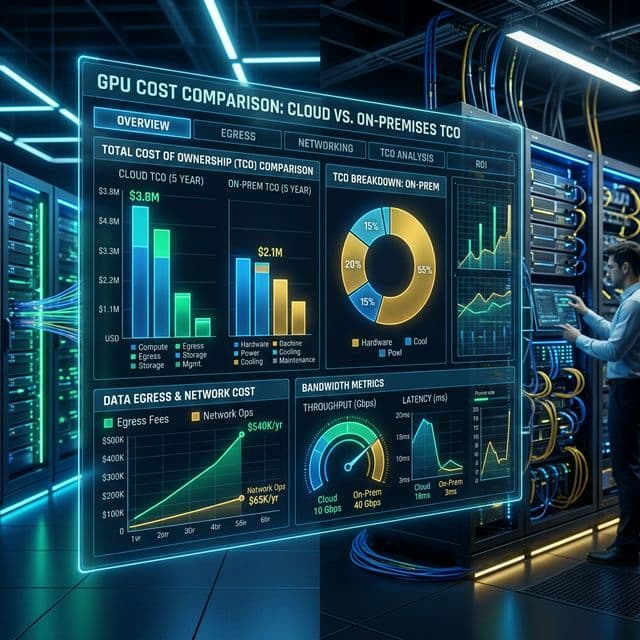
AI Infrastructure Economics: Decoding the TCO Paradox
Analyzing the transition from Elastic OpEx to Foundational CapEx in the H100/B200 Era.
Beyond the Hourly Rate: The True Cost of Intelligence
In the semiconductor-constrained landscape of 2026, the decision to build or borrow GPU clusters has moved from the server room to the boardroom. While cloud providers advertise attractive per-GPU hourly rates, often ranging from **$2.00 to $5.50 for NVIDIA H100 and Blackwell modules**, the reality of the monthly invoice is often far more complex.
Total Cost of Ownership (TCO) in AI infrastructure is not a linear summation of compute hours. It is a multidimensional optimization problem that must account for **data gravity**, **interconnect topology costs**, **thermodynamic efficiency (PUE)**, and **regulatory friction**. This article provides a comprehensive engineering framework for analyzing the transition from the flexibility of Cloud OpEx to the foundational efficiency of On-Premise CapEx.
The "Compute Only" Fallacy
Many organizations fail their first AI audit because they only model the instance cost. In a typical AWS p5.48xlarge environment, the instance cost represent only ~65% of the total cost of running a training job. The rest is claimed by Elastic Block Storage (EBS) throughput, S3 API requests, and the dreaded cross-AZ networking tax.
The Egress Trap: Networking as a Strategic Moat
Cloud providers operate on a "free-to-ingest, pay-to-leave" model. While this works for standard web applications, it is catastrophic for distributed machine learning workloads that require constant external synchronization. For a deep-learning pipeline, the real financial friction occurs in four specific vectors:
- Multi-Region Inference
Exporting high-precision model weights (100GB+) to global inference endpoints several times a day creates a recurring daily tax.
- Dataset Portability
Moving multi-petabyte datasets between cloud providers to chase the best Spot Instance pricing can trigger egress bills in the six-figure range.
- Checkpoint High Availability
Syncing training states (Gradient maps) for disaster recovery across multiple providers or on-prem backups involves massive throughput.
- Logging & Telemetry
Debugging distributed clusters requires pulling gigabytes of logs and telemetry to developer workstations for analysis.
On-Premise: The Physics of Power & Cooling
For on-premise builds, the primary operational expense shifts from networking taxes to **electricity and thermodynamics**. Modern H100 and B200 (Blackwell) clusters have moved beyond the limits of standard air-cooled data centers, creating a new 'Cooling Gap' in TCO models.
kW per Rack Density
Rack densities are pushing 100kW per cabinet. This mandates transitioning to Rear Door Heat Exchangers (RDHx) or Direct-to-Chip Liquid Cooling (DCLC).
PUE Efficiency Math
A facility with a PUE of 1.7 costs 40% more to run than a Tier 4 facility with 1.2 PUE. In AI networking, PUE is your primary margin protector.
Floor Loading Weights
A fully loaded AI rack can weigh over 3,000 lbs. Many legacy data centers require expensive structural reinforcement that isn't in standard TCO grids.
Thermodynamics Simulation
Interactive model exploring the relationship between rack power density and cooling efficiency. Compare Air Cooling vs. Direct-to-Chip Liquid Cooling for high-density AI infrastructure.
THERMAL DYNAMICS SIMULATOR
Rack Density vs. Cooling Efficiency
Air cooling cannot dissipate heat fast enough. GPU performance drops by 30%.
Lower ITD allows for higher rack density and overclocking stability.
Reliability Centered Maintenance (RCM)
Going on-premise means you are now the primary maintainer. The cost of downtime in a GPU cluster is measured in thousands of dollars per hour of lost training progress. Implementation of an RCM strategy is non-negotiable for large clusters.
The Fail-Fast Infrastructure Model
In a cluster of 512 GPUs, probability dictates that a hardware failure (transceiver, DIMM, or fan) will occur every 11-14 days. Unlike the cloud where instances are simply restarted elsewhere, on-prem TCO models must include the cost of Forward-Deployed Spares (FDS) and the labor cost for 2-hour physical remediation.
The On-Prem Burden List
- 01
Inventory of SFP+/QSFP-DD Spares (3-5% of total CapEx)
- 02
Gold Tier Service Contracts with 4-hour on-site response
- 03
Precision Environmental Monitoring (Thermal, Humidity, and Leak Detection)
- 04
24/7 NOC/SOC staffing for immediate fabric remediation
The Universal TCO Equation
A comprehensive TCO model for infrastructure comparison must account for the initial Capital Expenditure (), the annualized Operational Expenditure (), and the Net Present Value (NPV) of the hardware at EOL.
Where is the discount rate, is annual cost, and is the secondary market value of used GPUs.
Case Study: The 1,024-GPU Scaling Pivot
Consider a growth-stage AI company training a 175B parameter foundation model. In a typical Hyperscale Cloud environment using NVIDIA P5 instances (H100), the monthly bill is approximately **$2.6M**.
High flexibility, high per-unit cost, significant egress fees included.
Includes $35M CapEx, power, cooling, and two dedicated engineers.
*Calculation assume 90% utilization, 12c/kWh electricity, and Tier-3 colocation fees. The breakeven point occurs at month 15.3. By month 36, the on-prem strategy yields a net saving of **$35.2 Million**—enough to fund an entire new generation of hardware.*
Regulatory & Compliance Drivers
Beyond cost, **Data Sovereignty** is often the final arbiter. Organizations in highly regulated sectors (Finance, Healthcare, Defense) are frequently mandated to use air-gapped or localized on-premise clusters to satisfy GRC (Governance, Risk, and Compliance) requirements. In these cases, the Cloud vs On-Prem debate is pre-empted by legal necessity. Our tool assists these organizations in optimizing their mandatory on-prem TCO by identifying waste in cooling and power distribution overhead.
Strategic Synthesis
There is no universal "right" choice in the AI infrastructure wars. The decision between GPU Cloud and On-Premise is an evolving balance of **velocity versus margin**. If you need to ship a demo by next Friday, the Cloud is your only logical path. If you are building the economic foundation of a generational AI entity, your infrastructure strategy must eventually transition to a low-cost, high-performance on-premise environment. Use the TCO comparison engine above to define your transition point with mathematical precision.