
GDS ROI & Efficiency Simulator
Quantify the performance gains and dollar-value ROI of bypassing the CPU mediator in your AI storage pipeline. Model JCT reduction for LLM training.
Workload Configuration
GDS vs CPU copy.
Effective data rate.
Per training run.
Time Comparison
100000 GB total data transfer
Time Saved
1.19 hrs
Checkpoint (Traditional)
51.2s
Checkpoint (GDS)
8.2s
Speedup
6.3×
GPUDirect Storage reduces data load time by 84.0%, saving $11.95 per training run and accelerating checkpoints by 6.3×.
"GPUDirect Storage bypasses system RAM entirely, eliminating CPU bottlenecks in high-throughput AI data ingestion."
1. The CPU Wall: A Legacy Data Path Crisis
In a traditional storage stack, data movement is \"CPU-Centric.\" When a GPU needs data, the data is first read into the System Page Cache (CPU DRAM), and then copied a second time into GPU Device Memory (VRAM).
Latency & Jitter Calculus
At modern fabric speeds (400G+), a high-core-count CPU can spend **40% of its cycles** simply managing I/O interrupts. This is the CPU Wall—where adding more GPUs doesn't increase training speed because the host processor is saturated by background copies.
2. The Zero-Copy Economy: Magnum IO cuFile
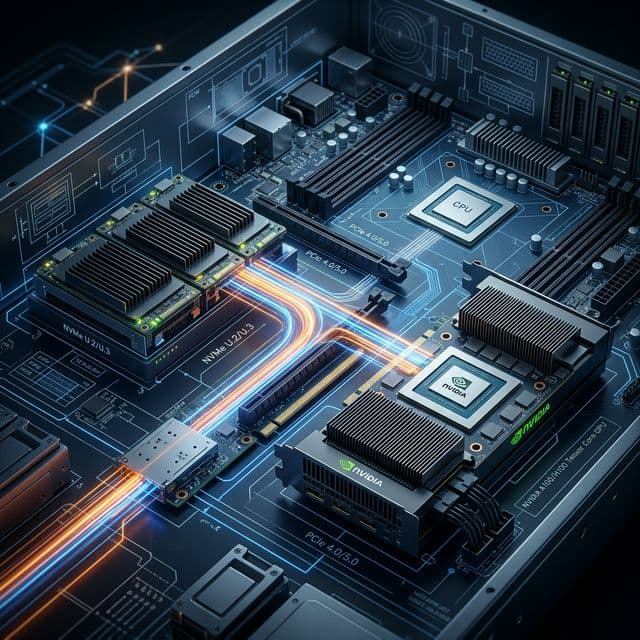
GPUDirect Storage (GDS) utilizes the **Magnum IO cuFile** library to establish a direct DMA (Direct Memory Access) path between the storage controller (NVMe) and the GPU memory.
PCIe Efficiency
Standard paths use the PCIe bus twice: Storage → CPU, then CPU → GPU. GDS uses it once: Storage → GPU. This effectively doubles your PCIe bandwidth per lane.
DMA Directness
By using Peer-to-Peer (P2P) mapping, the NVMe controller writes data directly into the GPU memory BAR space, bypassing the system DRAM and CPU entirely.
3. The ROI of Uptime: GPU Idle Statistics
The primary ROI driver for GDS is not the storage cost—it is the reduction of **GPU Idle Time**.
Model Flops Utilization (MFU)
If a $40,000 GPU is waiting for data 20% of the time, you are wasting $8,000 of value per card. In a 512-GPU cluster, that is **$4 Million** in stranded capital.
Throughput Impact
GDS typically yields a **3x increase** in aggregate bandwidth for large sequential reads. This is the difference between a 15-minute checkpoint and a 5-minute checkpoint.
4. Implementation: The IOMMU & P2P Fabric
Enabling GDS requires a specific hardware/software synergy. It is not just a driver update.
BIOS Tuning
The motherboard BIOS must support **ACS (Access Control Services)** override and **IOMMU Passthrough**. Without this, the host CPU will intercept and block Peer-to-Peer DMA.
cuFile Runtime
Applications must link against `libcufile.so`. This replaces standard POSIX `read()` calls with direct DMA requests handled by the GPU memory controller.
Fabric Support
Storage must be GDS-aware. Systems like Weka, Lustre (2.15+), and VAST provide the shim to map network RDMA frames direct to VRAM.
Frequently Asked Questions
Technical Standards & References
Related Engineering Resources
"You are our partner in accuracy. If you spot a discrepancy in calculations, a technical typo, or have a field insight to share, don't hesitate to reach out. Your expertise helps us maintain the highest standards of reliability."
Contributors are acknowledged in our technical updates.