
GDS ROI & Efficiency Simulator
Quantify the performance gains and dollar-value ROI of bypassing the CPU mediator in your AI storage pipeline. Model JCT reduction for LLM training.
Workload Configuration
GDS vs CPU copy.
Effective data rate.
Per training run.
Time Comparison
100000 GB total data transfer
Time Saved
1.19 hrs
Checkpoint (Traditional)
51.2s
Checkpoint (GDS)
8.2s
Speedup
6.3×
GPUDirect Storage reduces data load time by 84.0%, saving $11.95 per training run and accelerating checkpoints by 6.3×.
"GPUDirect Storage bypasses system RAM entirely, eliminating CPU bottlenecks in high-throughput AI data ingestion."
1. The CPU Wall: A Legacy Data Path Crisis
In a traditional storage stack, data movement is \"CPU-Centric.\" When a GPU needs data, the data is first read into the System Page Cache (CPU DRAM), and then copied a second time into GPU Device Memory (VRAM).
Latency & Jitter Calculus
At modern fabric speeds (400G+), a high-core-count CPU can spend **40% of its cycles** simply managing I/O interrupts. This is the CPU Wall—where adding more GPUs doesn't increase training speed because the host processor is saturated by background copies.
2. The Zero-Copy Economy: Magnum IO cuFile
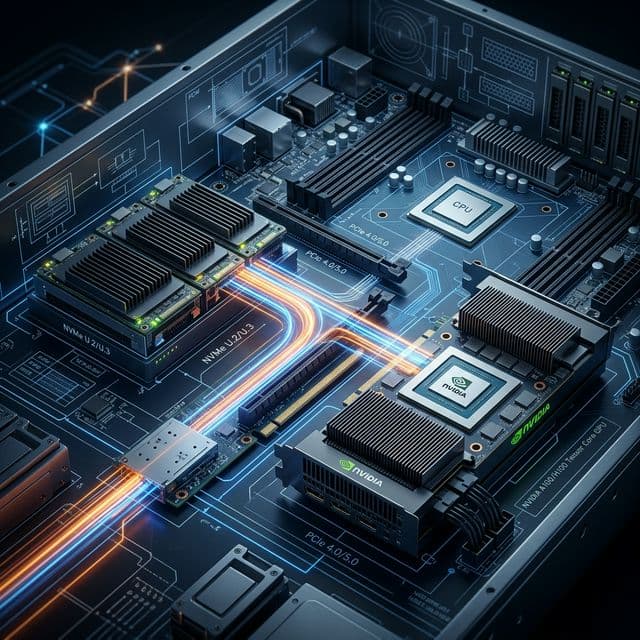
GPUDirect Storage (GDS) utilizes the **Magnum IO cuFile** library to establish a direct DMA (Direct Memory Access) path between the storage controller (NVMe) and the GPU memory.
PCIe Efficiency
Standard paths use the PCIe bus twice: Storage → CPU, then CPU → GPU. GDS uses it once: Storage → GPU. This effectively doubles your PCIe bandwidth per lane.
DMA Directness
By using Peer-to-Peer (P2P) mapping, the NVMe controller writes data directly into the GPU memory BAR space, bypassing the system DRAM and CPU entirely.
3. The ROI of Uptime: GPU Idle Statistics
The primary ROI driver for GDS is not the storage cost—it is the reduction of **GPU Idle Time**.
Model Flops Utilization (MFU)
If a $40,000 GPU is waiting for data 20% of the time, you are wasting $8,000 of value per card. In a 512-GPU cluster, that is **$4 Million** in stranded capital.
Throughput Impact
GDS typically yields a **3x increase** in aggregate bandwidth for large sequential reads. This is the difference between a 15-minute checkpoint and a 5-minute checkpoint.
4. Implementation: The IOMMU & P2P Fabric
Enabling GDS requires a specific hardware/software synergy. It is not just a driver update.
BIOS Tuning
The motherboard BIOS must support **ACS (Access Control Services)** override and **IOMMU Passthrough**. Without this, the host CPU will intercept and block Peer-to-Peer DMA.
cuFile Runtime
Applications must link against `libcufile.so`. This replaces standard POSIX `read()` calls with direct DMA requests handled by the GPU memory controller.
Fabric Support
Storage must be GDS-aware. Systems like Weka, Lustre (2.15+), and VAST provide the shim to map network RDMA frames direct to VRAM.
5. GDS and the RDMA Fabric: Coupling Storage DMA to the Network Path
GDS does not operate in isolation; its direct-to-VRAM path terminates at the storage controller, but in distributed training the data must still cross a fabric. The GPUDirect RDMA (GDR) extension completes the picture by letting the network adapter write inbound RDMA payloads directly into GPU memory, and GPUDirect Storage extends that same hardware path to the storage side. When both are enabled, a remote NVMe read can traverse RDMA, the fabric, the NIC, and land in VRAM with a single zero-copy chain — never touching host DRAM and never consuming a CPU memcpy cycle. The engineering details of this path, including the peer-memory registration and the P2P mapping requirements, are covered in the GPUDirect RDMA deep-dive.
The ROI simulator models the coupling through a pipeline efficiency factor: the end-to-end transfer rate is the harmonic mean of the storage bandwidth, the fabric bandwidth, and the PCIe bandwidth, not the minimum of the three. A GDS deployment on a 200 GB/s NVMe-oF storage array feeding a 400 Gbps (50 GB/s) fabric gives an effective pipeline of 1/(1/200 + 1/50 + 1/64) ≈ 40.6 GB/s — the fabric, not the storage, is the binding stage. This is why hyperscalers pair GDS with high-radix fabrics and why the modeler always asks for the network tier as a required input. The storage-side architecture that makes the direct mapping possible — including cuFile's library stack and the GDS-enabled file system shims — is analyzed in the GPUDirect Storage (GDS) reference.
6. JCT Variance Reduction: The P99 Dimension of the ROI Model
A JCT (Job Completion Time) model built on mean values understates the GDS benefit, because distributed training is serialized at the slowest node. Every worker must reach the same barrier before the next iteration starts, so the wall-clock time is set by the P99 of per-node I/O latency, not the average. The CPU-bounce path exhibits heavy-tailed latency: page cache misses, TLB shootdowns, and interrupt storms occasionally push individual reads to 5-10x their median. GDS removes those tail generators because DMA transfers have bounded, hardware-managed completion.
The simulator therefore computes two JCT figures: one from mean transfer rates and one from a fitted P99 latency model, then reports the variance delta as a separate ROI line item. For checkpoint-dominated workloads, the difference is typically 8-15% of wall-clock time even when the mean-bandwidth calculation shows only a 2x gain. Capturing this tail is what separates an engineering model from a marketing slide, and it is the same statistical discipline applied to the checkpoint-frequency sensitivity analysis in the amortization section above.
Frequently Asked Questions
Technical Standards & References
Related Engineering Resources
Amortization Schedules for GDS Hardware
GPUDirect Storage carries a significant upfront hardware cost: compatible NVMe drives, BlueField DPUs or CX-7 adapters, and the software licensing for Magnum IO. The decision to deploy GDS hinges on whether the JCT reduction amortizes this capital expenditure within the hardware refresh cycle.
Break-Even Training Hours
The break-even point occurs when cumulative time savings equal the GDS premium. If a GDS deployment reduces per-epoch checkpoint time from to , the saving per checkpoint is . At 100 epochs per training run and 10 runs per month, the monthly time saving is of GPU time.
Sensitivity to Checkpoint Frequency
The amortization schedule is highly sensitive to checkpoint frequency. A training job that checkpoints every 100 steps requires 10x more I/O operations than one checkpointing every 1,000 steps. The GDS advantage grows linearly with checkpoint frequency, making it essential to model accurately. At low checkpoint frequencies (every 10K+ steps), the CPU-bounce path may be sufficient and the GDS premium cannot be justified.
GPU Memory Bandwidth Contention in Multi-Tenant GPU Clusters
When multiple training jobs share a single GPU node via MIG (Multi-Instance GPU) or vGPU partitioning, the memory bandwidth contention at the HBM (High Bandwidth Memory) controller becomes a first-order performance limiter that the direct ROI model must incorporate. Each HBM2e stack on an NVIDIA A100 provides approximately 900 GB/s of bandwidth shared across up to seven MIG instances (for the A100-80GB SKU). When two MIG instances issue concurrent memory transactions — one performing the all-reduce gradient sync and the other computing the forward pass — the HBM controller interleaves the requests at the row-buffer level, causing bank conflicts and row-activation penalties that reduce effective bandwidth by 15-30% compared to the single-instance benchmark. The GDS (GPU Direct Storage) path exacerbates this contention because the DMA engine issuing the PCIe reads must also arbitrate for HBM bandwidth against the compute kernels, and GDS is typically configured with a dedicated DMA channel that bypasses the GPU's L2 cache hierarchy. The resulting memory bandwidth competition between GDS transfers and compute kernels can increase kernel execution time by 12-18%, an effect that is invisible to the simple bandwidth-based ROI calculation but that directly impacts the wall-clock training time that the financial model depends on.
The all-reduce algorithm choice further modulates the memory contention penalty. Ring all-reduce (NCCL) partitions the gradient tensor across GPUs and performs N−1 scatter-reduce and N−1 all-gather steps, each requiring one send and one receive per step. Each NCCL kernel launch triggers a CUDA kernel that reads the gradient buffer from HBM, performs the reduction (addition), and writes the result back — a read-modify-write cycle that consumes approximately 2× the gradient tensor size in HBM traffic per step. For a 175B-parameter model with mixed-precision (FP16) gradients (350 GB total gradient storage), a single all-reduce step generates 700 GB of HBM traffic across the node. When this traffic overlaps with the forward-pass computation (which reads approximately 1.5× the parameter size in activations per layer), the HBM bandwidth becomes the binding constraint. The effective throughput under contention follows a saturation model: B_eff = B_peak / (1 + α × N_contending), where α is the contention coefficient (typically 0.08-0.12 for HBM2e) and N_contending is the number of concurrent memory-intensive kernels. For α = 0.1 and N_contending = 3 (forward, backward, and GDS DMA), B_eff = B_peak / 1.3 = 692 GB/s, a 23% reduction from the nominal 900 GB/s peak.
The GDS advantage also depends critically on the NUMA (Non-Uniform Memory Access) topology of the CPU-to-GPU interconnect. On a dual-socket AMD EPYC or Intel Xeon platform with four A100 GPUs per socket, the GDS path that terminates on a GPU attached to socket 0 must traverse the socket-to-socket Infinity Fabric (xGMI) or UPI link if the NVMe drive is connected to socket 1. The cross-socket bandwidth on a single EPYC 7763 xGMI link is approximately 50 GB/s in each direction, shared with all other inter-socket traffic (MPI communication, file system metadata, etc.). If the GDS data crosses this link, the effective transfer rate drops from the PCIe Gen4 x16 limit of 31.5 GB/s to the cross-socket bottleneck of 12-15 GB/s after accounting for protocol overhead and competing traffic. The ROI simulator should model this topology by accepting the CPU socket topology as an input parameter and adjusting the GDS bandwidth down by the cross-socket penalty factor (typically 0.4-0.5) when the GPU and NVMe target reside on different sockets. Training jobs that are NUMA-aware — pinning the training process to the same socket as the GPU and storage — avoid this penalty entirely and see the full GDS benefit, which is why the financial model should include the NUMA pinning configuration as a binary discriminator that toggles between the full-GDS and penalized-GDS performance curves.
"You are our partner in accuracy. If you spot a discrepancy in calculations, a technical typo, or have a field insight to share, don't hesitate to reach out. Your expertise helps us maintain the highest standards of reliability."
Contributors are acknowledged in our technical updates.