
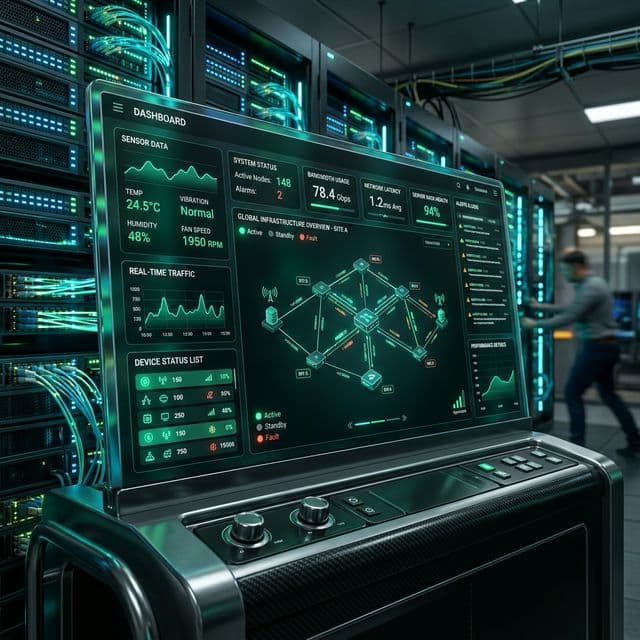
Engineering Industrial Telemetry
Bridging the IT/OT Visibility Gap
The Gravity of Industrial Jitter
In traditional IT networking, a 50ms spike in jitter may go unnoticed by the user. In the world of Operational Technology (OT), jitter can break the synchronization of high-speed robot controllers or cause PLC heartbeats to time out, triggering emergency shutdowns. Monitoring these flows requires specialized telemetry that treats network health as part of the physical system.
Deterministic Networking
Time-Sensitive Networking (TSN) and EtherNet/IP require deterministic delivery. This dashboard monitors the "packet arrival consistency" rather than just raw bandwidth.
Edge Telemetry Processing
Sending raw millions of sensor readings to the cloud is inefficient. Modern architectures process telemetry at the edge, transmitting only anomalies and heartbeats to central dashboards.
The Convergence of PLC and API
As factories move toward Industry 4.0, the distinction between industrial protocols and web APIs is blurring. MQTT and REST are now co-existing on the same fiber backbones as legacy Modbus flows. A unified dashboard is no longer a luxury—it is a security and operational necessity.
Interpreting Industrial Telemetry Metrics
Raw sensor values are meaningless without context. A vibration reading of 4.7 mm/s on a motor bearing requires comparison against ISO 10816-3 vibration severity charts to determine if the asset is in a green, yellow, or red zone. Similarly, a temperature spike from 42°C to 61°C on a VFD cabinet may indicate a failing cooling fan rather than an overload condition. The dashboard provides time-series visualization so operators can distinguish between transient spikes, step changes, and gradual drift patterns—each requiring a different response protocol.
Jitter in industrial networks is measured differently than in IT. While office Ethernet tolerates 5-30ms of jitter, a Profinet IRT (Isochronous Real-Time) network demands jitter under 1µs. The dashboard highlights jitter excursions that violate your configured thresholds, allowing you to trace back to the offending switch port or cable segment. Packet loss in OT environments often manifests as "late packets" rather than truly dropped frames—a frame arriving 50µs too late for a motion controller is functionally equivalent to a lost packet. The terminal interface distinguishes between physical loss (CRC errors, FCS failures) and timing violations (late arrivals beyond the application deadline).
Protocol health indicators track the state machines of industrial protocols at Layer 7. For Modbus TCP, this means monitoring the ratio of successful reads to exception responses (error codes 0x01-0x0B). For EtherNet/IP, the dashboard tracks CIP connection timeouts and Class 1 (implicit) messaging throughput versus Class 3 (explicit) messaging queues. A sudden increase in Modbus exception code 0x04 (Server Device Failure) across multiple slaves often indicates a backplane or power supply issue rather than a network problem—context the dashboard preserves by showing correlated sensor readings alongside protocol telemetry.
PLC Heartbeat Monitoring
Programmable Logic Controllers use watchdog timers and heartbeat messages to confirm liveness. If a PLC misses three consecutive heartbeats, safety logic may force an emergency stop. This dashboard visualizes heartbeat intervals and flags deviations before they cascade into production halts.
Alarm Flood Prevention
When a single power outage triggers 500 sensor alarms simultaneously, operators experience alarm flood. The dashboard groups correlated alarms by root cause, suppressing the avalanche and highlighting the originating event so response teams focus on the source, not the symptoms.
Deployment Across Industrial Verticals
In discrete manufacturing, the dashboard connects to assembly line PLCs tracking cycle times, reject rates, and tool wear indicators. A press machine cycling 12% slower than baseline triggers an alert before parts fall out of tolerance. In process industries (chemical, pharmaceutical, oil & gas), the dashboard aggregates temperature, pressure, and flow sensors from DCS (Distributed Control Systems) and flags deviation from the MES recipe parameters. A distillation column running 3°C above setpoint may indicate fouling that impacts yield by 2-4% over a shift.
Power utilities use the dashboard to monitor substation telemetry following IEC 61850 standards. Merging units stream Sampled Values (SV) at 80 samples per cycle for protection relays; any disruption in this stream can delay fault clearing. The dashboard verifies that SV messages arrive within the 3ms window mandated by GOOSE (Generic Object Oriented Substation Event) messaging. Water and wastewaterfacilities monitor pump station telemetry across distributed geographic zones, tracking flow rates, reservoir levels, and chlorine residual. Cellular backhaul for remote RTUs introduces variable latency that the dashboard normalizes, applying deadband filtering so operators see meaningful trends rather than noise.
Common Pitfalls in OT Network Monitoring
Over-aggregation is the most frequent mistake. Averaging sensor readings over 60-second windows hides the microbursts that cause buffer overflows in intermediate switches. A network that reports 5% utilization averaged over a minute may be saturated for 800ms every 3 seconds—long enough to disrupt motion control. The dashboard preserves sub-second granularity for critical flows while allowing aggregated views for less sensitive data.
Neglecting baseline drift is another common oversight. Equipment degrades gradually: a bearing that vibrates at 2.8 mm/s today will be at 4.2 mm/s within weeks. Without a rolling baseline, operators normalize the degradation and miss the window for condition-based maintenance. The dashboard maintains 7-day, 30-day, and 90-day rolling baselines and flags statistically significant deviations using exponentially weighted moving averages (EWMA). Finally, treating all sensor data equally wastes bandwidth and storage. A temperature sensor on a cooling tower changes slowly and needs sampling every 30 seconds; a vibration sensor on a high-speed spindle may need sampling at 10 kHz. The dashboard allows per-sensor sampling policies, applying Nyquist-appropriate rates rather than a one-size-fits-all approach.
Best Practices for Operational Telemetry
First, establish tiered alerting—advisory, warning, and critical—with distinct escalation paths. An advisory for a slight temperature rise goes to the shift supervisor; a critical vibration alarm goes to the maintenance lead with an automated work order created in your CMMS. Second, implement edge aggregation before transmitting to centralized dashboards. A single PLC rack may generate 10,000 data points per second; transmitting every sample consumes unnecessary bandwidth. Instead, use edge gateways to compute min/max/avg and standard deviation over configurable windows, sending only the statistical summary plus any outlier samples. Third, correlate network and process metrics. A drop in production throughput may be caused by a network fault (increased retransmissions starving the PLC of data) or a physical fault (a jammed conveyor). The unified dashboard lets operators see both domains simultaneously, dramatically reducing mean time to diagnose (MTTD).
Secure by Segmentation
The Purdue Model defines five levels of industrial control—from physical sensors at Level 0 to enterprise ERP at Level 4. Segmentation firewalls and unidirectional gateways between levels are the foundation of OT security. This dashboard visualizes cross-level flows, flagging any traffic that violates the segmentation policy, such as a Level 2 HMI attempting to communicate directly with the corporate DMZ.
Modbus TCP Polling vs MQTT Streaming
Industrial IoT protocols each make different trade-offs between determinism, bandwidth utilization, and scalability. Modbus TCP and MQTT represent two ends of the spectrum — synchronous request-response vs asynchronous publish-subscribe — and the choice between them directly impacts the dashboard's data freshness and network overhead.
Poll Interval and Bandwidth Utilization
Modbus TCP creates a fixed polling overhead regardless of data change frequency. For each polled every seconds, the network load is . With devices, , and each way, the load is — manageable but wasteful when of values are unchanged.
Determinism vs Scalability Trade-Off
Modbus TCP provides deterministic polling — every device is guaranteed to be read exactly once per interval. MQTT inherently lacks this guarantee; if the publisher or broker is overloaded, updates may be delayed or dropped. For control-critical operations (e.g., circuit breaker status), Modbus's synchronous guarantee is essential. For monitoring dashboards showing temperature trends, MQTT's efficiency gain of less bandwidth at steady state makes it the superior choice. A hybrid architecture using Modbus for the control plane and MQTT for telemetry provides the best of both worlds.
Time-Series Data Compression at the Industrial Edge
Industrial IoT sensor networks generate time-series data at rates that challenge both storage and network bandwidth in brownfield deployments. A typical oil refinery with 50,000 sensors, each sampled at 1 Hz with a 4-byte float and a 8-byte timestamp, produces 50,000 × 12 bytes × 86,400 seconds = 51.8 GB of raw data per day. After accounting for Modbus TCP overhead (7-byte MBAP header + 1-byte function code + 1-byte slave address per read request), the daily network traffic can exceed 200 GB. The industry standard for lossless time-series compression is the XOR-based algorithm pioneered by Facebook Gorilla (now part of the Prometheus TSDB ecosystem). The Gorilla algorithm encodes consecutive floating-point values by XORing the current value with the previous value: if the XOR result is zero (value unchanged), a single "0" bit is stored, achieving an effective compression ratio of 64:1 for constant signals. If the XOR result is non-zero but shares a common leading zeros pattern with the previous XOR, only the differing bits are stored (center bits), yielding an average compression ratio of 6-12:1 for real sensor data with typical measurement noise. For the refinery scenario with Gorilla compression, the 51.8 GB raw daily data compresses to approximately 4.3-8.6 GB, reducing the WAN upload bandwidth requirement from 4.8 Mbps to 0.4-0.8 Mbps — easily transmitted over a cellular backup link.
The edge gateway running the compression algorithm must balance CPU utilization against compression ratio. Gorilla compression on a single sensor stream requires 3-5 CPU cycles per sample (primarily XOR comparisons and bit packing), so a 4-core ARM Cortex-A72 edge gateway at 1.5 GHz can process approximately (1.5 × 10^9 × 4 × 0.5) / 4 = 750 million samples per second of Gorilla encoding — over 10,000× the required throughput for 50,000 sensors at 1 Hz. The practical bottleneck is not the compression itself but the memory bandwidth for sensor data ingestion: each sensor value arrives over Modbus TCP as a discrete read transaction, and the Modbus master must issue 50,000 read-holding-register requests (each returning 2 bytes for a single register or up to 125 registers for a block read) at the configured polling interval. With block reads of 125 registers per request (250 bytes of data plus Modbus overhead), the number of Modbus transactions drops from 50,000 to 400 per polling cycle, and the per-transaction CPU overhead for TCP connection management (context switching, socket buffer copies) drops from approximately 10 μs per transaction to 1.5 μs per transaction. The dashboard's polling frequency calculator models this trade-off: for each sensor type (discrete vs. analog, fast vs. slow), it recommends the optimal Modbus read block size and the polling interval that minimizes the transaction overhead while keeping the data latency below the process control threshold (typically 100 ms for closed-loop control, 1 second for monitoring-only sensors).
Long-term historical storage introduces the need for compression tiering. Hot data (less than 30 days old) is stored at the edge gateway in Gorilla-compressed format with 1-second resolution, consuming approximately 130-260 GB for the refinery scenario. Warm data (30-365 days) is downsampled to 1-minute resolution using a retention policy that stores the mean, min, max, and count (the "four-tuple" or "MMMC" aggregation) for each minute, compressing further via delta-of-delta timestamp encoding: the Gorilla timestamp encoding stores the difference between consecutive timestamps as a variable-length integer, and for fixed-interval data (1-minute samples), the delta-of-delta is nearly always 0, requiring only 1 bit per sample. Warm data storage typically requires only 0.5-1% of the hot data volume. Cold data (archive, 1+ years) is stored in Parquet columnar format with ZSTD compression, which achieves 15-20:1 compression on the downsampled four-tuple data by leveraging run-length encoding on the often-identical min/max values during stable operations. The total 10-year storage requirement for a 50,000-sensor refinery drops from 189 TB (raw uncompressed) to approximately 1.2 TB (with the three-tier compression strategy), fitting comfortably in a dual-NVMe RAID-1 edge storage appliance and reducing the cloud storage cost from approximately $12,000/month (S3 standard) to $120/month at $0.023/GB. The dashboard's storage projection module implements this tiered model and outputs the expected storage consumption and the recommended data lifecycle policy for each sensor class.