
Optical Module Power Estimator
QSFP-DD/OSFP Thermal Analysis & AI Fabric Heat Planning
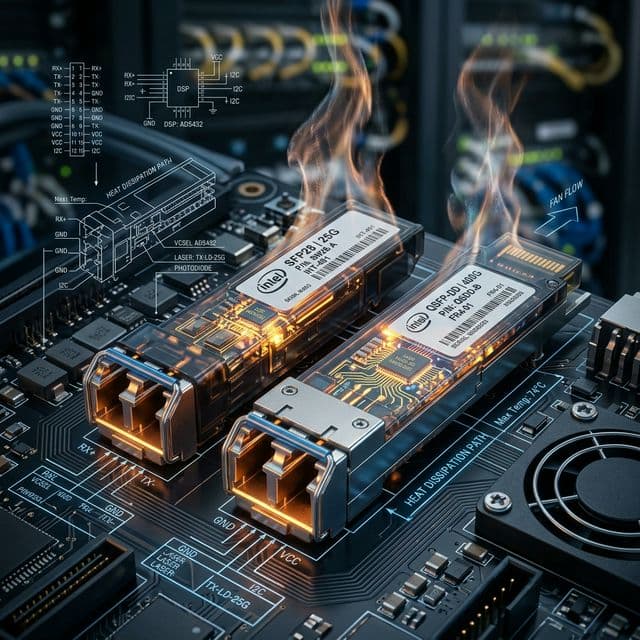
Module Thermal Estimator
Calculate peak power draw and BTU/hr heat dissipation for optical transceiver arrays.
Configuration
Total Ports
Module Power
BTU/hr Heat
Cooling Tons
Thermal Load Analysis
400DR4 modules across 32 nodes
Per Module
12W
Airflow Req.
461-614 CFM
Breaker Size
32A
@ 1.5 PUE
4.61 kW
"800G optics generate 80% more heat than 400G. Plan cooling capacity before deployment."
Section 1: The Physics of Optical Power Conversion
Optical transceivers are energy transducers. They convert high-speed electrical signals (modulated voltages) into optical photons and vice versa. This process is inherently inefficient, with a significant portion of the input electrical power being lost as thermal energy. The total heat dissipated by a module is defined by the energy conservation law:
Where is typically < 5-10mW, making essentially equal to the electrical input power.
In high-speed 800G optics, the efficiency is further challenged by the modulation format. Transitioning from NRZ (Binary) to PAM4 (Pulse Amplitude Modulation 4-level) required 4x the signal-to-noise ratio (SNR), necessitating complex Forward Error Correction (FEC) and Digital Signal Processing (DSP) logic that consumes power non-linearly.
Section 2: The DSP Tax: Why 800G is "Hot"
In a modern 800G QSFP-DD module, the power budget is dominated by the DSP. As we push towards 112G and 224G per-lane SerDes speeds, the amount of equalization (FFE, DFE, and MLSE) required to recover the signal from the distorted electrical channel becomes massive.
- Retiming & Reshaping: The DSP must compensate for the skin effect and dielectric losses in the PCB traces between the switch ASIC and the transceiver.
- FEC Overhead: High-speed links require "KP4" or "Hamming" FEC codes. The processing of these codes at 800Gbps speeds generates significant switching power within the DSP gates.
- ADC/DAC Precision: Converting analog optical signals to digital requires high-speed Analog-to-Digital Converters (ADCs) which are notoriously power-hungry.
Current 7nm DSPs in 800G modules consume ~18W. The transition to 5nm and 3nm is expected to reduce this by ~20%, but the bandwidth migration to 1.6T will immediately consume those gains, keeping the thermal density at the edge of physical limits.
Laser Physics Impact
The choice of laser significantly impacts the thermal profile. **VCSELs (Vertical-Cavity Surface-Emitting Lasers)** used in multimode fiber are efficient but limited in reach and speed. **EMLs (Electro-absorption Modulated Lasers)** used in single-mode fiber provide cleaner signals at high speeds but require a precise bias current and often a heating/cooling element to maintain wavelength stability.
Silicon Photonics (SiPh)
SiPh allows for the integration of modulators, splitters, and detectors onto a silicon substrate. While it reduces the number of components, it often uses an external CW (Continuous Wave) laser. The heat from this external source must be managed carefully to avoid impacting the silicon chip's refractive index, which is highly temperature-sensitive.
Section 3: Thermal Management in AI Data Centers
In an AI cluster with thousands of NVIDIA H100 GPUs, the total power draw of a single rack can exceed 100kW. Within that rack, the "InfiniBand" switches are densely packed with 800G optics. A fully loaded 64-port switch dissipates:
64 Ports \times 20W = 1,280W (Just Optics)This 1.2kW of heat is concentrated in a tiny volume (the front panel). Standard cooling strategies include:
1. Airflow Optimization (C-B & F-B)
Moving air from the "Cold" aisle to the "Hot" aisle. For switches, "Connector-to-Bezel" (exhaust at the ports) or "Bezel-to-Connector" (intake at the ports) orientations are critical. If the ports are at the exhaust side, the transceivers will be hit with 50°C+ air from the ASIC, leading to immediate overheating.
2. Liquid Cooling (DLC)
Direct-to-Chip liquid cooling is now moving to the transceiver sleeve. Cold plates are mounted directly to the transceiver cage to wick away heat without relying on high-velocity fans, which contribute to noise and mechanical vibration.
Section 4: Future Horizons: LPO and CPO
To solve the power crisis, two major architectural shifts are underway:
Linear Drive Pluggable Optics (LPO)
LPO removes the DSP from the module, reducing power consumption from ~18W to <8W. However, it requires the switch ASIC to have high-performance SerDes capable of driving the optical modulator directly through the PCB and connector.
Co-Packaged Optics (CPO)
CPO eliminates the pluggable form factor entirely. The optical engines are mounted on the same organic substrate as the switch ASIC. This reduces the electrical path length to millimeters, potentially reducing total interconnect power by 30-50% while enabling 102T+ switch capacities.
Section 5: Reliability and the Arrhenius Failure Model
Optical modules are susceptible to "wear-out" mechanisms, primarily laser degradation. The degradation rate follows the Arrhenius Equation, where the rate of chemical or physical reaction (failure) increases exponentially with temperature:
Where is the activation energy, is Boltzmann's constant, and is the absolute temperature.
In practical terms, running an 800G transceiver at 75°C instead of 65°C can reduce its lifespan by nearly 50%. For a massive AI cluster with 50,000 transceivers, this temperature difference can mean the difference between a stable network and a continuous stream of failed links.
Section 6: Total Cost of Ownership (TCO) & The Optical Tax
When calculating the cost of an AI networking fabric, engineers often overlook the operational expenditure (OpEx) tied to optical power. The "Optical Tax" consists of three components:
Direct Energy Cost
At $0.12/kWh, a 20W module running 24/7 costs ~$21/year. In a cluster with 60,000 modules, this is $1.26M/year in direct electricity for optics alone.
Cooling Overhead
Data centers have a Power Usage Effectiveness (PUE) ratio. If PUE is 1.5, every 1W of optical power requires an additional 0.5W for cooling, raising the cost by 50%.
Replacement Cycles
Higher operating temperatures leads to higher replacement rates (Capex). A 1% increase in failure rate across 60k modules is 600 replacements per year, plus labor.
Designing with LPO or high-efficiency cooling can significantly reduce this TCO, making the network infrastructure more sustainable and economically viable for long-term AI training workloads.
"You are our partner in accuracy. If you spot a discrepancy in calculations, a technical typo, or have a field insight to share, don't hesitate to reach out. Your expertise helps us maintain the highest standards of reliability."
Contributors are acknowledged in our technical updates.