
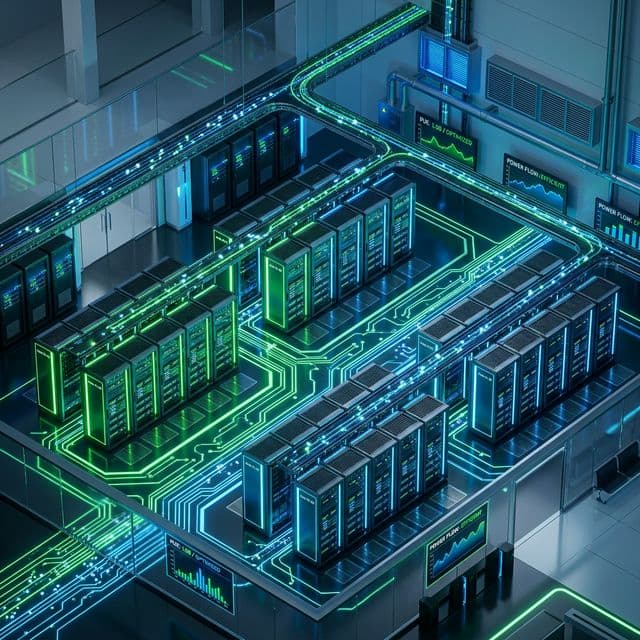
Industrial PUE Model
Input facility and IT power metrics to analyze infrastructure efficiency and energy overhead. Compliant with ISO/IEC 30134-2 measurement standards.
PUE Calculator
Real-time Data Center Infrastructure Efficiency Metrics
Servers, storage, network
CRAC, CRAH, chillers
Inefficiency leaks
Distribution losses
Facility lighting
Pumps, fans, misc
Industry average. Room for optimization.
Data Center Infrastructure Efficiency. The percentage of power actually used by IT equipment versus total facility power.
Sum of all power consumed by IT, cooling, lighting, UPS losses, and auxiliary systems.
Infrastructure Overhead Breakdown
Annual energy consumed by non-IT infrastructure (cooling, power distribution losses, lighting).
Annual cost of wasted energy at $0.12/kWh. Reducing PUE directly lowers operating expenses.
Estimated annual carbon footprint based on 0.5 kg CO₂/kWh grid intensity.
Engineering Note: Precise PUE results require calibrated utility meter readings (Facility) and UPS/Rack-level output readings (IT). A PUE of 1.58 is the global average (Uptime Institute, 2023). For AI clusters, target < 1.25 through advanced liquid cooling.
Psychrometric Load Visualizer
Model how ambient temperature and relative humidity impact your cooling plant's COP (Coefficient of Performance) and overall facility PUE.
PUE Efficiency Lab
Infrastructure Load vs IT Utility
Observation: Every watt saved in cooling or distribution losses directly reduces the multiplier applied to your IT power bill.
1. The Efficiency Framework: Deconstructing PUE
Power Usage Effectiveness (PUE) is more than a simple ratio; it is a measure of the "parasitic" energy cost of doing work. In a perfectly efficient facility, every electron would be consumed by an IT component performing a logical operation.
ISO 30134-2 Equations
A PUE of 2.0 indicates that for every 100 kW of server compute, the facility is drawing 200 kW from the grid. For a 10 MW data center, a fractional increase from 1.3 to 1.5 represents an additional **2,000,000 watts** of waste.
2. The Thermodynamic Wall: Psychrometrics
Data center cooling is governed by the Psychrometric Chart, which maps the relationship between air temperature (Dry Bulb) and moisture content (Relative Humidity).
Sensible vs Latent Heat
Cooling systems perform two jobs: lowering air temperature (Sensible) and removing moisture (Latent). In humid climates, 'Latent Work' consumes up to 30% of energy without changing the server temperature.
Carnot Limit (COP)
The energy required to move heat depends on the temperature gradient. Raising server inlet temps from 20°C to 27°C can reduce chiller energy by 20% by narrowing this gradient.
3. Fan Affinity: The Cubic Power Law
The energy consumed by cooling fans is non-linear. This is the single most effective lever for PUE optimization in air-cooled environments.
Power Proportionality
Fan power is proportional to the cube of its speed ($N$). This means that doubling the speed increases power usage by 8x. Conversely, a small reduction yields massive savings.
Aggregation Strategy
Running four fans at 50% speed consumes much less energy than running two fans at 100% speed. This is why high-density pods use 'Fan Walls' with distributed EC fans.
4. Electrical Distribution Forensics
Energy is lost at every stage of the distribution chain—from high-voltage switchgear to the server power supply (PSU).
UPS Conversion Tax
Standard double-conversion (VFI) UPS systems add ~4-8% overhead. In AI clusters, we use Multi-Mode or Eco-Mode to drop this to <1% by bypassing the inverter during steady-state.
Transformer K-Factor
Non-linear server loads inject harmonic distortion (THD). This causes eddy current heating in transformer cores. High K-factor transformers are mandatory to avoid efficiency decay and overheating.
5. Liquid Cooling: The Future of PUE 1.05
As individual chips exceed 800W TDP, air is no longer a viable transport medium. Water has ~3,500x the volumetric heat capacity of air.
PUE Impact: -0.20
Cold plates move heat directly into warm-water loops. Eliminates chilled water pumps and large CRAC fans.
PUE Target: 1.01
Full dielectric immersion eliminates server fans (a major IT load component). Reduces the base load itself.
District Heating
Warm liquid loops allow waste heat to be salvaged for district heating, potentially dropping 'net' PUE below 1.0.
Frequently Asked Questions
Technical Standards & References
Related Engineering Resources
Chiller Plant vs Free-Air Cooling PUE Curves
Data center cooling accounts for 30-50% of total facility power. The choice between chiller-based mechanical cooling and free-air economization determines both the achievable PUE and the geographic constraints on AI cluster deployment.
Mechanical Cooling PUE Components
A chilled-water plant with centrifugal chillers, cooling towers, and pumps has a power overhead of . Typical chiller COP ranges from 3.0 to 6.5 depending on ambient temperature. The total cooling overhead adds to the PUE, bringing it to . The chiller power consumption scales with the cube of the compressor speed: .
Free-Air Economization Duty Cycle
Free-air cooling uses outside air directly (or via indirect air-to-air heat exchangers) to remove heat from the data hall. The duty cycle fraction determines annual average PUE. In regions like Northern Europe, is achievable, yielding annualized PUE of . However, GPU clusters with density may require supplemental cooling even during economization hours because the temperature delta between supply and return is larger than for traditional server racks.
Evaporative Cooling vs. Adiabatic Cooling: Water-Efficiency Trade-offs in Edge AI Deployments
Direct evaporative cooling passes outdoor air through wetted media, reducing the dry-bulb temperature by converting sensible heat to latent heat through water evaporation. The cooling effectiveness is governed by the psychrometric saturation efficiency: ε = (T_dbin - T_dbout) / (T_dbin - T_wbin), where T_dbin and T_dbout are the entering and leaving dry-bulb temperatures, and T_wbin is the entering wet-bulb temperature. A high-quality Celdek media pad achieves ε = 0.85-0.90, meaning the leaving air temperature approaches 85-90% of the wet-bulb depression (the difference between dry-bulb and wet-bulb temperatures). In a Phoenix, AZ environment with T_db = 43°C and T_wb = 18°C (a typical monsoon-condition wet-bulb depression of 25°C), the leaving temperature is 43 - 0.85 × 25 = 21.75°C—well within the ASHRAE Class A1 server inlet range of 15-32°C. However, the leaving air is nearly saturated: relative humidity approaches 95-98%, which exceeds the ASHRAE Class A1 upper humidity limit of 80% RH at 21.75°C. The condensation risk on server components and the potential for corrosion from water-saturated air require careful monitoring and, in many cases, a post-cooling dehumidification step that erodes the energy advantage of evaporative cooling.
The water consumption of direct evaporative cooling is substantial: roughly 0.5-1.0 gallons per ton-hour of cooling, or approximately 0.004-0.008 GPM per kW of IT load. For a 500 kW edge AI pod, the peak water consumption is 2-4 GPM, or 2,880-5,760 gallons per day. In water-stressed regions where WUE (Water Usage Effectiveness) is increasingly regulated under LEED v4 and local watershed management plans, this water consumption may be untenable. Adiabatic cooling—where water is sprayed onto the intake of a cooling coil or radiator rather than into the airstream—consumes 60-80% less water because evaporation occurs on the coil surface rather than in the supply airstream, and the water that does not evaporate is recirculated rather than exhausted. The trade-off is a higher leaving air temperature: the coil-based adiabatic approach achieves T_dbout ≈ T_wbin + 3-5°C compared to T_dbout ≈ T_wbin + 1-2°C for direct evaporative media. For a 100 kW GPU cluster at 30 kW/rack density, this 2-3°C temperature difference translates to an additional 5-8% fan power at the server level to maintain the target GPU inlet temperature.
The hybrid evaporative-plus-chiller configuration is the most common deployment for AI-optimized data centers seeking to balance PUE, WUE, and geographic deployment flexibility. In this architecture, the evaporative cooling stages are used during ambient conditions where the wet-bulb temperature is below the chilled water supply setpoint (typically 10-15°C for a 22°C server inlet), providing "free cooling" with chiller bypass. When the wet-bulb temperature exceeds the supply setpoint, the chiller operates in series with the evaporative stage, using the evaporative cooler to reduce the chiller's condensing temperature. The chiller's COP improves by 15-25% when its condensing temperature drops from 40°C (air-cooled condenser) to 24°C (with evaporative pre-cooling). The annual energy savings depend on the climate zone: a facility in Northern Virginia (ASHRAE Climate Zone 4) achieves 6,500-7,000 hours of partial or full evaporative cooling per year, reducing the annualized PUE by 0.08-0.12 compared to a chiller-only design, at a water consumption of 200-400 gallons/MWh of IT energy. In contrast, a facility in Singapore (Climate Zone 0, tropical) achieves fewer than 500 hours of free cooling per year, and the evaporative stages operate primarily to boost chiller COP at a higher water cost per MWh of IT energy saved.
The water treatment and scaling prevention engineering for evaporative cooling is an often-underestimated operational cost center. The recirculating water in evaporative cooling systems concentrates dissolved minerals as pure water evaporates, leaving calcium carbonate (CaCO₃), silica (SiO₂), and magnesium silicate scale behind. A typical 500-ton cooling tower recirculates 150 GPM, and if the make-up water has 200 ppm of total dissolved solids (TDS)—typical of municipal water in the Southwestern US—the concentration cycles in the recirculating water will reach 5-8 cycles (1,000-1,600 ppm TDS) before blowdown is required. At 8 cycles of concentration, the scaling potential for CaCO₃ is approximately 12× the saturation limit at a pH of 8.5, requiring either chemical scale inhibitors (phosphonates at 2-5 mg/L, costing approximately $1,500-3,000/year per 500 tons) or a side-stream water softening system (ion exchange at $10,000-15,000 capital cost plus $500-1,000/year in salt regeneration). The PUE benefit of evaporative cooling must be weighed against this water chemistry management cost: for a 10 MW facility, the annual savings from 0.10 PUE improvement ($175,000 at $0.08/kWh) must be reduced by the water and chemical costs ($15,000-25,000/year for a 500-ton system), yielding a net benefit of $150,000-160,000/year—still positive but requiring the operational discipline of chemical water management that many IT teams lack.
"You are our partner in accuracy. If you spot a discrepancy in calculations, a technical typo, or have a field insight to share, don't hesitate to reach out. Your expertise helps us maintain the highest standards of reliability."
Contributors are acknowledged in our technical updates.