
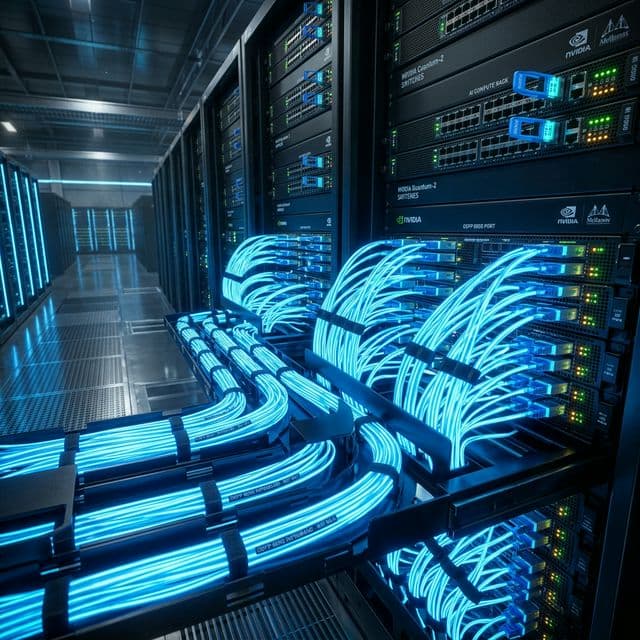
The AI Revolution is a Network Revolution
When we talk about Artificial Intelligence, we focus on GPUs (Nvidia H100s, B200s). But a single GPU is useless for training a Large Language Model (LLM). Training requires *thousands* of GPUs to act as a single, unified computer. The "Glue" that makes this possible is the **Backend Network Fabric**.
In AI networking, standard enterprise rules don't apply. We don't care about "Reliability through Retransmission" (TCP); we care about "Zero-Packet-Loss" and "Nanosecond Latency." If a single packet is dropped in an AI cluster, the entire training job stops for milliseconds—costing thousands of dollars in wasted compute time.
AI Fabric Architecture
AI FABRIC ARCHITECTURE
Simulating High-Performance Backend Interconnects
"The transition from lossy to lossless networking is the single most expensive and critical step in AI infra design."
1. RDMA: Direct Memory Access
Standard networking (TCP/IP) is too slow for AI. The CPU has to spend too much time "thinking" about headers. **RDMA (Remote Direct Memory Access)** allows GPU A in Rack 1 to read data directly from the VRAM of GPU B in Rack 50 without involving the CPUs of either server.
Zero-Copy
Data doesn't need to be copied into multiple buffers, reducing latency and CPU cycles.
Kernel Bypass
The application talks directly to the Network Card (NIC), skipping the OS overhead.
2. The Two Contenders: InfiniBand vs. RoCE v2
InfiniBand
InfiniBand is a dedicated networking technology designed specifically for HPC. It is natively "Lossless"—the hardware itself ensures that no packet is ever dropped due to congestion.
Engineering Profile
- Lowest Tail Latency
- Highest Efficiency
- Proprietary Ecosystem
RoCE v2
RoCE v2 wraps RDMA inside standard UDP/IP/Ethernet packets. This allows it to run on standard Ethernet hardware from any major vendor.
Engineering Profile
- Multi-Vendor Silicon
- Complex PFC/ECN Tuning
- Cost-Effective Scale
3. Topology: Non-Blocking Fat-Trees
Standard networks use "Oversubscription" (assuming not everyone talks at once). AI assumes **everyone is talking at once, at full speed**. We use **Clos Topologies (Fat-Trees)** with a 1:1 oversubscription ratio.
Architect's Insight
This means every GPU has an unobstructed "Clear Path" to every other GPU at 400Gbps or 800Gbps. This requires a massive number of high-radix switches and a "Forest" of fiber optic cables.
The Future: 800G and Beyond
As LLMs grow from 175B parameters to 10T+, the network bandwidth must double every 18 months. We are already seeing the deployment of **800G OSFP** optics and the rise of **Optical Circuit Switching (OCS)**, where mirrors literally reflect laser beams to change network paths in real-time.
Conclusion: The Network is the Computer
We have entered the era where the network is no longer a utility; it is a core component of the compute engine. The engineers who can bridge the gap between "Distributed Systems" and "High-Speed Optics" are the ones who will build the infrastructure that powers the next generation of intelligence.
Series Navigation
The Pillars of Technical Implementation
Thermal Engineering
Direct Liquid Cooling (DLC) and rack-scale thermodynamics for 120kW+ density.
Compute Benchmarking
H100 vs Blackwell architecture. Analyzing FP8/FP4 TFLOPS and memory scaling.
Fabric Topology
Fat-Tree, Dragonfly, and rail-optimized networking architectures for GPU clusters.
Training Mechanics
Gradient synchronization, All-Reduce bottlenecks, and NCCL optimization patterns.