
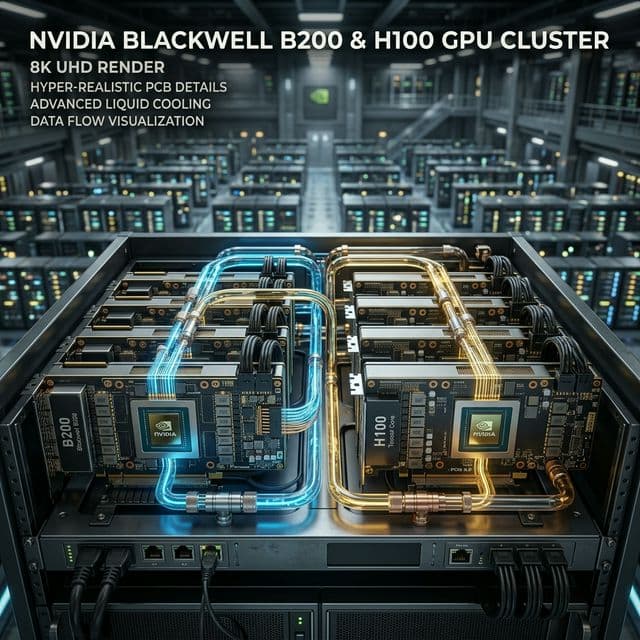
The Compute Gap: Beyond TFLOPS
When NVIDIA announced the B200 (Blackwell) with 20 PFLOPS of FP4 performance, the industry focus shifted entirely to raw compute. However, for a network architect, the compute throughput is only half the story. The real "Benchmark" of an AI system is its **Compute-to-Network Ratio**.
If a chip processes 2.2x more data per second but the scale-out optical bandwidth only increases by 20%, the GPU remains idle for longer periods waiting for gradient weight synchronization. This efficiency drop is what defines the economics of modern LLM training.
GPU ROOFLINE PERFORMANCE MODELER
Arithmetic Intensity vs. Hardware Limits
The GPU is waiting on HBM3e bandwidth. Arithmetic logic is idle.
Hardware is operating at peak TFLOPS. Limited by total CUDA/Tensor Cores.
Arithmetic Intensity
The ratio of floating-point operations to bytes of memory data moved.
Memory Bandwidth
The speed at which data travels from HBM3e to the GPU compute cores.
Fabric Saturation
When the 800G backend fabric becomes the bottleneck for collective ops.
Anatomy of a Generation Shift
Analyzing the transition from H100 (Hopper) to B200 (Blackwell) requires looking at the **Memory-to-Compute scaling**. While FP8 TFLOPS roughly doubled, the HBM (High Bandwidth Memory) capacity and bandwidth saw an even more aggressive jump to accommodate trillion-parameter models.
Scaling Comparison (Per GPU Unit)
The Scaling Tax
In a multi-node cluster, GPUs don't work in isolation. They are part of a synchronized machine. The **Amdahl's Law of AI** states that the maximum speedup is limited by the serial part of the task—in our case, the time it takes to synchronize gradients over the network.
Compute-Bound (Ideal)
The GPU processing time is much larger than the network communication time. This happens when the model parameters fit perfectly within HBM and the network bandwidth is high (e.g., local NVLink).
I/O-Bound (Scaling Tax)
The GPUs stall because they are waiting for data from the fabric. As we move to 1.6T Ethernet, the goal is to shift more workloads back toward being compute-bound.
Architect's Insight: FP4 Precision
Blackwell introduces the FP4 micro-format. By reducing numerical precision from 8 bits to 4 bits, engineers can double the effective compute throughput and halve the memory bandwidth requirements for inference—provided the model weights can be quantized without accuracy loss.
The Road to Zettascale
Benchmarking AI infrastructure is no longer about single-node peak performance. It is about the holistic efficiency of the **Liquid-Cooled GPU Rack**, the **Non-Blocking Network Layer**, and the **NCCL Optimization libraries**. As we build towards Zettascale clusters, the benchmark metric of truth will be "Model Throughput per Dollar-Energy."
Power Efficiency
Analyzing the TFLOPS/Watt trajectory of H200 vs B200.
Scale-Out Rail
Planning for 8x 800G per node on the Blackwell fabric.
Series Navigation
The Pillars of Technical Implementation
Thermal Engineering
Direct Liquid Cooling (DLC) and rack-scale thermodynamics for 120kW+ density.
Compute Benchmarking
H100 vs Blackwell architecture. Analyzing FP8/FP4 TFLOPS and memory scaling.
Fabric Topology
Fat-Tree, Dragonfly, and rail-optimized networking architectures for GPU clusters.
Training Mechanics
Gradient synchronization, All-Reduce bottlenecks, and NCCL optimization patterns.