
Packet Loss Dynamics
Analysis of Signal Degradation and Retransmission Overhead
How to measure Network Stability? Mechanics of Packet Loss
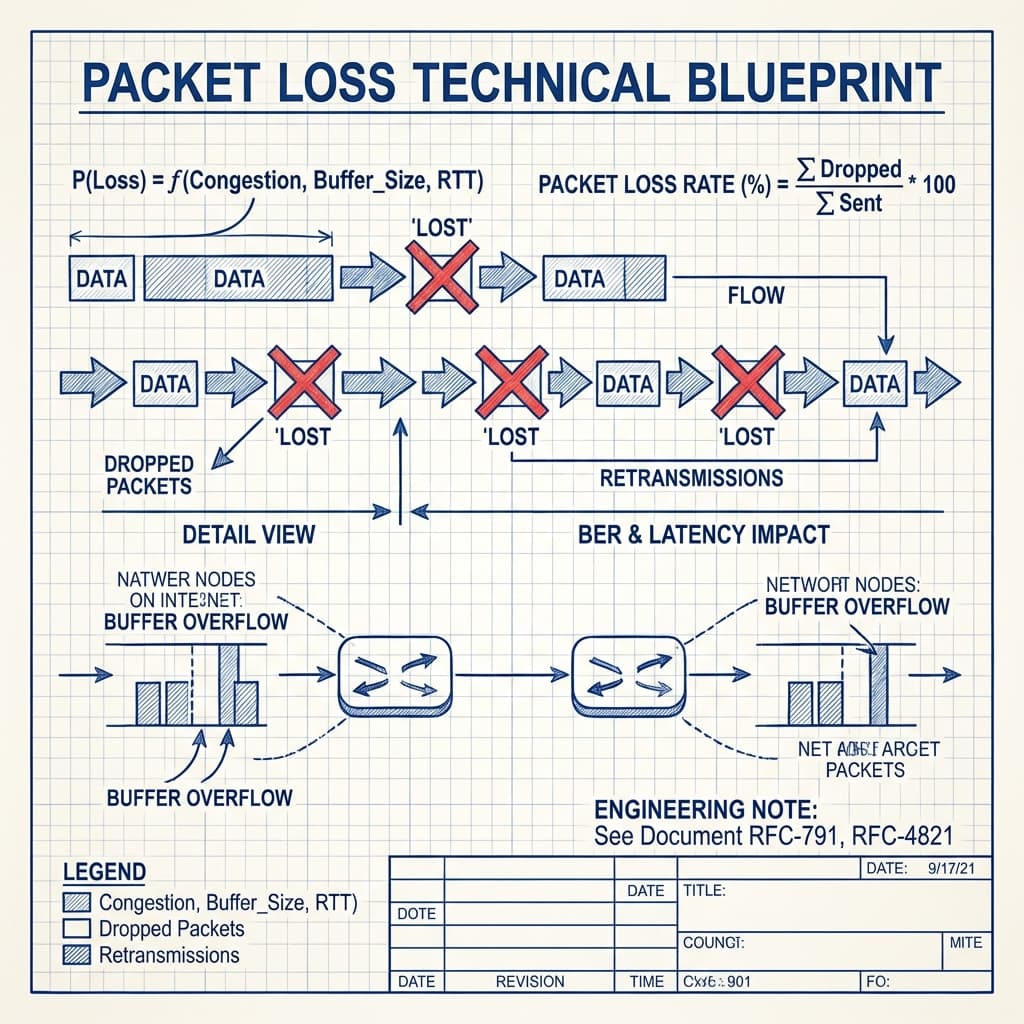
In any network, routers have finite buffer space. When a router receives more data than it can process, it is forced to discard incoming packets—a process known as Tail Drop. This is a primary indicator of network congestion and bufferbloat.
Packet Loss & Retransmission
Simulating TCP-style recovery on a lossy link.
Engineering Insight: Packet loss in high-reliability networks is often caused by Interference or Buffer overflows. While TCP handles recovery via retransmission, this introduces significant Tail Latency which can disrupt real-time operations.
Why does Signal Propagation fail? Physical Layer Integrity
Beyond congestion, packet loss is often rooted in physical infrastructure failure and signal degradation.
- Electromagnetic Interference (EMI): Unshielded cables near power lines or faulty Wi-Fi environments affecting network stability.
- Fiber Attenuation: Signal loss over long distances or due to physical damage in the glass.
- Hardware Decay: aging router circuitry causing periodic transmission failure.
3. Packet Loss Diagnostic Thresholds
For web browsing, 1% packet loss is tolerable. For high-fidelity diagnostic tools and industrial maintenance monitoring, even 0.1% loss can lead to erroneous data interpretation. In VOIP, packet loss manifest as "digital silence" or audio gaps that the human brain cannot easily reconstruct.
Technical Standards & References
Related Engineering Topics
Jitter Mastery
Analyzing temporal variance and the impact of Bufferbloat on real-time data arrival distribution.
Network Reliability
Building for the 'Five Nines' and understanding the engineering metrics of high-availability systems.