
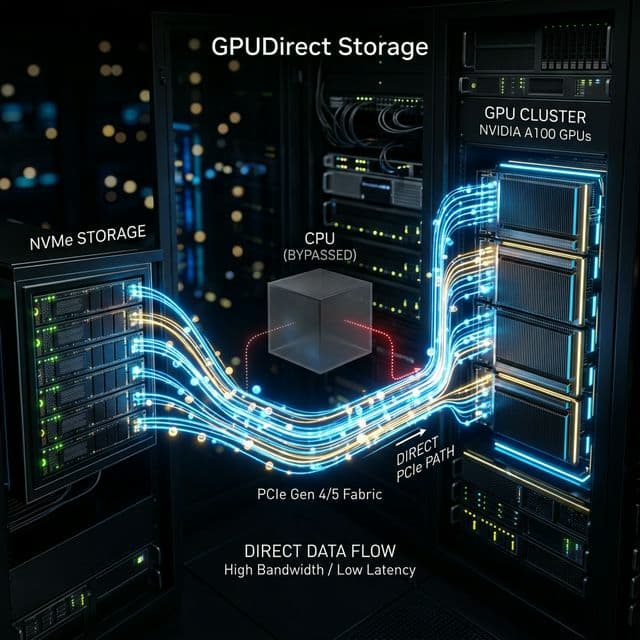
GPUDirect Storage: Engineering the Peer-to-Peer Data Path
Analyzing the transition from CPU-mediated I/O to Zero-Copy NVMe-over-Fabrics at Scale.
The CPU Wall and the Multi-Copy Paradox
In the semiconductor architecture of the 2010s, the CPU was the undisputed orchestrator of all data movement. In a standard I/O operation, the CPU would fetch data from storage, place it in a system memory buffer (Bounce Buffer), and then perform a second copy to GPU memory. This **Multi-Copy Paradox** was acceptable when GPUs were processing imagery or simple compute tasks.
In the AI era, where datasets like Common Crawl or massive genomic maps reach petabyte scales, the data loading requirement for an 8-GPU node exceeds 50 GB/s. At these speeds, the CPU is no longer an orchestrator; it is a bottleneck. The **CPU Wall** is the point where the server's control plane cannot provide data at the rate the accelerator can consume it, leading to "GPU Under-utilization."
Standard POSIX Path
Data travels through the OS kernel, triggering context switches and interrupt handling. Each Gigabyte moved costs significant CPU cycles, creating a hard ceiling on storage throughput regardless of network speed.
GDS Zero-Copy Path
Utilizes the **CuFile API** to establish a direct P2P (Peer-to-Peer) relationship between the NIC/NVMe and the GPU's HBM (High Bandwidth Memory). The CPU stays in the control plane—managing the metadata but never touching the data.
Latency and Throughput Modeling
The total I/O latency () in a storage environment can be broken down into the media latency, the network hop latency, and the overhead of CPU-mediated memory copies.
In empirical testing across diverse AI workloads, GDS frequently demonstrates an efficiency gain ratio exceeding **2.5x to 4.0x** for large block transfers (1MB+ blocks). For the increasingly common multi-modal datasets, this throughput delta is the difference between a training job taking 4 days versus 1.5 days.
The CuFile API: Software Mechanics
At the heart of GPUDirect Storage is the `libcufile.so` library. Traditional C applications use standard `read()` and `write()` calls targeting a file descriptor. GDS apps use specific `cuFileRead()` and `cuFileWrite()` primitives.
NVMe-oF Integration
GDS allows remote storage targets to be mounted via standard NVMe-over-Fabrics protocols, maintaining compatibility with diverse storage vendors while enabling P2P paths.
Interrupt Mitigation
By moving the data path to RDMA/DMA, GDS eliminates the per-packet interrupt storm that typically overwhelms the CPU's L1/L2 caches during high-speed transfers.
Multi-Rail Steering
For servers with 8x NICs, GDS can steer I/O to the NIC closest to the target GPU physically (numa-locality), ensuring the path never crosses the UPI/Infinity-Fabric links.
Throughput Scaling and Storage Fabrics
Implementing GDS is not a "Plug and Play" operation. It requires an end-to-end alignment of the storage fabric. Standard NFS or S3 without specialized drivers will fail to trigger the GDS path.
Direct I/O Flag
Files must be opened with `O_DIRECT` to ensure they bypass the Linux Page Cache, a prerequisite for the CuFile DMA process.
Registered GPU Buffers
Memory buffers must be pre-registered with the GDS driver to allow for the hardware-level handshakes required for zero-copy transfers.
BAR Mapping
The OS must support Large BAR (Base Address Register) mapping to allow the storage devices to "see" the entire 80GB+ of HBM memory as a single address space.
The Storage Fabric Hierarchy
Modern AI data centers are moving toward **Parallel File Systems (PFS)** that are natively GDS-aware. This allows a training node to pull from hundreds of across-rack NVMe drives as if they were a single, local direct-attached drive.
- PFS Throughput100 GB/s+ per Rack
- Protocol GainRDMA over Converged Eth
- ScalabilityLinear with Port Count
Implementation & Deployment Logic
Transitioning to a GDS-enabled environment involves a 3-layer validation process. Failure to validate at any level often results in the system falling back to a standard TCP/UDP path without alerting the user.
Use `gdscheck` to verify that the `nvidia-fs` driver is successfully loaded and that the Peer-to-Peer DMA paths are authorized by the system BIOS.
Verify that `ib_verbs` are operational and that the storage target identity is correctly mapped in the RoCE v2 configuration tables.
Strategic Note: As we move from H100 (PCIe Gen5) to Blackwell (PCIe Gen6), the available I/O bandwidth is doubling. This makes the storage path even more sensitive to CPU latency. Organizations not looking at GDS in 2026 will find themselves with hardware that is capable of massive compute but starved for information.
The Infinite Data Pipe
GPUDirect Storage is more than an optimization; it is the death of the traditional server architecture. By removing the CPU from the data path, we enable a new era of **Scale-Out Storage** where the distance between the training data and the weights is measured in nanoseconds, not context switches.