
1. Beyond Air: The Thermodynamic Wall
Air-cooling has a physical limit based on the "Thermal Resistance" of copper heat pipes and the volume of air a server fan can move. When a single GPU chip (like the Blackwell B200) draws **1,200 Watts**, air-cooling heatsinks become so large they interfere with signal integrity and rack density. The thermal conductivity of air is roughly ~0.026 W/m┬╕K (at sea level), whereas water is ~0.6 W/m┬╕K—a 23x advantage in raw heat transfer capability.
We have reached the point where **Liquid Cooling** is not an option; it is a requirement. By pumping coolant directly onto cold plates in contact with the GPU die and HBM memory, we can capture 95%+ of the thermal load with near-zero fan noise and significantly lower PUE. In a 120kW rack, air cooling would require a CFM (Cubic Feet per Minute) so high that the resulting air velocity would physically stress the connectors and create an environment impossible for human technicians to inhabit without specialized hearing protection.
Thermal Performance Simulator
THERMAL DYNAMICS SIMULATOR
Rack Density vs. Cooling Efficiency
Air cooling cannot dissipate heat fast enough. GPU performance drops by 30%.
Lower ITD allows for higher rack density and overclocking stability.
2. Taxonomy of Liquid Cooling Strategies
Cold Plate (DLC)
The "Safe" approach (Direct-to-Chip). Distilled water or dielectric fluid flows through micro-fins in a copper cold plate. Best for hybrid environments where fans still cool secondary components (VRMs, NICs). Standard for OCP (Open Compute Project) rack designs.
Single-Phase Immersion
Servers are submersed in a mineral-oil-like dielectric fluid. Heat is transferred via convection. No fans, no noise, 1.03 PUE. Complicated by "Fluid Drag" during maintenance and material compatibility issues.
3. Two-Phase Immersion: The Phase-Change Advantage
Two-phase cooling represents the ultimate frontier of thermal density. Unlike single-phase cooling where the fluid temperature rises as it absorbs heat, two-phase cooling utilizes the **Latent Heat of Vaporization**. The fluid (e.g., 3M Novec or similar carbon-neutral alternatives) boils directly on the hot component surfaces at a precisely tuned temperature (e.g., 50┬░C).
The resulting vapor rises to the top of the sealed tank, where it comes into contact with a water-cooled condenser coil. The vapor condenses back into liquid and falls back into the bath. This passive cycle can handle heat fluxes exceeding **100 Watts per square centimeter**, which is necessary for future 2,000W+ GPUs. However, the requirement for a hermetically sealed pressure vessel makes at-scale deployment significantly more expensive than DLC.
Efficiency Benchmark (kW/Rack)
Theoretical limit: ~500kW per tank
5. Manifold Dynamics: Solving for ΔP
Distributing liquid to 72 GPUs in a single rack isn't just about plumbing; it's about **Computational Fluid Dynamics (CFD)**. The primary goal is to ensure "Hydronic Balance"—where every GPU receives the exact same flow rate regardless of its position in the rack.
If the manifold is poorly designed, the GPUs at the bottom (closest to the pump) will receive high-velocity flow, while the GPUs at the top will receive sluggish, low-pressure flow. This results in "Thermal Spread," where some GPUs run 10┬░C hotter than others, leading to clock-speed drift and jitter in the AI training workload.
The Reynolds Number Threshold
To maximize heat transfer, the coolant must be in a state of **Turbulent Flow** (Re > 4000). Laminar flow (Re < 2300) creates a "Boundary Layer" of stagnant fluid against the micro-fins, acting as an insulator. We tune the pump pressure to maintain a Reynolds number of ~5,800 inside the cold plates.
ρ = Fluid Density | v = Velocity | D = Pipe Diameter | μ = Dynamic Viscosity
Precision orifice plates and "Tapered Manifolds" are used to maintain constant static pressure across all 18 compute trays. A typical GB200 manifold must handle a **Pressure Drop (ΔP)** of 15-25 PSI from the inlet to the return line while maintaining a leak-proof "Blind-Mate" connection.
6. PSU Harmonics & The AC/DC Bridge
Converting 415V 3-phase AC power into stable 48V DC at the 120kW scale introduces massive **Total Harmonic Distortion (THD)** into the building's electrical grid. AI workloads are highly "Bursty"—thousands of GPUs might snap from 100W to 1,200W simultaneously during a gradient synchronization step.
This sudden surge creates a "Voltage Sag" on the DC bus. To mitigate this, GB200 racks include massive **Capacitor Banks** and local **Battery Backup Units (BBU)** located directly on the busbar. These BBUs act as a "Shock Absorber," providing the immediate current (Amps) needed during a compute spike without waiting for the main power supplies to ramp up.
Harmonic Mitigation
Active Power Factor Correction (PFC) stages in the PSUs ensure a power factor of >0.99, preventing inductive heating in the data center transformers.
Inrush Current Control
Soft-start circuits prevent the rack from tripping circuit breakers when 120kW of power is first applied to empty capacitors.
5. 48V Power Delivery: The End of 12V Racks
When a single Blackwell GB200 NVL72 rack draws **120,000 Watts**, traditional 12V power distribution becomes physically impossible. At 12V, 120kW would require **10,000 Amps** of current. The copper busbars required to carry 10,000A without melting would be larger than the rack itself.
The industry has pivoted to **48V DC Power Distribution**. By increasing the voltage, we reduce the current by a factor of 4. Since ohmic losses (heat) are calculated as **I┬▓R**, a 4x reduction in current results in a **16x reduction in waste heat** in the busbars.
At 12V (Legacy): P_loss = (10,000)^2 * R = 100,000,000 * R
At 48V (Blackwell): P_loss = (2,500)^2 * R = 6,250,000 * R
Efficiency Gain: 93.75% reduction in distribution waste heat.
However, the GPU silicon still operates at ~0.8V to 1.1V. This requires massive **Point-of-Load (PoL) Converters** that step 48V down to 1V directly next to the GPU. This "Last-Inch" power delivery is where signal integrity and thermal management collide—current densities reach **1,000A/square-inch** on the motherboard. To handle this, NVIDIA uses a "Power Mesh" integrated into the interposer to distribute current evenly across the trillion-transistor die.
6. PUE Math: The Cost of Intelligence
Power Usage Effectiveness (PUE)
PUE = (Total Facility Power) / (IT Equipment Power). In a legacy air-cooled data center, PUE is 1.6-2.0, meaning for every 1MW of compute, you spend 1MW on cooling and power loss.
Liquid-cooled AI clusters target a **PUE of 1.05 to 1.12**. This ROI is driven by three main factors:
- Elimination of high-static pressure CRAC fans (saves ~15% of total energy).
- Higher "Warm Water" limits (32┬░C+ cooling water vs 7┬░C chilled water).
- Reduced "Thermal Jitter" in HBM3e leading to shorter training cycles.
7. GB200 NVL72: The 120kW Super-Rack
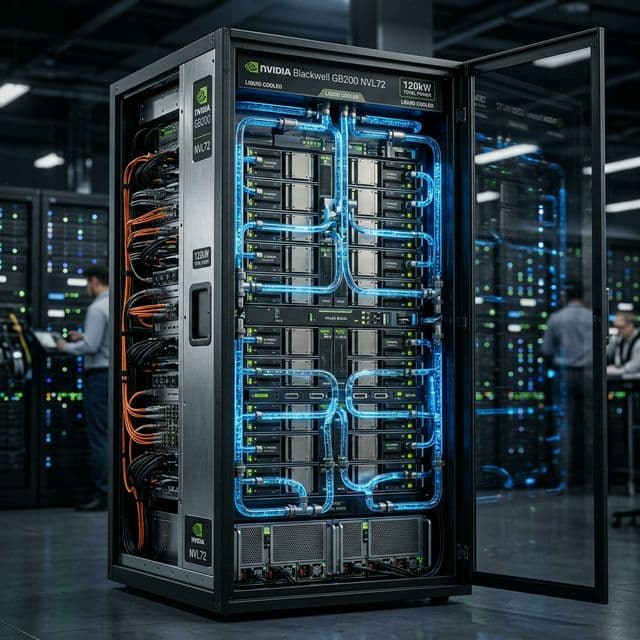
The NVIDIA Blackwell GB200 NVL72 is the first rack-scale computer designed from the ground up for **Liquid Cooling**. It consists of 36 Grace CPUs and 72 Blackwell GPUs interconnected via the NVLink Switch System.
Computing Pod
18x compute trays, each with 2x GB200 Superchips. TDP per tray: ~5,400 Watts.
Network Fabric
9x NVLink Switch trays. 130TB/s aggregate bandwidth. Liquid-cooled ASICs.
Distribution
Blind-mate liquid manifolds at the rear of the rack. Zero-drip quick disconnects.
The key innovation is the **Blind-Mate Manifold**. In previous liquid-cooled generations (like H100 with third-party DLC), technicians had to manually connect hoses to each server tray. In NVL72, the manifold is integrated into the rack frame. When a compute tray is slid into the rack, the liquid and power connectors engage automatically. This reduces the risk of human error and allows for "Hot-Swapping" trays without draining the entire coolant loop.
8. Sustainability: Scope 1, 2, and 3
The AI Decarbonization Paradox
Training a 1.8T parameter model like GPT-4 consumes millions of kilowatt-hours. However, liquid cooling reduces the **Operational Carbon (Scope 2)** by significantly slashing the energy wasted on fans and mechanical chillers.
The challenge shifts to **Scope 3 (Embodied Carbon)**—the carbon produced during the manufacturing of thousands of miles of copper busbars, precision-machined cold plates, and complex CDUs.
9. Coolant Chemistry: The PG25 Standard
The liquid inside an AI cluster isn't just tap water. It is a highly engineered fluid, typically **PG25** (a 25% Propylene Glycol mix with distilled water) or a specialized dielectric fluid. The chemistry of this fluid is critical for the long-term survival of the $100M infrastructure.
Corrosion Inhibition
Because the cooling loop contains multiple metals (Copper in cold plates, Aluminum in manifolds, Stainless Steel in connectors), it is prone to **Galvanic Corrosion**. The fluid must contain "Yellow Metal Inhibitors" that form a microscopic sacrificial layer on the copper surfaces.
Biological Control
Warm, stagnant water is a breeding ground for algae and bacteria. Biocides (non-oxidizing) are added to the loop to prevent "Biofouling," which can clog the 200-micron fins in the GPU cold plates and cause localized hotspots.
10. Thermal Jitter & HBM Stability
One of the least discussed benefits of liquid cooling is the reduction of **Thermal Jitter**. In air-cooled systems, fan speeds ramp up and down in response to workload, creating a oscillating temperature profile. This temperature cycling causes physical expansion and contraction of the silicon and its solder bumps.
For **High Bandwidth Memory (HBM3e)**, which is stacked vertically via TSVs (Through-Silicon Vias), thermal stability is paramount. Heat increases the leakage current in the memory cells, leading to a higher rate of **Correctable Errors (CE)** and, eventually, **Uncorrectable Errors (UE)** that crash the training run. By maintaining a constant, liquid-cooled T-junction temperature (Tj), we can tighten memory timings and reduce the "Refresh Rate" needed for the HBM, freeing up more bandwidth for compute.
Bit-Error Rate (BER) vs Junction Temp
11. Dynamic Power Capping: The Algorithmic Fuse
At 120kW per rack, you cannot rely on simple thermal throttling to protect the hardware. If the rack-level pump fails, the temperature rise is so steep (dT/dt) that the hardware would reach destruction temperatures (150┬░C+) before the Grace CPU could even register the interrupt.
Modern AI clusters use **Dynamic Power Capping (DPC)**. This is a firmware-level coordination between the CDU and the GPU's Power Management Unit (PMU). If the CDU detects a drop in coolant pressure (Delta-P) or a rise in inlet temperature, it sends a hardware-level signal (via Sideband signals or PLDM) to the GPUs to immediately cap their TDP to 200W.
The "Last Gasp" Discharge
When power is lost to the facility, the GPUs must perform a "Graceful Halt" to save their state to NVMe. However, the cooling pumps also lose power. AI racks use **Hydraulic Accumulators**—pressurized tanks that can provide ~30 seconds of coolant flow without pump power, allowing the GPUs to cool down while the BBUs (Battery Backup Units) provide the energy for the final state-save.
12. Secondary & Tertiary Loops: The Path to the Atmosphere
Moving heat off the chip is only Step 1. Step 2 is moving that heat out of the building. This is typically done through a series of nested loops:
- S
Secondary Loop (Technology Cooling System)
Circulates PG25 between the CDU and the GPU Cold Plates. Operating temperature: 32┬░C to 45┬░C.
- P
Primary Loop (Facility Water System)
Circulates water between the CDU Heat Exchanger and the Data Center Chiller or Dry Cooler. Operating temperature: 25┬░C to 35┬░C.
- T
Tertiary Loop (Rejection Loop)
The cooling tower or evaporative cooler that finally dumps the energy into the outside air. In winter, this heat is often recaptured for "District Heating" in nearby offices or greenhouses.
13. Leak Detection: Forensic Sensitivity
In a liquid-first data center, a single pinhole leak in a hose is a catastrophic multi-million dollar event. We use a multi-layered detection strategy:
Trace Cable Sensing
A "Wick-Style" rope sensor runs along the bottom of the rack. When liquid hits the rope, it triggers an immediate circuit break and pump shutdown. Sensitivity: ~20ml of liquid.
Differential Flow Analysis
The CDU monitors GPM_IN vs. GPM_OUT. If there is a mismatch of >0.5%, the system assumes a leak is occurring and isolates the specific rack manifold using "E-Stop" solenoids.
14. Thermal Interposer: Managing 1kW/cm┬▓ Heat Flux
The most difficult thermal challenge in a Blackwell GPU isn't the total power (1,200W); it's the **Heat Flux Density**. Because the GPU die is small, the power is concentrated in a tiny area, creating heat fluxes exceeding **1,000 Watts per square centimeter**. For context, the surface of the sun is ~6,000 W/cm┬▓.
To handle this, NVIDIA uses a **Diamond-Infused Thermal Interface Material (TIM)** and a specialized copper interposer with vapor chamber technology. The vapor chamber uses a "Liquid-to-Gas" phase change internally to spread the heat laterally across the entire surface of the cold plate, preventing "Hot Spots" that could cause local silicon degradation.
The Thermal Resistance Path (R_jc)
The "Junction-to-Case" thermal resistance (R_jc) is the bottleneck. Even with perfect liquid cooling, if the TIM between the silicon and the cold plate is too thick, the GPU will overheat. We use **Phase Change Materials (PCM)** that are solid at room temperature but melt at 45┬░C, filling every microscopic void between the die and the copper.
15. Power Shelf Design: 415V to 48V Conversion
The Blackwell rack doesn't just plug into a wall. It uses a **Power Shelf**—a 5U block of high-efficiency rectifiers. These units take 415V 3-phase AC and output 48V DC to a solid copper busbar that runs down the back of the rack.
Rectifier Efficiency
Titanium+ Grade efficiency at 50% load.
The "N+1" redundancy means the rack can lose 2 full power modules without impacting the AI training run. The modules are "Hot-Pluggable," allowing for live maintenance of the electrical system while the 72 Blackwell GPUs continue to process tokens.
16. Connector Forensics: 12VHPWR & Meltdown Risk
The "Last-Centimeter" of power delivery is the most vulnerable. For H100 GPUs, the industry struggled with the **12VHPWR (PCIe 5.0)** connector, which can deliver up to 600W through a single 16-pin interface. Forensic analysis of failed units showed that minor "Cable Creep" or improper seating caused increased contact resistance.
The Resistance Spiral
At 600W (12V / 50A), a contact resistance of just **2 milliohms** (0.002Ω) generates 5 Watts of heat at the connector pin. This heat causes the plastic housing to soften, leading to further misalignment, higher resistance, and eventual thermal runaway.
Blackwell GB200 systems move away from traditional modular cables, using **Direct Busbar Attachments** and stiff high-current "Power Blades." These connectors have contact areas 5x larger than PCIe pins, reducing contact resistance to sub-0.1 milliohm levels and eliminating the "Meltdown Risk" inherent in high-current consumer interfaces.
17. Case Study: Equinix Brownfield Retrofit
Most AI infrastructure isn't built in new "Greenfield" data centers. It is retrofitted into existing "Brownfield" facilities. Equinix's shift to liquid cooling highlights the architectural friction of this transition.
Retrofit Challenge Checklist
- Floor Loading (kg/m┬▓)
A liquid-filled 120kW rack weighing 3,000lb exceeds the PSI limits of most raised floors. Reinforced steel plinths are required.
- Pump Cavitation Risk
If the facility water pressure is too low, the CDU pumps can "Cavitate," creating vacuum bubbles that erode the impeller and kill the cooling loop.
- Humidity Control (Dew Point)
If the coolant is too cold (<18┬░C), water will condense out of the air onto the electronics. Precise "Dew Point Tracking" is required for every CDU.
18. Biofouling Forensics: When Cooling Fails
Even with Propylene Glycol (PG25), biological growth can occur if the loop is contaminated during installation. Forensic analysis of clogged cold plates using **Scanning Electron Microscopy (SEM)** reveals a "Biofilm"—a complex layer of extracellular polymeric substances (EPS) that acts as a potent thermal insulator.
The Micro-Fin Bottleneck
Blackwell cold plates use fins as thin as **50 microns** with 100-micron spacing. A biofilm layer only 10 microns thick can increase the thermal resistance (R_th) of the plate by **40%**, causing the GPU to hit its Tj_max limit even while the coolant temperature remains nominal.
- - Detection: Periodic "Pressure-Drop" testing (ΔP increase indicates clogging).
- - Remediation: High-concentration biocide flushes and UV-C sterilization in the CDU.
19. PID Control: The Mathematics of Flow
The CDU pump speed is controlled by a **Proportional-Integral-Derivative (PID)** loop. The goal is to maintain a constant "Return Temperature" regardless of the GPU workload.
- K_p (Proportional): Reacts to current temperature error.
- K_i (Integral): Eliminates steady-state error (the "Offset").
- K_d (Derivative): Predicts future error by looking at the *rate* of temperature change.
If the K_d term is too high, the pumps will "Oscillate," causing pressure spikes that stress the fittings. If too low, the GPUs will overheat during sudden bursts of activity (like a transformer block computation). Data center engineers must "Tune" these loops for every unique facility layout.
20. Phase-Change Heat Pipes: Passive Superconductors
While liquid cooling handles the rack-scale heat, **Heat Pipes** handle the "Last-Millimeter" transport inside the GPU module itself. A heat pipe is a vacuum-sealed copper tube containing a small amount of working fluid (usually water).
It operates as a passive thermal superconductor. When heat is applied at the "Evaporator" end (the GPU die), the fluid boils, turning into vapor. The vapor travels at high speed to the "Condenser" end (the cold plate), where it releases its latent heat and turns back into liquid. The liquid then travels back to the evaporator via capillary action through a "Wick" structure (sintered copper powder). This cycle allows for thermal conductivities **100x higher than solid copper**, which is essential for evening out the heat flux before it hits the secondary cooling loop.
21. Conclusion: The Thermodynamic Imperative
As we move toward 2,000W+ GPUs and 500kW racks, the distinction between "Compute Engineering" and "Mechanical Engineering" is vanishing. The success of the next generation of AI models depends as much on the **Nusselt Number** of the coolant flow as it does on the sparsity of the neural network architecture.
Engineering the thermodynamic cycle is no longer a "Facility Problem"; it is a first-class citizen of the AI hardware stack. Data centers that fail to transition to liquid-first architectures will find themselves physically incapable of hosting the silicon required for the next leap in machine intelligence. We are not just building faster chips; we are building more efficient engines for the processing of information, and in the world of thermodynamics, there is no such thing as a free lunch.
Series Navigation
The Pillars of Technical Implementation
Thermal Engineering
Direct Liquid Cooling (DLC) and rack-scale thermodynamics for 120kW+ density.
Compute Benchmarking
H100 vs Blackwell architecture. Analyzing FP8/FP4 TFLOPS and memory scaling.
Fabric Topology
Fat-Tree, Dragonfly, and rail-optimized networking architectures for GPU clusters.
Training Mechanics
Gradient synchronization, All-Reduce bottlenecks, and NCCL optimization patterns.
Related Engineering Resources
22. Coolant Chemistry: Dielectric vs. Conductive Fluids
The choice of coolant fluid is one of the most consequential engineering decisions in a liquid-cooled AI data center. Two broad categories dominate: **Dielectric Fluids** (non-conductive, used in immersion cooling) and **Water-Glycol Mixtures** (conductive, used in direct-to-chip cold plates).
Dielectric fluids, such as 3M Novec or engineered hydrocarbon oils, have the advantage that they can directly contact electronics without causing shorts. This enables **Single-Phase Immersion Cooling**, where entire servers are submerged. The thermal conductivity of dielectric fluids is typically 0.07 W/m·K — approximately 10x worse than water. This means immersion cooling requires much higher flow rates and larger heat exchanger surface areas to achieve the same thermal transfer as a water-based cold plate.
Thermal Conductivity Comparison
The water-glycol mixture (typically 25% Propylene Glycol / 75% deionized water, or PG25) offers superior thermal performance but carries the risk of catastrophic electrical damage if a leak occurs. Modern CDUs mitigate this through **Double-Walled Heat Exchangers** where the facility water loop and the server coolant loop are physically separated by a copper plate. Even if a tube bursts on the facility side, the server coolant remains contained and non-conductive coolant (if using dielectric on the secondary side) prevents short circuits.
The long-term degradation of coolant chemistry is tracked through **Conductivity Sensors** and **pH Monitors**. As glycol breaks down over time, it forms acidic byproducts that can corrode the copper cold plates, increasing the dissolved copper concentration in the coolant. This dissolved copper can then plate out on the GPU's silicon surface, creating thermal hot spots. A rigorous 6-month coolant replacement schedule is mandated for all PG25 loops operating above 60°C return temperature.
Immersion Cooling Fluid Dynamics and Dielectric Breakdown Risks
Single-phase immersion cooling submerges entire GPU servers in dielectric fluid, eliminating the need for cold plates, water loops, and the associated leak risks. The engineering challenge shifts from thermal interface design to fluid dynamics and dielectric reliability. The dielectric fluid must simultaneously serve as a heat transfer medium, an electrical insulator, and a chemically stable environment for PCB materials, solder joints, and connector contacts. Three fluid families compete in the 2026 market: engineered hydrocarbons (eg. Asperitas Fluid), synthetic esters (eg. MIVOLT), and fluorocarbons (eg. 3M Novec 7500).
The critical thermal parameter is the **Prandtl Number** — the ratio of momentum diffusivity to thermal diffusivity. A high Prandtl number (hydrocarbons: Pr = 25-40) means the fluid develops thick thermal boundary layers that reduce heat transfer coefficient despite high flow rates. A low Prandtl number (fluorocarbons: Pr = 4-8) provides thinner boundary layers and better heat transfer at the same flow velocity. However, fluorocarbons have 5x lower thermal conductivity (0.07 W/mK) than hydrocarbons (0.35 W/mK), partially offsetting the boundary layer advantage. The combined figure of merit is the **heat transfer coefficient (h)**, which for natural convection in immersion tanks ranges from 200-600 W/m^2K — an order of magnitude lower than direct-to-chip liquid cooling (2000-5000 W/m^2K).
Dielectric breakdown is the hidden risk. As the fluid absorbs moisture from ambient air (typical saturation: 200-500 ppm for hydrocarbons), its dielectric strength drops from 40 kV/mm to below 5 kV/mm. A 48V server backplane with 0.5 mm trace spacing experiences an electric field of 96 kV/mm — below the dry fluid's breakdown threshold but 20x above the saturated fluid's threshold. The arc event vaporizes a microscopic channel of fluid, creating a conductive carbon path that permanently shorts the traces. To prevent this, immersion fluids require continuous **dehydration** through molecular sieve filters that reduce moisture content below 50 ppm. The filtration system must process the entire tank volume every 2 hours to maintain safe dielectric margins, consuming approximately 500W of pumping power per rack.
The viscosity-temperature relationship determines the pumping power required for adequate flow. At 40°C operating temperature, hydrocarbon fluids have a kinematic viscosity of 5-8 cSt (centistokes), requiring a pump pressure of 2-3 bar to achieve the 10 L/min flow rate needed per GPU server. At 60°C (the maximum safe operating temperature for most immersion fluids before accelerated chemical degradation), viscosity drops to 2-3 cSt, reducing pumping power by 60%. However, operating at 60°C increases the GPU junction temperature to 95-100°C, reducing transistor switching speed by approximately 5% due to increased carrier mobility. The optimal economic operating point balances the pumping power savings against the GPU performance loss — typically settling at 50°C fluid temperature for most 2026 deployments.