
Deconstructing Jitter
Root Causes and Mitigation in Real-Time Systems
1. Defining Jitter: The Mathematics of Instability
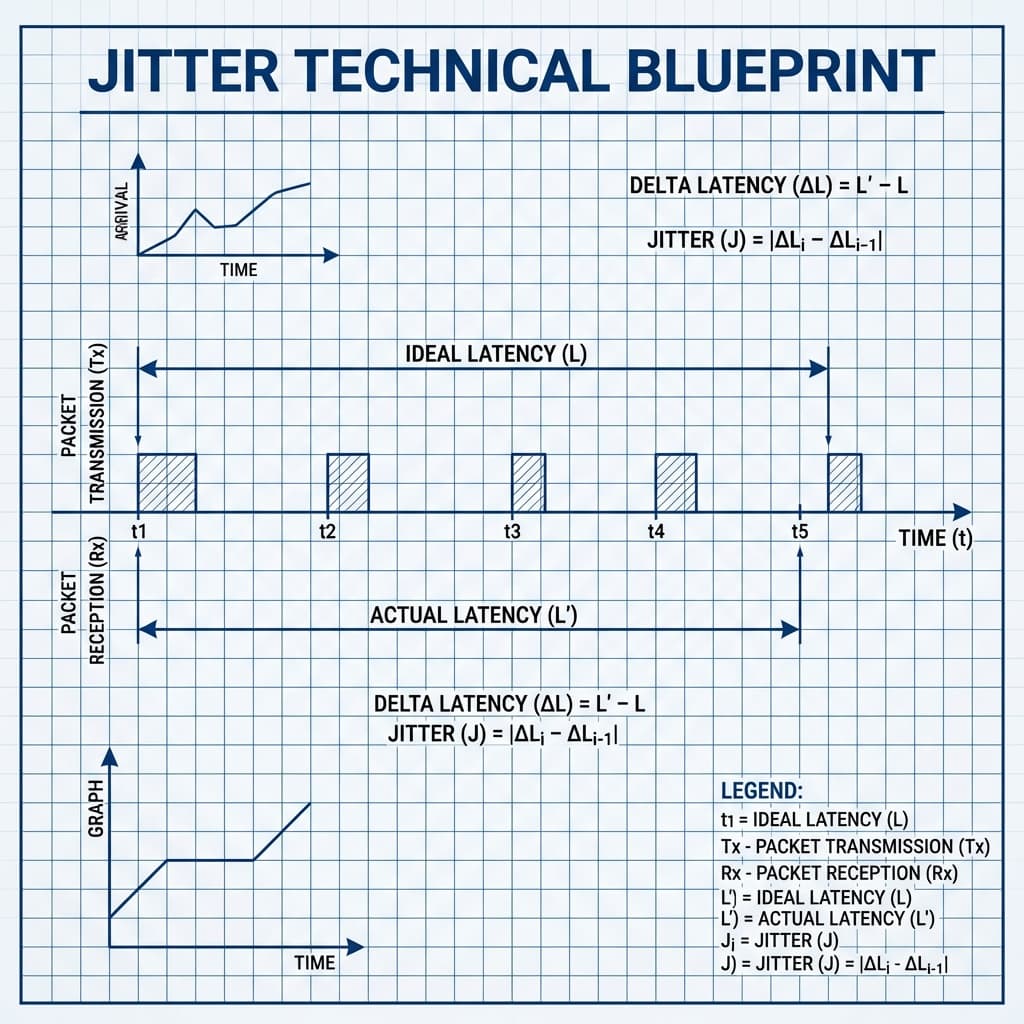
In signal processing and network engineering, Jitter (specifically Packet Delay Variation or PDV) is the variance in latency between sequential packets. While latency is a measure of speed, jitter is a measure of stability. In a perfectly deterministic system, the inter-arrival time of packets would exactly match the inter-departure time. Any deviation from this symmetry is jitter.
For a stream of packets, if represents the latency of the -th packet, the instantaneous jitter is defined as the absolute difference in latency between the current packet and the previous one:
Equation 1: Instantaneous Packet Delay Variation (PDV)
However, single-packet variation is noisy and often misleading for buffer design. In professional analysis (per RFC 3393 and RFC 1889), we look at the Smoothed Jitter, which uses an exponentially weighted moving average (EWMA) to provide a stable metric for jitter buffer sizing. This smoothing ensures that the application doesn't overreact to a single outlier while still tracking long-term trends in network congestion.
Equation 2: RFC 1889 / RTP Smoothed Jitter Calculation
In high-precision contexts, we also distinguish between One-Way Jitter (measuring variance from source to sink) and Round-Trip Jitter. Round-trip jitter is easier to measure (no clock sync required) but obscures whether the instability is occurring on the ingress or egress path—a distinction that is critical for troubleshooting asymmetric links like Starlink or DSL.
2. The Taxonomy of Jitter: Deterministic vs. Random
Not all jitter is created equal. In high-speed serial links (like PCIe or SerDes) and network engineering, we decompose Total Jitter () into two primary components: Deterministic Jitter (DJ) and Random Jitter (RJ). This decomposition is essential for hardware design, as it allows engineers to identify whether the timing problem is physical (thermal) or architectural (logic).
Equation 3: Total Jitter as a function of Bit Error Rate (BER)
Deterministic Jitter (DJ)
Deterministic jitter is bounded and predictable. It has a specific cause and does not grow indefinitely over time.
- Data-Dependent Jitter (DDJ): Caused by the specific pattern of bits being transmitted. If a long string of 0s is followed by a 1, the rising edge may be delayed due to residual charge in the medium (Inter-Symbol Interference).
- Periodic Jitter (PJ): Caused by external frequencies, such as switching power supplies, fan motors, or clock-coupling on a PCB.
- Bounded Uncorrelated Jitter (BUJ): Crosstalk from adjacent lanes in a cable bundle or on a high-density backplane.
Random Jitter (RJ)
Random jitter is unbounded and follows a Gaussian (Normal) distribution. It is typically caused by thermal noise (Johnson-Nyquist noise) in electronic components or semiconductor physics. Because it is unbounded, the peaks of RJ grow the longer you measure. We define it by its standard deviation ( or RMS).
To ensure a specific reliability level (e.g., a Bit Error Rate of ), the multiplier (often called the Q-factor) is applied to the RMS value. For a BER, , making the multiplier (since we look at peak-to-peak).
3. Phase Noise vs. Jitter: The Spectral Perspective
Jitter is a time-domain measurement, but in radio frequency (RF) and high-speed clocking, we look at the same phenomenon in the frequency domain as Phase Noise. Understanding the relationship between the two is vital for wireless engineering and fiber-optic modulation.
Phase noise describes how the energy of a clock signal "leaks" into adjacent frequencies. To convert Phase Noise into RMS Jitter, we integrate the phase noise power over a specific frequency offset:
Equation 4: Integrating Phase Noise to find RMS Jitter
This integration reveals a critical engineering truth: Low-frequency noise (Wander) is often more destructive to clock recovery circuits than high-frequency jitter. High-frequency jitter can be filtered by a simple Phase-Locked Loop (PLL), but low-frequency wander passes through the filter, causing long-term timing drift that can eventually lead to buffer overflows or "frame slips" in synchronous networks like SONET/SDH.
4. Clock Skew and the PTP Revolution
In distributed systems, jitter is often a symptom of Clock Skew. If two machines don't agree on the exact time, their measurements of packet arrival will be distorted. While NTP (Network Time Protocol) is sufficient for web browsing, it lacks the precision for industrial automation, cellular backhaul, or sub-millisecond telemetry.
IEEE 1588: Precision Time Protocol (PTP)
PTP achieves sub-microsecond synchronization by using Hardware-Level Timestamping. Traditional NTP timestamps a packet at the application layer, meaning the "OS Jitter" (the time it takes for the kernel to process the packet) is included in the measurement. PTP timestamps the packet as it leaves the physical network interface (PHY), bypassing the OS entirely.
By accounting for the exact Residence Time of a packet inside a switch, PTP allows devices to neutralize "Network-Induced Jitter." This is the bedrock of 5G infrastructure, where phase alignment between cell towers must be accurate to within 1.5 microseconds to prevent destructive interference on the air interface.
5. The Allan Variance: Measuring Long-Term Stability
Standard deviation is a poor tool for measuring the stability of clocks because it doesn't distinguish between random noise and systematic drift. Engineers use the Allan Variance () to characterize the stability of oscillators over different observation times ().
Equation 5: Allan Variance for Fractional Frequency
A typical Allan deviation plot shows "White Jitter" at short time intervals (the random noise) and "Flicker Walk" or "Random Walk" at longer intervals (systematic drift). In high-performance data centers, choosing between a TCXO (Temperature Compensated Crystal Oscillator) and an OCXO (Oven Controlled Crystal Oscillator) is determined by these Allan curves. An OCXO provides much lower wander over hours, which is critical for maintaining synchronization during a network outage (Holdover Mode).
6. Wireless Contention: The Randomness of Air
Wi-Fi is inherently non-deterministic. It is a half-duplex medium where only one device can transmit on a channel at any given moment. This is managed by CSMA/CA (Carrier Sense Multiple Access with Collision Avoidance), a "listen-before-talk" protocol.
The Binary Exponential Backoff
When two devices try to transmit at once, they both wait a random amount of time (a "Contention Window") before retrying. If they collide again, the wait time doubles. This randomness is the literal definition of jitter. In high-density environments, this backoff mechanism can cause jitter to spike from 2ms to over 200ms in a fraction of a second.
This is why WiFi 6/7 introduced OFDMA (Orthogonal Frequency Division Multiple Access). Instead of devices competing for the entire channel, the Access Point can divide the channel into smaller "Resource Units" (RUs) and schedule multiple devices simultaneously. This transforms "Contention Chaos" into "Scheduled Determinism," drastically reducing jitter for real-time applications.
7. QUIC and HTTP/3: Solving Head-of-Line Jitter
In traditional TCP, if a single packet is lost or delayed by jitter, the entire stream stops until that packet is recovered. This is known as Head-of-Line (HoL) Blocking. For a multi-component webpage or a complex API, this means jitter on one object (e.g., a tiny CSS file) can delay the delivery of every other object.
The TCP Flaw
TCP treats the entire connection as a single byte-stream. Jitter affecting packet #5 stops packet #6, #7, and #8 from being processed by the application.
The QUIC Solution
QUIC supports independent streams. Jitter on Stream A does not affect Stream B. This "Stream-Level Independence" effectively hides jitter from the user experience.
Furthermore, QUIC implements Packet Pacing. Instead of sending a "burst" of packets at the start of a window (which creates micro-burst jitter), QUIC calculates the inter-packet gap needed to maintain a smooth flow, spreading the load evenly across the available time.
8. The HFT "Race to Zero": Nanosecond Jitter
In High-Frequency Trading (HFT), jitter isn't measured in milliseconds—it's measured in nanoseconds. When a market event occurs, multiple firms attempt to hit the exchange simultaneously. The winner is often decided by whoever has the most stable internal hardware clock.
Scenario: The Microwave Outage
To beat the speed of light in fiber (which is ~30% slower than in a vacuum), HFT firms use line-of-sight Microwave Links between Chicago and New York. While faster, these links are highly susceptible to Scintillation Jitter caused by temperature inversions or heavy rain.
A forensic audit of a failed trade once revealed that a passing flock of birds created a 400-nanosecond jitter spike. This tiny variance was enough to desynchronize the firm's FPGA-based order executor, causing it to miss the "Liquidity Window" by a margin of only 12 nanoseconds. To solve this, firms now use Triple-Modular Redundancy for their timing paths, voting between three atomic clocks to ignore outliers.
9. Jitter in Motion: Why 500μs Breaks the Line
In a robotic assembly line, a PLC (Programmable Logic Controller) sends update commands to multiple servos. If the command for "Servo A" arrives at 10ms and "Servo B" arrives at 10.5ms (only 500 microseconds of jitter), the two servos will no longer be perfectly synchronized.
For high-speed motion control, this jitter creates physical "Tear"—where one part of a machine moves faster than the other. This results in harmonic vibrations, increased mechanical wear, and eventually, product defects (e.g., a car door that doesn't quite align). Industrial networks solve this by using Time-Sensitive Networking (TSN) to create a "Time-Aware Shaper" that clears the wire for critical control packets at precisely scheduled intervals, making the network behave like a hardware clock.
10. Micro-bursts: The Silent Jitter Source
A Micro-burst occurs when a high-speed interface (e.g., 100 Gbps in a spine switch) sends a burst of data to a lower-speed interface (e.g., 10 Gbps at the server leaf). Even if the average bandwidth usage is low, the 10:1 ratio means the 10 Gbps buffer is filled instantly for a few microseconds.
The Overflow Valve
These bursts are too fast for traditional SNMP monitoring (which polls every 1-5 minutes) to see. They are essentially "invisible" to standard dashboards. However, they create instantaneous jitter spikes as real-time packets (like database locks or voice) get caught in the temporary logjam. Network architects solve this by using switches with Virtual Output Queuing (VOQ) or implementing ECN (Explicit Congestion Notification) to tell the sender to throttle back before the buffer overflows.
11. Space-Edge Jitter: LEO Constellations
In Low Earth Orbit (LEO) satellite constellations like Starlink, jitter is dominated by Orbital Velocity and Handover Dynamics. As a satellite moves at 7.5 km/s overhead, the propagation delay to a stationary ground terminal is constantly changing.
- Doppler Jitter: The frequency shift caused by the satellite's velocity creates a phase shift in the carrier, which must be compensated for by high-speed DSPs (Digital Signal Processors) to avoid timing slips.
- Handover Jitter: When a user terminal switches from one satellite to the next, there is a brief "re-alignment" period. If the two satellites have different path lengths to the ground station, the sudden jump in RTT creates a massive jitter spike (e.g., 15-30ms) that can drop sensitive VPN sessions.
- Atmospheric Scintillation: Turbulence in the ionosphere and troposphere causes fast, random fluctuations in the signal's phase, acting as a source of "Random Jitter" that requires robust Forward Error Correction (FEC) to mitigate.
12. Mitigation Strategies: Engineering Determinism
Neutralizing jitter requires a multi-layer approach, from the physical hardware up to the application logic.
- Active Queue Management (AQM): Algorithms like CoDel (Controlled Delay) that monitor the time packets spend in a buffer. If packets stay too long, the algorithm proactively drops them to signal TCP to slow down, keeping the queue (and thus jitter) small.
- QoS / DSCP Tagging: Using Expedited Forwarding (EF) tags to ensure that voice and control packets bypass the "Bulk Data" queues entirely. This creates a dedicated high-speed lane for time-sensitive traffic.
- Clock Cleaners: Using specialized hardware chips (jitter attenuators) that take a noisy input clock and generate a new, ultra-stable output clock using a narrow-bandwidth PLL.
- Adaptive Buffering: Software that adjusts its play-out delay in real-time. If jitter increases, the buffer grows; if jitter decreases, the buffer "drains" to restore low latency.
13. The Psycho-Acoustics of Jitter
Why does 50ms of jitter sound so much worse than 50ms of latency? It comes down to Human Pattern Recognition. The human brain is highly sensitive to variations in rhythm.
In audio, jitter creates "Glitching" or "Crackling"—artifacts that the brain cannot filter out because they don't follow a predictable pattern. In video, jitter creates "Judder" or "Stuttering," disrupting our ability to track motion smoothly. While we can adapt to a constant 200ms delay by slowing down our speech, we cannot adapt to a stream that changes its timing every few milliseconds. This cognitive load is the primary driver of "meeting fatigue" in the digital age.
14. Technical Encyclopedia: Jitter Dynamics
Packet Delay Variation. The formal IETF term for jitter defined in RFC 3393.
Long-term variations in clock phase (frequency offsets below 10 Hz). Jitter's slow-moving cousin.
The frequency-domain representation of clock instability, measured in dBc/Hz.
Time Interval Error. The difference between an actual clock edge and its ideal position in time.
Allan Deviation. A mathematical measure of frequency stability over time.
Serializer/Deserializer. The hardware responsible for high-speed data transmission where jitter is most critical.
When the jitter buffer is empty but the application needs to play data, causing a dropout.
Precision Time Protocol. A protocol for sub-microsecond synchronization across Ethernet networks.
Crystal oscillators with temperature compensation or oven-control to reduce thermal-induced jitter.
15. Conclusion: The Art of the Smooth Stream
In a perfect world, every packet would arrive at the exact same interval. But the internet is not a perfect world; it is a chaotic mesh of competing traffic, varying distances, and unpredictable congestion.
As a network engineer, your goal is to transform this chaos into a predictable stream. Whether you are tuning a PTP clock for a 5G tower or configuring an adaptive buffer for a global video platform, you are fighting for Determinism. Jitter is the measurement of how well you are winning that fight. In the modern era of Industry 4.0 and global real-time collaboration, Speed is a luxury; stability is a requirement.
16. Jitter Measurement Decomposition: Per-Hop Delay Variation and Path Characterization
The measurement of jitter at the per-hop level is essential for identifying the specific router or link along the path that is introducing the delay variation. The per-hop jitter measurement requires the deployment of in-band network telemetry (INT) or the use of precision time protocol (PTP) on the network infrastructure. The INT mechanism embeds a timestamp and a queue depth in each packet as it traverses each router, and the receiver extracts the per-hop timing data to calculate the delay variation contributed by each hop. The per-hop jitter decomposition reveals the specific router where the delay variation is being introduced: if the jitter at hop 3 (the data center distribution switch) is 1-2 microseconds, while the jitter at hop 5 (the WAN edge router) is 10-50 milliseconds, the WAN edge router is the dominant source of jitter in the path. The jitter decomposition data is displayed on the network monitoring dashboard as a "jitter heatmap": each hop in the path is represented as a colored cell, with the color intensity indicating the magnitude of the delay variation contributed by that hop. The jitter heatmap enables the network engineer to quickly identify the problematic hop and to drill down into the hop's configuration and performance data to determine the root cause of the jitter.
The characterization of the jitter distribution at each hop provides deeper insights into the nature of the delay variation. The jitter distribution at a router is typically a heavy-tailed distribution with a large number of small delay variations (sub-millisecond queuing delay fluctuations caused by normal traffic multiplexing) and a small number of large delay variations (10-100 millisecond queuing delay spikes caused by micro-bursts of traffic from the upstream router). The characterization of the jitter distribution requires the collection of a sample of at least 1,000 delay measurements per hop (which requires the monitoring system to capture at least 1,000 packets through the path, or about 100 seconds of monitoring at 10 packets per second). The jitter distribution is summarized by three statistics: the median jitter (the 50th percentile of the absolute delay variation), the 95th percentile jitter (which represents the delay variation that is exceeded only 5% of the time), and the peak jitter (the maximum delay variation observed in the measurement interval). The comparison of the median, 95th percentile, and peak jitter provides a diagnostic fingerprint for the type of network issue: a high peak jitter with a low median jitter suggests occasional micro-bursts that cause temporary queuing (which is common in data center networks with bursty traffic patterns), while a high median jitter with a moderate peak jitter suggests persistent queue buildup from sustained over-subscription (which is common in WAN links that are running at 80-95% utilization).
The measurement of jitter in cellular networks requires the use of specialized techniques that account for the unique characteristics of the LTE/5G air interface. The cellular radio link introduces significant jitter due to the dynamic radio resource allocation: the base station (eNodeB in LTE, gNodeB in 5G) allocates radio resources (time-frequency blocks) to each user equipment (UE) based on the channel quality (CQI) reports, the traffic demand, and the priority scheduling policies. The radio resource allocation is typically performed every 1 ms (the LTE TTI) or every 0.5 ms (the 5G TTI), and each allocation decision can change the transmission timing by 1-2 ms (the scheduling delay) or by 10-50 ms (if the UE is moved to a different scheduling priority or if the radio channel quality degrades). The measurement of jitter in cellular networks requires the use of a dedicated measurement tool that implements the 3GPP TS 23.203 QoS monitoring procedures: the tool sends a probe packet with a timestamp at 10-100 ms intervals, and the network measures the one-way delay between the UE and the PGW (the PDN Gateway in LTE) or the UPF (the User Plane Function in 5G). The cellular network jitter measurement is reported as the "PDV" (Packet Delay Variation) per QoS class identifier (QCI), enabling the network operator to verify that the real-time applications (VoIP, video conferencing, gaming) are receiving the guaranteed QoS treatment that is specified in the user's service level agreement.
The practical deployment of per-hop jitter measurement in enterprise networks without INT infrastructure can be achieved using the "traceroute with timing" technique. The traceroute -T (TCP-based) or traceroute -U (UDP-based) command sends a series of probe packets with increasing TTL values: the first probe packet is sent with TTL=1 and the first-hop router returns a Time Exceeded ICMP message, the second probe packet is sent with TTL=2 and the second-hop router returns a Time Exceeded message, and so on. The traceroute command measures the RTT to each hop by recording the time of each probe packet and the time of the corresponding Time Exceeded response. The per-hop jitter is calculated from the variance of the RTT measurements for each hop over multiple traceroute probes. The per-hop traceroute technique provides a coarse approximation of the per-hop jitter distribution (10-100 milliseconds accuracy, depending on the network conditions and the operating system timer resolution) and is useful for identifying the specific WAN router that is introducing significant queuing delay variation. The per-hop traceroute technique can be automated in a monitoring script that executes a traceroute to each critical target every 5-15 minutes, stores the per-hop RTT and jitter data in the time-series database, and alerts the network engineering team when any hop's jitter exceeds the configured threshold (typically 10 ms for WAN links, 1 ms for data center links).
The Pingdo platform's jitter measurement implementation in the browser-based ping tool uses the same multi-probe methodology described in the host-based measurement section, but with the additional capability of measuring the jitter at the application layer. The browser-based tool measures the RTT for each HTTP probe (HEAD request), calculates the jitter as the deviation of each RTT measurement from the running average of the last 10 RTT measurements, and displays the jitter as a stacked band on the latency chart (the width of the band indicates the jitter magnitude at each sample point). The browser-based tool also measures the jitter at a higher time resolution by using the Resource Timing API's transferSize and duration properties: the transferSize property indicates the number of bytes received in the HTTP response, which enables the tool to distinguish between the network jitter (caused by queuing and routing variation) and the variability in the response body size (which affects the download duration but is not a network jitter). The browser-based tool reports the jitter as a distribution histogram on the Pingdo dashboard, with the x-axis representing the jitter magnitude (0-10 ms in 1 ms bins) and the y-axis representing the percentage of measurements in each bin. The jitter distribution histogram provides a visual representation of the jitter characteristics that is more informative than the simple average or peak jitter values, enabling the engineer to understand the full range of delay variation in the network path.
17. Advanced Jitter Mitigation Techniques: Adaptive Buffering, FEC, and Traffic Shaping
The mitigation of jitter at the application layer is primarily achieved through adaptive jitter buffering, which stores incoming packets in a buffer before delivering them to the application decoder. The adaptive jitter buffer adjusts its size dynamically based on the measured jitter statistics: when the network introduces high jitter, the buffer increases its size to store more packets and absorb the delay variation, and when the network stabilizes with low jitter, the buffer reduces its size to minimize the buffering delay. The adaptive jitter buffer algorithm is defined in ITU-T G.1020 and is implemented in all major VoIP and video conferencing systems. The algorithm maintains a running estimate of the network jitter using the "jitter estimate" parameter J, which is updated for each received packet using the formula J = J + (|D(i-1, i)| - J)/16, where D(i-1, i) is the difference in the one-way delay between packet i-1 and packet i. The jitter buffer size is set to 4J (which provides protection against 95% of the delay variations in a normal distribution), and the buffer is adjusted in steps of 10-20 ms to prevent audio glitches from sudden buffer changes. The adaptive jitter buffer also includes a "playout delay" that is the time between the packet's arrival and its playback to the user, which is continuously optimized to balance the jitter protection (longer playout delay) against the end-to-end latency (shorter playout delay).
The integration of forward error correction (FEC) with jitter buffering provides a second layer of protection against jitter-induced packet loss. The FEC encoding generates redundant packets from the original data packets, and the receiver can reconstruct the original data even when some packets are lost due to excessive jitter (the packets arrive too late for the decoder to use them, which is functionally equivalent to packet loss). The combination of FEC and adaptive jitter buffering is used in the Opus audio codec (IETF RFC 6716), which is the standard codec for WebRTC-based real-time communication. The Opus codec's FEC mode encodes a redundant low-bitrate version of the previous audio frame as a "redundancy packet" that is embedded in the current audio packet. If the current packet arrives at the receiver before its playout deadline, the decoder uses the main audio data from the current packet and the redundancy data from the next packet (if available) to repair any lost frames. If the current packet arrives after its playout deadline (due to jitter), the decoder uses the redundancy data from the next packet to reconstruct the lost frame, minimizing the audio glitch. The Opus FEC scheme adds 10-30% overhead to the audio bitrate (depending on the redundancy resolution and the frame duration) and provides effective loss recovery for 5-20% packet loss rates, which is the typical loss range for congested networks with moderate jitter.
The deployment of traffic shaping at the network infrastructure layer reduces the jitter at the source by smoothing the bursty traffic patterns that cause the queuing delays at downstream routers. The traffic shaping algorithm buffers the outgoing packets in a "shaper queue" and transmits them at a rate that is configured to be lower than the interface capacity, which absorbs the traffic bursts and produces a smooth, predictable output stream. The traffic shaping is configured on the egress interface of the router that is connected to a WAN link or to a network segment with limited capacity. The shaper queue size should be set to the bandwidth-delay product of the link: for a 100 Mbps link with a 10 ms RTT, the bandwidth-delay product is 100 Mbps x 10 ms = 125 KB, and the shaper queue should be configured to 125-250 KB (1-2x the bandwidth-delay product). The traffic shaping reduces the jitter for all traffic flows that traverse the shaped link, because the smoothed output stream reduces the queue buildup at the next-hop router. The combination of traffic shaping at the edge and adaptive jitter buffering at the endpoints provides a comprehensive jitter mitigation strategy that reduces the jitter at every layer of the network: the traffic shaping prevents the jitter from being introduced at the network layer, and the adaptive buffering protects the application from any residual jitter that escapes the shaping.
The emerging approach to jitter mitigation in software-defined networks (SDN) is the use of "deterministic networking" (DetNet) techniques that provide a bounded maximum latency and zero jitter for critical traffic flows. The DetNet architecture, defined in IETF RFC 8655, uses a combination of resource reservation (bandwidth and buffer space on each hop), traffic shaping (at the ingress of the DetNet domain), and time-aware scheduling (at each hop within the DetNet domain) to guarantee that each DetNet flow has a bounded end-to-end latency and zero jitter (within the precision of the clock synchronization). The IEEE 802.1Qbv time-aware shaper (TAS) is the key technology for implementing the per-hop scheduling: the TAS divides the transmission time into a repeating cycle (the "gate control list" cycle, typically 125 microseconds to 1 millisecond), and within each cycle, each traffic class has a time slot during which it is allowed to transmit. The TAS eliminates the queuing delay for the scheduled traffic class because the transmission slot is guaranteed to be available when the packet arrives at the switch, and the only delay is the time until the start of the next scheduled slot (which is bounded by the cycle time). The deployment of TAS-based DetNet in industrial automation (PROFINET, EtherCAT) and in-vehicle networks (Automotive Ethernet) enables the transmission of time-critical control data with zero jitter, ensuring that the robot arm receives the position update within the 1 ms control cycle or that the autonomous vehicle receives the brake command within the 100 microsecond safety cycle.
The practical deployment of jitter mitigation techniques in enterprise networks requires a systematic approach that starts with the measurement and characterization of the jitter baseline, followed by the selection and implementation of the appropriate mitigation techniques based on the application requirements and the network characteristics. The jitter mitigation strategy for a video conferencing application (which requires 50 ms maximum jitter with a 150 ms end-to-end latency budget) is different from the strategy for a high-frequency trading application (which requires 1 microsecond maximum jitter with a 10 microsecond end-to-end latency budget). The network engineering team should use the Pingdo monitoring platform to measure the jitter baseline for each network path, characterize the jitter distribution (using the histogram described in the measurement section), and identify the dominant jitter sources (using the per-hop decomposition technique). The team then selects the jitter mitigation techniques that provide the required jitter protection within the application's latency budget: the adaptive jitter buffer (10-50 ms added latency) for VoIP and video conferencing applications, the FEC encoding (5-15% overhead) for real-time streaming applications, the traffic shaping (minor latency addition from the shaper queue) for WAN links, and the DetNet architecture (requires specialized hardware and network infrastructure investment) for the most demanding industrial and financial applications. The deployment of jitter mitigation techniques should be validated by comparing the post-mitigation jitter statistics with the baseline measurements, and the mitigation parameters should be adjusted iteratively to find the optimal balance between jitter protection and latency overhead.