
Packet Loss Dynamics
Analysis of Signal Degradation and Retransmission Overhead
1. The Geometry of Discard: Mechanics of Packet Loss
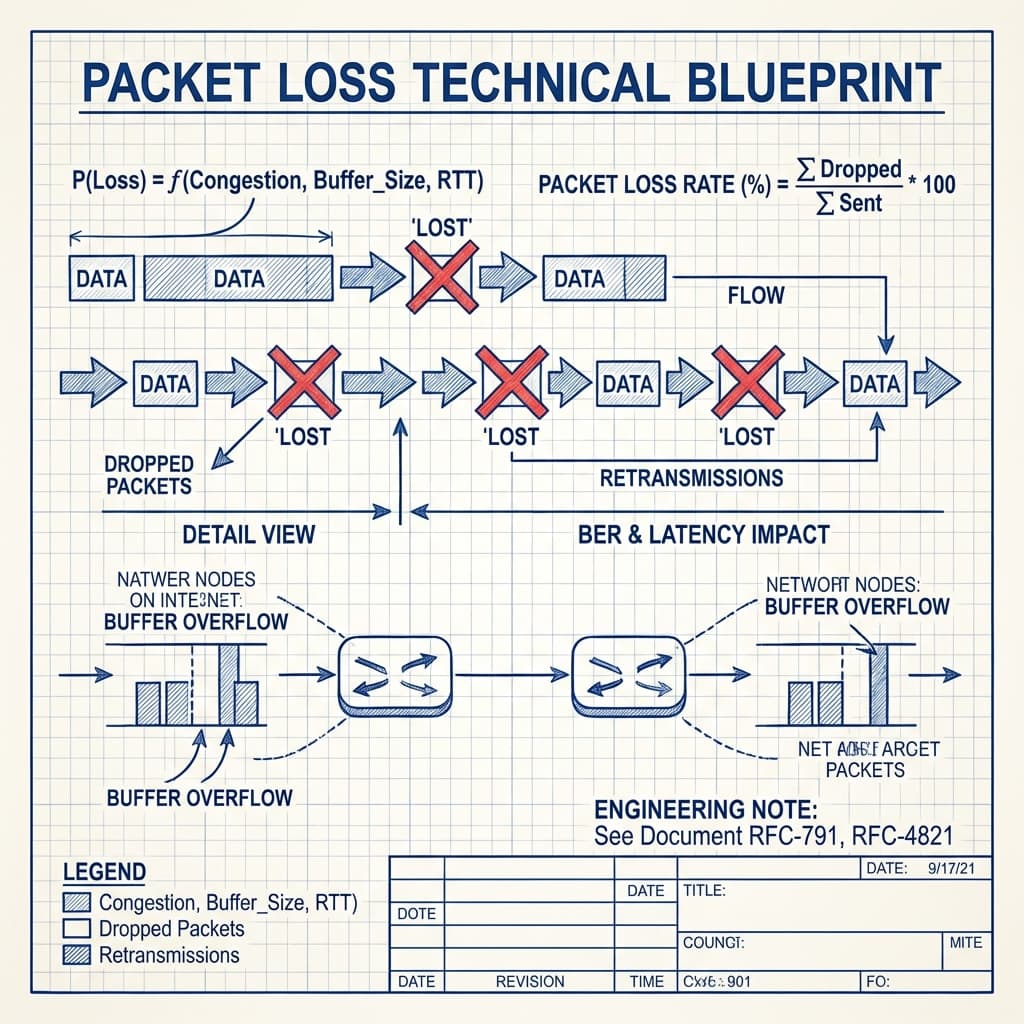
In any network, routers have finite buffer space. When a router receives more data than it can process, it is forced to discard incoming packets—a process known as Tail Drop. This is the primary indicator of network congestion and bufferbloat.
Packet Loss & Retransmission
Simulating TCP-style recovery on a lossy link.
Engineering Insight: Packet loss in high-reliability networks is often caused by Interference or Buffer overflows. While TCP handles recovery via retransmission, this introduces significant Tail Latency which can disrupt real-time operations.
2. The Congestion Wars: TCP Reno vs. Cubic
Packet loss is not just an error; it is a signal. In the design of the Transmission Control Protocol (TCP), packet loss is the primary feedback mechanism for Congestion Control.
TCP Reno (AIMD)
Uses Additive Increase/Multiplicative Decrease. Upon packet loss, it cuts the Congestion Window (cwnd) by 50%. This creates the famous "sawtooth" pattern. While safe, it is extremely inefficient on 10Gbps+ links where a 50% drop can take seconds to recover.
TCP Cubic
The standard for modern OSs. It uses a cubic growth function to quickly reclaim lost bandwidth after a drop. It maintains high network stability by staying near the bottleneck capacity for longer durations than Reno.
3. Burst Loss: The Gilbert-Elliott Model
Real-world packet loss is rarely random (Bernoulli). It often occurs in "bursts" due to interference or buffer exhaustion. To model this, we use the Gilbert-Elliott Model, a two-state Markov Chain consisting of a "Good" state (low loss) and a "Bad" state (high loss).
The State Transition Matrix
If is the probability of transitioning from Good to Bad, and is the probability of returning, the duration of a loss burst is governed by the ratio of these transitions. This model is critical for designing Jitter Buffers and Forward Error Correction (FEC) strategies that can survive sustained "Bad" intervals.
4. Head-of-Line Blocking: The Silent Killer
In TCP, every packet must be delivered in order. If Packet 1 is lost, Packets 2, 3, and 4 must sit in the receiver's buffer, even if they arrived perfectly. This is Head-of-Line (HOL) Blocking.
The QUIC / HTTP/3 Solution
QUIC (over UDP) eliminates HOL blocking by making the transport layer aware of individual streams. If a packet in "Stream A" is lost, "Stream B" can continue processing data without delay. This reduces the "Loss Penalty" by limiting its scope to the specific resource affected.
1 lost packet stops ALL resources on that connection.
1 lost packet ONLY stops the resource it belongs to.
5. Healing the Stream: Forward Error Correction (FEC)
In high-latency environments (like satellite links), retransmission takes too long (RTT > 500ms). Instead, we use FEC. The sender sends extra "Parity" packets.
Reed-Solomon Codes
Traditional block-based FEC. If you send 8 data packets and 2 parity packets, the receiver can lose ANY 2 of the 10 and still reconstruct the original data perfectly. This is the math behind CDs, DVDs, and QR codes.
LDPC (Low-Density Parity-Check)
Used in 5G and modern satellite links. It approaches the Shannon Limit (the theoretical maximum data rate for a given noise level), allowing for zero-loss links over incredibly noisy wireless channels.
6. The Black Channel Principle: Safety Over Loss
In industrial automation (Profinet, EtherCAT), a lost packet isn't just a slow website—it's a safety risk. These protocols use the Black Channel Principle (IEC 61784-3).
Trusting the Untrusted
The protocol assumes the underlying network is inherently "Bad" and will lose packets. To ensure safety, every packet includes a high-entropy CRC (Cyclic Redundancy Check) and a monotonically increasing sequence number. If a packet is lost or corrupted, the safety logic enters a "Safe State" (e.g., E-Stop) within one cycle time (). We don't try to fix the loss; we design the system to remain safe in spite of it.
7. Audio Resiliency: Packet Loss Concealment (PLC)
In VoIP, we cannot wait for retransmissions. If a 20ms audio packet is lost, your ears will hear a click. Modern codecs (like Opus) use PLC to "hallucinate" the missing sound.
- Zero Insertion: Replacing the loss with silence. This is the simplest but most jarring method.
- Waveform Substitution: Repeating the previous 20ms of audio but fading the volume. Because human speech changes slowly, this "trick" is often undetectable for single-packet losses.
- AI-Driven Inpainting: High-end codecs now use neural networks to predict the most likely next phoneme based on the preceding audio, creating seamless transitions even through 10-15% sustained packet loss.
| Medium | Typical BER | Source of Loss | Engineering Fix |
|---|---|---|---|
| Single-Mode Fiber | 10⁻¹² | Chromatic Dispersion | Coherent DSP |
| Cat6a Copper | 10⁻⁹ | EMI / Crosstalk | Shielded Pairs (STP) |
| 4G/5G Wireless | 10⁻³ to 10⁻⁵ | Shadow Fading | HARQ / Turbo Codes |
| LEO Satellite | 10⁻² | Rain Fade / Scintillation | ACM / Phased Array |
| Underwater Acoustic | 10⁻¹ | Multipath Reflections | Low-Rate OFDM |
8. Technical Encyclopedia: Loss Dynamics
The default behavior of a router discard policy when all buffer slots are occupied.
Selective Acknowledgment. Allows the receiver to tell the sender exactly which packets in a burst arrived, avoiding unnecessary retransmission of correct data.
Random Early Detection. A buffer management algorithm that drops packets before the buffer is full to signal congestion early and avoid global synchronization.
Explicit Congestion Notification. Uses IP header bits to mark congestion without dropping packets, enabling zero-loss throttle signals.
Hybrid Automatic Repeat Request. A combination of FEC and retransmission used in 4G/5G to achieve high reliability on lossy channels.
The effective bandwidth of a connection after subtracting retransmissions and protocol overhead.
The time duration or number of consecutive packets lost in a single failure event.
Frame Check Sequence error. Indicates corruption in the Ethernet frame, usually causing an immediate discard by the NIC.
The initial phase of a TCP connection where the congestion window is doubled every RTT until the first packet loss occurs.
9. Conclusion: The Zero-Loss Imperative
In the hierarchy of network metrics, packet loss is the most destructive. You can work around latency with better caching, and you can smooth out jitter with buffers, but you cannot fix loss without a performance penalty. Whether it is the 50% throughput drop of TCP Reno or the audio glitch in a VoIP call, packet loss is the ultimate friction in a distributed world.
For the engineer, success means designing a path where the signal is strong, the buffers are smart, and the protocol is resilient. By mastering the physics of BER, the math of Gilbert-Elliott, and the architectural advantages of QUIC, we can build systems that don't just survive loss—they out-engineer it. **Throughput is vanity; delivery is sanity.**
10. Forward Error Correction Implementation Strategies: Reed-Solomon, Raptor, and Beyond
Forward Error Correction (FEC) is a mathematical technique that enables the receiver to detect and correct errors in transmitted data without requiring retransmission from the sender. The fundamental principle of FEC is the addition of redundant information to the transmitted data stream, which the receiver uses to reconstruct the original data even when some of the transmitted bits or packets are lost or corrupted. The ratio of redundant data to original data is called the code rate, and a code rate of 1/2 means that for every 1 bit of original data, 1 bit of redundant data is transmitted (doubling the total transmission size). The error correction capability of a FEC code is determined by its minimum distance: a code with minimum distance d can correct up to (d-1)/2 errors in the received codeword. Reed-Solomon codes, which are the most widely deployed FEC codes in networking and storage systems, achieve optimal minimum distance for their code parameters and can correct up to t symbol errors in a block of n symbols (where n = 2^k - 1 for some integer k, and the code can correct up to (n-k)/2 symbol errors). In the context of packet loss in IP networks, Reed-Solomon codes are applied at the packet level: k data packets are encoded into n packets (where n > k), and the receiver can reconstruct the original k data packets as long as at least k of the n encoded packets are received correctly, regardless of which specific packets are lost.
The implementation of Reed-Solomon FEC in a real-time communication system requires careful consideration of the code parameters and the latency budget. The block size (k) and the protection level (n-k) determine the overhead ratio ((n-k)/k) and the error correction capability ((n-k)/2 for erasure correction). For a VoIP system with a 20 ms packetization interval and a requirement to recover from 10% packet loss, the system might use a (12, 10) Reed-Solomon code, which adds 2 redundant packets for every 10 data packets (20% overhead) and can recover from the loss of up to 2 packets in each block of 12 packets (16% loss recovery). The encoding and decoding of Reed-Solomon codes on a modern CPU requires approximately 1-5 microseconds per packet for the block sizes used in real-time communications, adding negligible computational overhead to the 20 ms packetization interval. However, the FEC encoding adds a fixed latency equal to the accumulation time of the block: for a (12, 10) code with 20 ms packetization, the sender must wait 10 x 20 ms = 200 ms to accumulate the complete block before encoding and transmitting the 2 redundant packets, and the receiver must wait up to 12 x 20 ms = 240 ms to receive all packets in the block before decoding. This 200-240 ms block latency is acceptable for one-way streaming applications (video-on-demand, live broadcast) but is too high for interactive applications (VoIP, video conferencing), which require end-to-end latency below 150 ms. For interactive applications, the system must use smaller block sizes (k=3, n=4) or alternative FEC schemes that do not require block accumulation, such as Pro-MPEG COP3 codes or fountain codes.
Fountain codes, also known as rateless erasure codes, represent a significant advancement over Reed-Solomon codes for packet loss protection. Unlike Reed-Solomon codes, which require the sender to predetermine the number of redundant packets (n-k) before transmission, fountain codes generate an unlimited number of encoded packets from the original data, and the receiver can reconstruct the original data from any set of received packets that is slightly larger than the original data size. The encoding process is analogous to filling a fountain with water (the original data) and collecting the drops (encoded packets) at the receiver: as long as the receiver collects enough drops, the original water can be reconstructed. The Raptor code (Rapid Tornado) is the most widely deployed fountain code in networking applications, used in 3GPP mobile broadcast (MBMS), DVB-H digital TV, and IETF RFC 5053. Raptor codes achieve near-optimal overhead: the receiver requires only (1 + epsilon) times the original data size to reconstruct, where epsilon is typically 0.05 (5%) for the block sizes used in networking applications. The encoding and decoding of Raptor codes is significantly faster than Reed-Solomon codes for large data blocks: a Raptor decoder can process data at 500 Mbps on a modern CPU, compared to 50 Mbps for a Reed-Solomon decoder. The linear-time encoding and decoding of Raptor codes makes them suitable for high-throughput applications such as satellite broadcast (where 100 Mbps of video data is protected against burst packet losses caused by weather events and solar interference) and peer-to-peer file distribution (where the same data block is distributed to thousands of receivers, each experiencing different packet loss patterns).
The practical deployment of packet-level FEC in enterprise networks requires integration with the existing transport protocols and application requirements. For TCP-based applications, FEC is generally not beneficial because TCP already implements retransmission-based error recovery, and the additional FEC redundancy consumes bandwidth that could otherwise be used for actual data transmission. However, for TCP connections traversing high-latency satellite links (where the RTT is 500-600 ms and TCP retransmissions would cause severe throughput degradation), a transparent FEC layer can be inserted between the TCP connection and the satellite modem, recovering packet losses induced by the link without triggering TCP retransmissions. This approach is called "Performance Enhancing Proxy (PEP) with FEC" and is standardized in IETF RFC 3135. For UDP-based applications, the decision to deploy FEC depends on the application's latency and loss requirements: real-time video streaming uses FEC to protect against burst losses (up to 100 ms of consecutive packet losses) with an overhead budget of 10-20% of the video bitrate, while real-time audio streaming uses FEC to protect against isolated packet losses with an overhead budget of 5-15% of the audio bitrate. The FEC protection parameters should be dynamically adjusted based on the measured packet loss statistics: when the network introduces burst losses (multiple consecutive packets lost), the FEC scheme should increase the interleaving depth to distribute the burst losses across multiple FEC blocks, and when the network introduces random isolated losses, the FEC scheme should increase the redundancy ratio ((n-k)/k) to improve the error correction capability.
The emerging trend in FEC for modern networks is the use of convolutional codes with Viterbi decoding, which process the data stream continuously without block boundaries and provide optimal error correction for real-time applications. The Pro-MPEG COP3 FEC standard, which is widely used in professional video broadcasting over IP networks, uses a two-dimensional parity code that protects against both column-wise and row-wise packet losses in a matrix of video packets. The Pro-MPEG COP3 code operates on a matrix of L columns and D rows of video packets, generating L + D parity packets that protect against the loss of any single packet in each column and each row. The latency of the Pro-MPEG COP3 code is equal to the accumulation time of one row of packets (typically 20-40 ms for broadcast video), which is significantly lower than the block accumulation latency of Reed-Solomon codes. The error correction capability of the Pro-MPEG COP3 code can be enhanced by using a diagonal interleaving pattern, which spreads the packet losses across multiple rows and columns and provides protection against burst losses of up to D packets. The Pro-MPEG COP3 code has been succeeded by the SMPTE ST 2022-1 standard, which uses a Reed-Solomon (n, k) code with block interleaving to provide protection against both random and burst packet losses with a configurable latency budget that adapts to the application's requirements. The deployment of FEC in modern networks is increasingly software-defined, with the FEC codec implemented as a user-space library that can be configured and upgraded independently of the network hardware, enabling rapid deployment of new FEC algorithms as they become available.
11. Multipath Transport: Simultaneous Redundancy and the End of Single-Path Loss Exposure
Multipath transport protocols represent a fundamental paradigm shift in packet loss mitigation: instead of protecting against packet losses on a single network path (using FEC or retransmissions), multipath protocols transmit data simultaneously over multiple independent network paths and use the best available path for each packet. The most mature multipath transport protocol is Multipath TCP (MPTCP), standardized in IETF RFC 8684, which extends TCP to operate over multiple subflows simultaneously. In an MPTCP connection, the sender establishes multiple TCP subflows over different network interfaces (e.g., one subflow over Wi-Fi, another subflow over 4G LTE, and a third subflow over Ethernet), and each subflow has its own sequence number space, congestion window, and retransmission timer. The MPTCP layer at the sender distributes the application data across the subflows using a scheduling algorithm that considers the current RTT, available bandwidth, and packet loss rate of each subflow. The MPTCP layer at the receiver reassembles the data from all subflows using a connection-level sequence number that is independent of the subflow-level sequence numbers. The critical advantage of MPTCP for packet loss mitigation is that a packet loss on one subflow does not stall the entire connection: the sender continues to transmit new data on the other subflows while the lost packet is being retransmitted on the affected subflow. In a typical deployment with two subflows (Wi-Fi and 4G LTE), the probability of simultaneous packet loss on both subflows is the product of the individual loss probabilities (assuming the subflows are truly independent), which means that a network with 1% loss on each path has only 0.01% probability of simultaneous loss on both paths.
The MPTCP scheduler is the key component that determines the throughput, latency, and loss recovery performance of the multipath connection. The simplest scheduler is the Round-Robin scheduler, which alternates transmissions across all available subflows in a fixed order. The Round-Robin scheduler works well when the subflows have similar RTT and bandwidth characteristics but performs poorly when the subflows are heterogeneous (e.g., Wi-Fi with 10 ms RTT vs. 4G LTE with 50 ms RTT), because packets sent on the slower subflow may arrive after packets sent later on the faster subflow, causing receiver buffer reordering and potential head-of-line blocking. The Low-Latency (LowRTT) scheduler addresses the heterogeneity problem by always selecting the subflow with the lowest RTT for each new packet transmission, using the low-latency subflow for most of the data and reserving the high-latency subflow for backup traffic. The Redundant scheduler is the most loss-tolerant: it transmits each packet on all available subflows simultaneously, ensuring that the receiver will receive at least one copy of each packet as long as at least one subflow is operational. The Redundant scheduler provides the best loss protection (any single-path failure is fully masked) at the cost of higher bandwidth consumption (each packet is transmitted N times, where N is the number of subflows). The Blest scheduler (Blocking Estimation-based scheduler) is an optimization for the Lossy-Latency case: it creates redundant copies of a packet only when the sender detects a potential retransmission timeout on a subflow, reducing the overhead of full redundancy while maintaining the error recovery performance.
The deployment of MPTCP in enterprise and carrier networks has been significantly accelerated by its adoption in Apple's iOS and macOS operating systems. Since iOS 12, Apple devices use MPTCP for Siri voice queries, Apple Music streaming, and iCloud services, using a combination of Wi-Fi and cellular subflows to provide seamless connectivity and robust packet loss recovery. In the Apple implementation, the MPTCP connection is established with the Wi-Fi subflow as the primary path and the cellular subflow as the backup path. When the Wi-Fi connection experiences packet loss exceeding 5% (detected using the TCP retransmission statistics), the MPTCP scheduler switches to the Redundant mode and transmits duplicate packets over the cellular subflow, ensuring that the application experience is not degraded by Wi-Fi interference or congestion. The user does not experience any application-level disruption during the switch because the MPTCP layer handles the subflow management transparently, and the application continues to use the standard TCP socket API without any awareness of the multipath transport beneath. The Apple deployment has demonstrated that MPTCP in the Redundant mode can recover from 99.9% of Wi-Fi packet loss events without affecting the application's throughput or latency, reducing the video rebuffering rate in Apple Music by 60% compared to the single-path TCP implementation.
The economic case for multipath transport is based on the cost-benefit analysis of deploying redundant connectivity versus improving single-path reliability. An enterprise that deploys a second internet connection from a different ISP with diverse physical path (different fiber routes, different cable landing stations) can achieve 99.99% availability through multipath transport, compared to the 99.9% availability of a single-path connection. The cost of the second connection is typically $500-$5,000 per month for a business-grade 100 Mbps to 1 Gbps connection, which represents a significant operational expense. However, the cost of a single hour of downtime for a critical business application (e.g., an e-commerce platform generating $1 million per hour in revenue) is $1,000,000, which exceeds the annual cost of the redundant connection by a factor of 10-200. The deployment of MPTCP on the enterprise's router or CPE device enables the aggregation of the two ISP connections into a single logical path, providing both load balancing (utilizing both connections for throughput) and redundancy (one connection fails, the other continues serving traffic). The MPTCP-compatible CPE device, such as the Peplink Balance series or the Viprinet multi-WAN routers, costs $500-$5,000 per device and supports up to 5 simultaneous ISP connections with automatic failover and load balancing. For enterprises with branches in regions with unreliable single-path connectivity (such as emerging markets where the average internet connection has 2-5% packet loss), the deployment of multipath transport with two or three ISP connections provides a cost-effective path to enterprise-grade reliability without requiring investment in private fiber or satellite connections.
The future evolution of multipath loss mitigation is the integration of multipath transport with application-layer coding and network-layer programmability. The QUIC transport protocol, which is natively multiplexed and connection-migratable, provides a natural foundation for multipath extensions that are being standardized in the IETF QUIC Working Group. The Multipath QUIC extension (draft-ietf-quic-multipath) defines a mechanism for QUIC connections to use multiple network paths simultaneously, inheriting the 0-RTT connection establishment, authenticated encryption, and stream multiplexing of the QUIC protocol. Multipath QUIC is expected to be deployed before MPTCP in many networks because QUIC is already supported by the major web servers and browsers, and the multipath extension does not require any changes to the existing QUIC infrastructure. The combination of multipath transport with network coding (a generalization of FEC) enables the full exploitation of multiple paths: the sender transmits linear combinations of the original packets on all paths, and the receiver can decode the original data as soon as it receives a sufficient number of coded packets from any combination of paths. The network-coding approach eliminates the scheduling problem of traditional MPTCP because the coded packets are independent of the path characteristics, and the receiver can decode the data even if the packet arrival order is mixed across paths. The implementation of network-coding-based multipath transport in software-defined networks with programmable data planes (P4) is the frontier of loss mitigation research and is expected to be deployed in large-scale data center and wide-area networks within 3-5 years, providing loss-tolerant, high-throughput, low-latency transport for the most demanding applications of the internet.