
Understanding Latency Dynamics
Master Class: The Physics of Synchronization and Round-Trip Time
1. The Physics of Distance: The Propagation Constant
In its most reductionist form, network latency is a function of the speed of light. Even in a perfect vacuum, signal propagation cannot exceed m/s. In fiber-optic media, this velocity is reduced by the refractive index of glass, typically yielding a speed roughly 30% slower than .
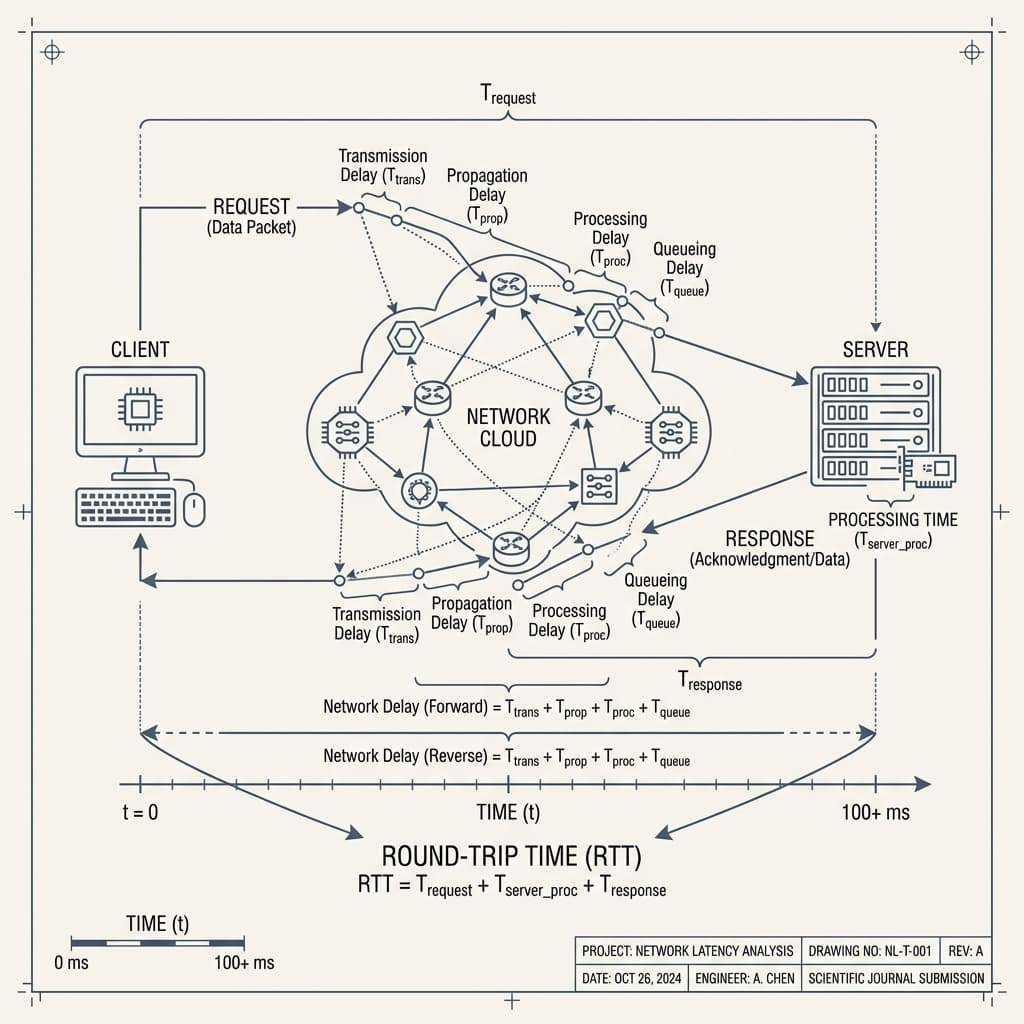
2. Deconstructing RTT: The Four Horsemen of Delay
Real-world Round-Trip Time (RTT) is rarely just about propagation. It is a cumulative sum of four distinct engineering variables, each with its own scaling laws and mitigation strategies.
Processing ()
The time routers take to examine packet headers and execute routing logic (ACLs, NAT, etc.). Modern ASICs keep this in the sub-microsecond range.
Queuing ()
The most volatile component. Packets waiting for their turn on the wire. This is the source of all Jitter.
Transmission ()
The "Serialization Delay." The time required to physically push bits onto the medium. It scales with bandwidth.
Propagation ()
The speed-of-light limit. Constant for a given path and medium. This is the unconquerable "floor" of latency.
3. Serialization Delay: The Bandwidth Myth
A common misconception is that increasing bandwidth always reduces latency. In reality, bandwidth only reduces Transmission Delay. If you have a 1 Gbps link, a 1500-byte packet takes 12 microseconds to serialize. Moving to a 10 Gbps link reduces this to 1.2 microseconds. However, the 100ms propagation delay from London to New York remains unchanged.
The Serialization Formula
In modern high-speed backbones (100G/400G), serialization delay is so negligible (sub-nanosecond) that it has virtually vanished as a troubleshooting factor. The battle has shifted entirely to queuing and processing logic.
4. Bufferbloat: The Latency of "Infinite" Memory
Bufferbloat is a paradox of modern hardware. As memory became cheap, router manufacturers added massive buffers to prevent packet loss. However, when a link saturates, these buffers fill up, causing packets to wait hundreds of milliseconds. The result? A "fast" link with "slow" responsiveness.
Active Queue Management (AQM)
To combat this, we use algorithms like CoDel (Controlled Delay). CoDel doesn't wait for the buffer to overflow; it monitors how long packets stay in the queue. If the "residence time" exceeds a target (e.g., 5ms), it proactively drops packets to signal the sender's TCP stack to throttle back. This keeps the queue short and the latency low.
5. Dispersion: The Temporal Blur of Light
In fiber optics, latency is also affected by Dispersion. As light pulses travel through glass, they don't remain perfect squares; they "smear" out in time. If a pulse smears too much, it overlaps with the next pulse, creating Inter-Symbol Interference (ISI).
- Chromatic Dispersion (CD): Different wavelengths of light travel at slightly different speeds in glass. This forces us to use Digital Signal Processors (DSPs) to "un-blur" the signal at the receiving end, adding several microseconds of algorithmic latency.
- Polarization Mode Dispersion (PMD): Caused by the core of the fiber being slightly non-circular. This creates two different speed paths for the light, further complicating high-rate (400G+) data recovery.
Dispersion mitigation is the primary reason why long-haul subsea cables require specialized amplifiers and regenerators every 50-80km, each of which adds its own processing delay to the total path.
6. The Handshake Tax: Why 0-RTT Matters
In high-latency environments (like satellite or trans-Pacific links), the primary bottleneck isn't data transfer—it's Connection Setup. A traditional HTTPS connection requires multiple round-trips before a single byte of data is sent.
TCP + TLS 1.2
3 RTTs
Handshake + Key Exchange + Data request.
TLS 1.3
2 RTTs
Combined handshake and key exchange.
QUIC (0-RTT)
1 RTT (or 0)
Sends encrypted data in the first packet.
On a 100ms link, TLS 1.2 takes 300ms just to start. QUIC reduces this to 100ms or even 0ms if a previous session exists. This is why QUIC is the foundation of modern low-latency web architecture.
7. Case Study: The Nanosecond Wall in HFT
In High-Frequency Trading (HFT), latency is the product. A firm that receives market data 100 nanoseconds faster than its competitor can capture arbitrage opportunities that vanish in the blink of an eye. This has led to a "Race to Zero" that pushes the boundaries of physics.
The Microwave Revolution
To beat the speed of light in fiber (~200,000 km/s), HFT firms built microwave towers between Chicago and New York. Because signals in air travel at ~299,700 km/s, the microwave path is roughly 30% faster. This saves ~2 milliseconds on a one-way trip—a gap large enough to secure billions in profit.
Hollow-Core Fiber
The latest frontier is "Hollow-Core" fiber. Instead of solid glass, the signal travels through an air-filled tube inside the glass cladding. This allows firms to achieve "Air Speed" (~299,000 km/s) while maintaining the protective routing of traditional underground fiber cables.
8. Edge Geometry: The 100km / 1ms Rule
The concept of Edge Computing is driven by a simple geographic truth: the 100km / 1ms Rule. Due to the propagation constant in fiber, every 100km of distance adds roughly 1ms of round-trip latency.
The Interactive Limit
Cloud gaming and VR require "Motion-to-Photon" latency under 20ms. If your data center is 1,000km away, you have already used up 10ms of your budget just on propagation, leaving only 10ms for game engine processing and video encoding.
Multi-access Edge (MEC)
By moving servers to the "Edge" (e.g., inside the cellular tower base station), we reduce the distance to , effectively zeroing out the propagation delay and allowing for sub-5ms reactive loops.
9. Consensus: The Network Wall of State
In distributed databases (like CockroachDB or Spanner), network latency dictates the speed of data consistency. Protocols like Raft or Paxos require a majority of nodes to acknowledge a write before it is considered committed.
This is the CAP Theorem in action. To scale beyond this network wall, architects must move to "Eventual Consistency" or use hardware-level timing (Atomic Clocks) to synchronize state without the RTT overhead of a traditional handshake.
10. LEO Satellites: Beating the Earthbound Fiber
Low Earth Orbit (LEO) constellations like Starlink are changing the global latency map. Traditional GEO satellites orbit at 35,000km, creating a 600ms latency "floor." Starlink orbits at 550km, achieving RTTs under 40ms.
Laser Inter-Satellite Links (ISL)
Crucially, LEO satellites use lasers to route traffic in the vacuum of space. Because light in a vacuum is 30% faster than in fiber, a long-distance packet (e.g., London to Sydney) can actually arrive FASTER via satellite than via undersea cable, bypassing the thousands of miles of refractive glass and the "Great Circle" routing inefficiencies of terrestrial fiber.
11. Human Perception: The Latency Floor
Engineering latency is only half the battle; the other half is understanding the human receiver.
Directional Audio
The delay required for the brain to detect spatial sound location.
Visual Integration
The speed of the fastest human visual response to a stimulus.
Interactivity
The threshold where a user feels a system is "instant."
Conversation Break
Where delays cause people to start talking over each other in VoIP.
12. Technical Encyclopedia: Latency Forensics
Time to First Byte. The duration from the user's request until the first byte is received from the server.
Zero Round-Trip Time Resumption. A feature of TLS 1.3 and QUIC that allows sending data in the first packet.
A switching method that begins forwarding a packet as soon as the destination address is read.
A switching method that waits for the entire packet to be received and checked for errors before forwarding.
The latency experienced by the 99th percentile of users, highlighting worst-case performance.
Technologies like DPDK that allow applications to process network packets without passing through the OS kernel.
Reconfigurable Optical Add-Drop Multiplexer. A device used in fiber backbones to switch wavelengths with sub-microsecond delay.
Multi-access Edge Computing. Cloud resources located within the cellular provider's radio access network.
A method of spreading burst errors over time, which increases reliability but adds fixed serialization latency.
13. Conclusion: The Unconquerable Constant
Latency is the one resource in networking that cannot be manufactured. You can buy more bandwidth, you can add more CPU, but you cannot change the speed of light. Every millimeter of fiber and every clock cycle of an ASIC is a permanent temporal debt.
In the modern era, the battle for the "Last Microsecond" is happening at every layer: from the subsea cables bridging continents to the kernel bypass drivers in high-frequency trading servers. For the network architect, mastering latency means accepting the constraints of the universe while optimizing the logic that navigates them. **Speed is a metric; responsiveness is physics.**
14. Latency Measurement Methodology: From ICMP Timestamps to Precision Time Protocol
The accurate measurement of network latency is a challenging engineering discipline that requires careful consideration of clock synchronization, measurement granularity, and the confounding effects of operating system scheduling and hardware timer resolution. The most common latency measurement tool is the ping command, which measures Round-Trip Time (RTT) by sending an ICMP Echo Request packet and measuring the time until the ICMP Echo Reply is received. The ping measurement is simple and universally supported, but it has significant limitations: the measurement includes the full round-trip time (the time for the packet to travel to the destination and back), not the one-way latency, and the measurement accuracy is limited by the timer resolution of the operating system (typically 1 ms on Linux, 10 ms on Windows without high-resolution timers, and 100-500 microseconds with the POSIX clock_gettime interface). The ping measurement also includes the processing time at the destination (the time between receiving the ICMP Echo Request and sending the ICMP Echo Reply), which is typically 100-500 microseconds on a lightly loaded Linux server but can increase to 1-10 milliseconds on a heavily loaded server or a router that is processing the ICMP packets at low priority. For accurate latency measurement in production networks, the ping measurement should be supplemented with application-level measurements that use the TCP or UDP timing information from the actual application traffic, which provides a more realistic measure of the latency experienced by the application.
The measurement of one-way latency requires synchronized clocks at the sender and receiver, which is significantly more challenging than RTT measurement. The sender timestamps each packet with its local time before transmission, and the receiver timestamps each packet with its local time upon reception, and the one-way latency is calculated as the difference between the two timestamps. The accuracy of the one-way latency measurement is entirely dependent on the clock synchronization accuracy between the sender and the receiver, and clock skew rates of even 1 microsecond per second (100 ppm) introduce cumulative timing errors of 3.6 ms/hour that render the one-way latency measurements meaningless for any measurement interval longer than a few seconds. The IEEE 1588 Precision Time Protocol (PTP) provides sub-microsecond clock synchronization accuracy over Ethernet networks using a master-slave clock hierarchy and hardware timestamping at the physical layer. In a PTP deployment, the grandmaster clock (typically synchronized to GPS or an atomic clock) distributes the time to boundary clocks and transparent clocks along the network path, and the end hosts use the PTP protocol to synchronize their local clocks to the grandmaster clock with an accuracy of 100 nanoseconds or better. The deployment of PTP in data centers and financial trading networks enables one-way latency measurements with 1-10 microsecond accuracy, which is essential for measuring the performance of high-frequency trading infrastructure and for detecting microsecond-level anomalies in the network path.
The measurement of latency in modern networks must account for the queuing delay, which is the time that a packet spends waiting in router buffers before being transmitted. The queuing delay is the most variable component of the total latency, ranging from 0 microseconds (when the outgoing interface is idle) to the maximum buffer capacity (which is typically 50-100 ms for commodity switches and up to 500 ms for core routers with large buffer pools). The measurement of queuing delay requires the decomposition of the total latency using a technique called "in-band network telemetry" (INT), which embeds a timestamp and queue depth in each packet as it traverses each router along the path. The INT metadata is inserted by programmable switches (such as Intel Tofino and Barefoot Networks P4 switches) and is used by the receiver to reconstruct the per-hop latency and queuing delay for each packet. The INT measurement data provides a detailed picture of where and why latency is being accumulated along the path: if the queuing delay is consistently high at a specific router, the outgoing interface is congested and the link capacity should be increased or traffic should be rerouted. The deployment of INT is limited to data centers and high-performance networks that have programmable switch hardware, and the measurement data increases the packet size by 20-100 bytes per INT hop, which adds overhead to the network traffic.
The practical implementation of latency measurement in enterprise networks must balance the accuracy requirements of the monitoring system with the operational complexity of deploying measurement infrastructure. For network operators who cannot deploy PTP or INT infrastructure, the most practical latency measurement approach uses TCP timestamps (RFC 7323), which are exchanged in the TCP header during connection establishment and ongoing data transfer. The TCP timestamp option provides a 32-bit timestamp value (incremented at a rate of 10-1000 Hz, depending on the operating system configuration) that the sender and receiver can use to estimate the one-way latency and the variance in the latency. The TCP timestamp measurement does not require clock synchronization, because the measurement is based on the difference between the received timestamp and the local timestamp at the receiver, which cancels out the clock offset (assuming the offset is constant over the measurement interval). However, the TCP timestamp measurement has limited accuracy (typically 1-10 ms granularity, depending on the timestamp clock rate) and is affected by the processing delay at the receiver, which introduces 100-500 microseconds of measurement noise. The TCP timestamp method is most useful for detecting significant changes in the network latency (e.g., a routing change that increases the path length by 50 ms) rather than for performing microsecond-level latency analysis.
The latency measurement system in Pingdo uses a multi-method approach that combines the accuracy of performance.now() Web API timers (which provide microsecond-resolution timestamps in modern browsers) with the richness of the Resource Timing and Navigation Timing APIs (which provide the TCP connection time, TLS handshake time, DNS resolution time, and server response time for each HTTP request). The Pingdo latency visualization displays the RTT measured from the browser to the target server, decomposed into the DNS resolution time, TCP connection time, TLS handshake time, time to first byte (TTFB), and content download time. The decomposition of the total HTTP request time into its constituent components enables the engineer to identify the specific phase where latency is being added: a high TTFB suggests server-side processing delay, a high TLS handshake time suggests cryptographic overhead on a low-computation device, and a high DNS resolution time suggests a slow DNS resolver or a misconfigured DNS caching hierarchy. The Pingdo measurement system also tracks the latency distribution over the monitoring interval, displaying the minimum, maximum, average, and 95th percentile latency values that provide a complete picture of the latency behavior of the target. The latency distribution is plotted as a histogram on the Pingdo dashboard, enabling the engineer to see the full spectrum of latency values (not just the average) and to detect the bimodal latency distributions that are characteristic of ECMP load-balancing asymmetry or anycast routing instability.
15. The Microsecond Frontier: Capacitive Loading, Circuit Switching, and the Future of Ultralow Latency
The pursuit of ever-lower network latency has reached the microsecond regime in high-performance data centers and financial trading networks, where every microsecond of latency reduction translates into significant competitive advantage or financial gain. At this timescale, the latency contributions of physical-layer components become dominant: the electrical propagation delay through a copper cable is approximately 5 ns per meter (0.67x the speed of light), the propagation delay through an optical fiber is approximately 5 ns per meter (0.67x the speed of light), and the propagation delay through a silicon ASIC is approximately 10-20 ps per gate. A single meter of copper cable adds 5 ns of latency, a single optical transceiver adds 100-500 ns of latency (including the serialization/deserialization and the electro-optical conversion), and a single switch ASIC adds 300-700 ns of latency (including the forwarding table lookup, the buffer management, and the switch fabric traversal). In a typical data center network with 3-tier CLOS topology (leaf, spine, super-spine), the physical-layer latency from server to server includes: 5 meters of copper cable (25 ns), 2 optical transceivers (200-1000 ns), 6 optical fiber segments (30 ns), 3 switch ASIC traversals (900-2100 ns), and 2 server NIC traversals (200-400 ns). The total one-way physical-layer latency is 1.4-3.6 microseconds, which represents the absolute minimum achievable latency for a packet traversing this network path, regardless of the network protocol or application.
The reduction of microsecond-level latency requires the elimination of packet buffering at every switch along the path, because each buffer stores incoming packets and introduces a queuing delay that can be orders of magnitude larger than the physical-layer latency. The traditional approach to buffer reduction is the deployment of "cut-through" switching, where the switch begins forwarding the packet before the entire packet has been received, reducing the per-hop latency from the full store-and-forward latency (which is equal to the packet transmission time: 1.2 microseconds for a 1500-byte packet at 10 Gbps) to the switch fabric traversal time (300-700 ns, independent of the packet size). The cut-through switching reduces the aggregate per-hop latency by a factor of 2-4 compared to store-and-forward switching, at the cost of forwarding a packet that may have a CRC error or a collision fragment if the input interface is not fully reliable. The emerging approach to buffer reduction is the deployment of "zero-buffer" switching, which uses optical circuit switching (OCS) technology to establish a dedicated optical path between the sender and the receiver for the duration of the data transfer. The optical circuit switch redirects the light signals from the input port to the output port using a MEMS (Micro-Electro-Mechanical System) mirror array, switching the light path in 10-50 microseconds with zero buffering and zero optical-to-electrical conversion delay. The optical circuit switch provides the lowest possible physical-layer latency (75-125 ns per switch, including the fiber coupling losses and the mirror positioning time) but requires the sender to signal the circuit establishment before data transmission, which adds a circuit setup latency of 10-50 microseconds that is amortized over the duration of the data transfer.
The deployment of ultralow-latency networks in financial exchanges requires the careful optimization of every component in the path, from the exchange's matching engine to the trading firm's colocation server. The exchange's matching engine is a dedicated FPGA-based processor that executes the order matching algorithm in 50-100 nanoseconds, which is the absolute minimum latency for a market order execution. The network path from the trading firm's colocation server to the exchange's matching engine includes: the server NIC (100-200 ns with kernel bypass), the top-of-rack switch (300-500 ns with cut-through switching), the data center spine switch (300-500 ns), the exchange's aggregation switch (300-500 ns), and the matching engine's NIC (100-200 ns). The total one-way network latency is 1.1-1.9 microseconds, and the total round-trip latency (including the matching engine processing) is 1.3-2.1 microseconds. Every microsecond of latency improvement in this path translates into a $50,000-$200,000 annual competitive advantage for the trading firm, because the firm can execute market orders faster than its competitors and capture the price differences that exist for only a few microseconds after a market event. The financial firms that dominate the high-frequency trading industry invest millions of dollars in microsecond-level latency optimization: upgrading from 10 Gbps to 100 Gbps NICs reduces the serialization delay from 1200 ns to 120 ns, upgrading from electronic switching to optical circuit switching reduces the per-hop latency from 500 ns to 100 ns, and deploying the server in the exchange's colocation facility (eliminating the fiber path from the firm's office to the exchange) reduces the propagation delay by 5-50 microseconds.
The application of ultralow-latency technology to enterprise networks is driven by the emergence of distributed computing workloads that require microsecond-level synchronization and coordination. The financial services industry is the primary adopter, with banks and hedge funds deploying ultralow-latency infrastructure for algorithmic trading, market data distribution, and risk management. The next wave of adoption is in the telecommunications industry, where 5G and 6G baseband processing requires microsecond-level timing synchronization between the radio units and the central unit. The O-RAN Alliance standardizes the fronthaul interface between the radio unit (RU) and the distributed unit (DU) with a one-way latency budget of 100 microseconds (including the processing delay at the RU and the DU), which requires the network path to contribute less than 25 microseconds of one-way latency. The O-RAN fronthaul network uses PTP for clock synchronization (100 ns accuracy) and time-sensitive networking (TSN) for deterministic packet delivery with bounded latency. The TSN standards define the IEEE 802.1Qbv time-aware shaper, which schedules the transmission of time-critical packets in a time-division multiple access (TDMA) frame, guaranteeing the maximum latency for each scheduled packet class. The deployment of TSN in the O-RAN fronthaul network enables the mobile operator to guarantee that the IQ data from the RU reaches the DU within the 25-microsecond latency budget, ensuring that the 5G baseband processing is completed within the 1 ms air interface latency requirement.
The long-term trajectory of network latency reduction is the integration of photonic switching and electronic processing into a single silicon photonic chip, which eliminates the optical-to-electrical conversion and the separate switch ASIC that add significant latency in current networks. The silicon photonic switch integrates the optical waveguides, the optical modulators, the photodetectors, and the electronic control logic on a single CMOS-compatible chip, providing sub-nanosecond switching times and sub-10 ns end-to-end latency. The silicon photonic switch is fabricated using the same CMOS process as the electronic switch ASIC, which enables the integration of the photonic switch fabric with the electronic forwarding logic and the buffer memory on the same chip. The prototype silicon photonic switches have demonstrated 3.2 Tbps switching capacity with 3.5 ns switching time and 12 ns end-to-end latency (including the fiber coupling, the photonic switching, and the electronic forwarding). The commercialization of silicon photonic switches is expected within 3-5 years, initially in high-performance computing interconnects and financial trading networks, and subsequently in enterprise data centers and wide-area networks. The silicon photonic switch represents the convergence of optics and electronics at the chip scale, which is the next frontier of latency reduction and the foundation for the exascale computing networks and global real-time communication systems of the 2030s.