
The Bufferbloat Phenomenon
Solving Latency Spikes in High-Congestion Environments
What is Bufferbloat? The 'Dark Buffer' Problem
Networking hardware is designed with buffers to handle temporary bursts of traffic. If a router receives data faster than it can transmit, it stores the excess packets in a buffer. However, many modern devices have buffers that are *too large*. When these buffers fill up, every packet must wait in a long 'line,' adding hundreds of milliseconds of delay.
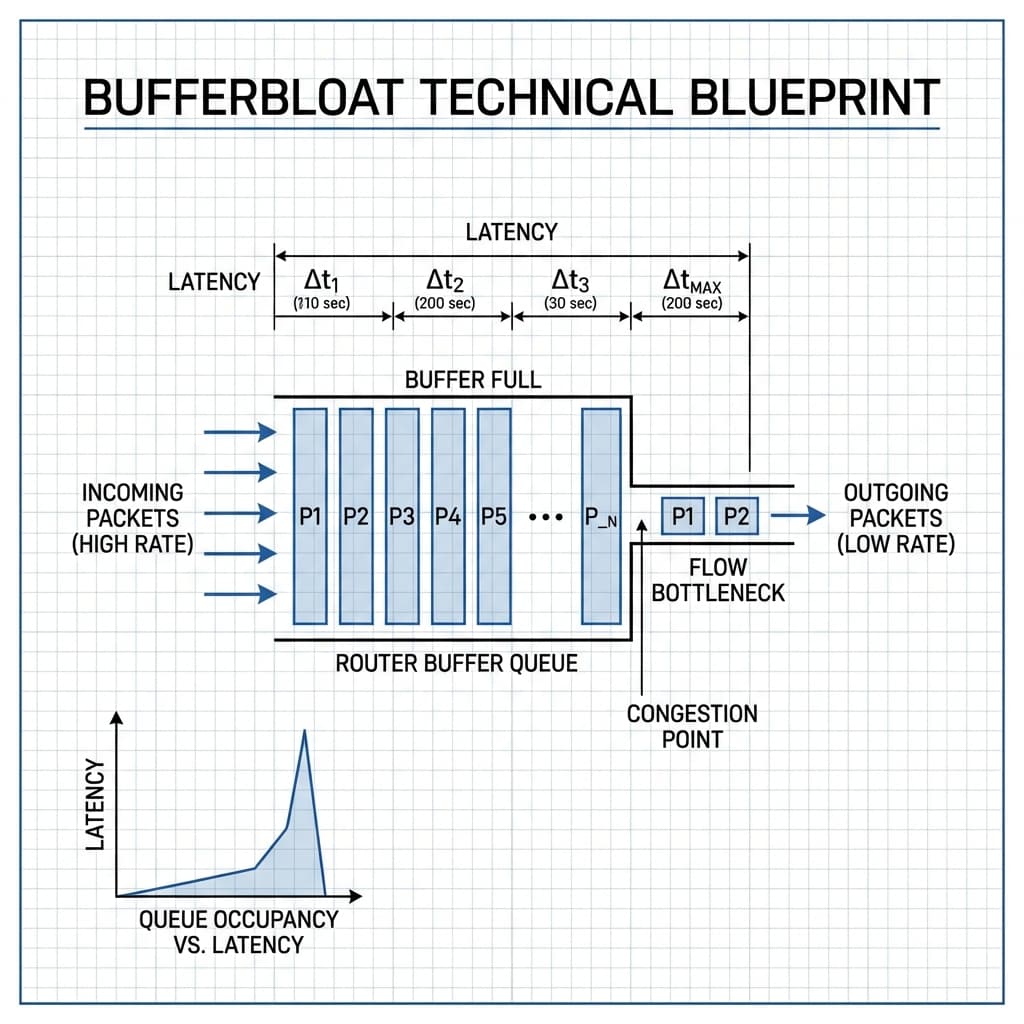
Bufferbloat & Queuing Dynamics
Narrative: High ingress traffic saturating the egress buffer.
Engineering Insight: When ingress traffic consistently exceeds the egress processing rate, the buffer builds up. This increases the total latency (). Once the buffer is full, Tail Drop occurs, leading to packet loss.
How to measure Bufferbloat? The Impact on Jitter
The defining characteristic of Bufferbloat is that latency remains low when the connection is idle, but spikes dramatically as soon as you start a large download or upload. This is often confused with Jitter, but it is specifically tied to congestion and buffer depth.
Solving Bufferbloat with AQM and SQM
Fixing bufferbloat requires Active Queue Management (AQM). Instead of letting the buffer fill to the brim, an AQM algorithm intelligently 'drops' or 'marks' packets as the buffer starts to grow, signaling the sender (via TCP) to slow down before a spike occurs.
- CoDel (Controlled Delay): An algorithm that monitors the 'sojourn time' of packets in the queue.
- Cake: A modern, comprehensive SQM (Smart Queue Management) script that handles both shaping and fair-queuing.
- PIE (Proportional Integral controller Enhanced): A lightweight AQM used in many commercial cable modems.
Addressing Bufferbloat is essential for maintaining Network Stability in environments where bandwidth is shared among many users.