
The Bufferbloat Phenomenon
Solving Latency Spikes in High-Congestion Environments
What is Bufferbloat? The 'Dark Buffer' Problem
Networking hardware is designed with buffers to handle temporary bursts of traffic. If a router receives data faster than it can transmit, it stores the excess packets in a buffer. However, many modern devices have buffers that are *too large*. When these buffers fill up, every packet must wait in a long 'line,' adding hundreds of milliseconds of delay.
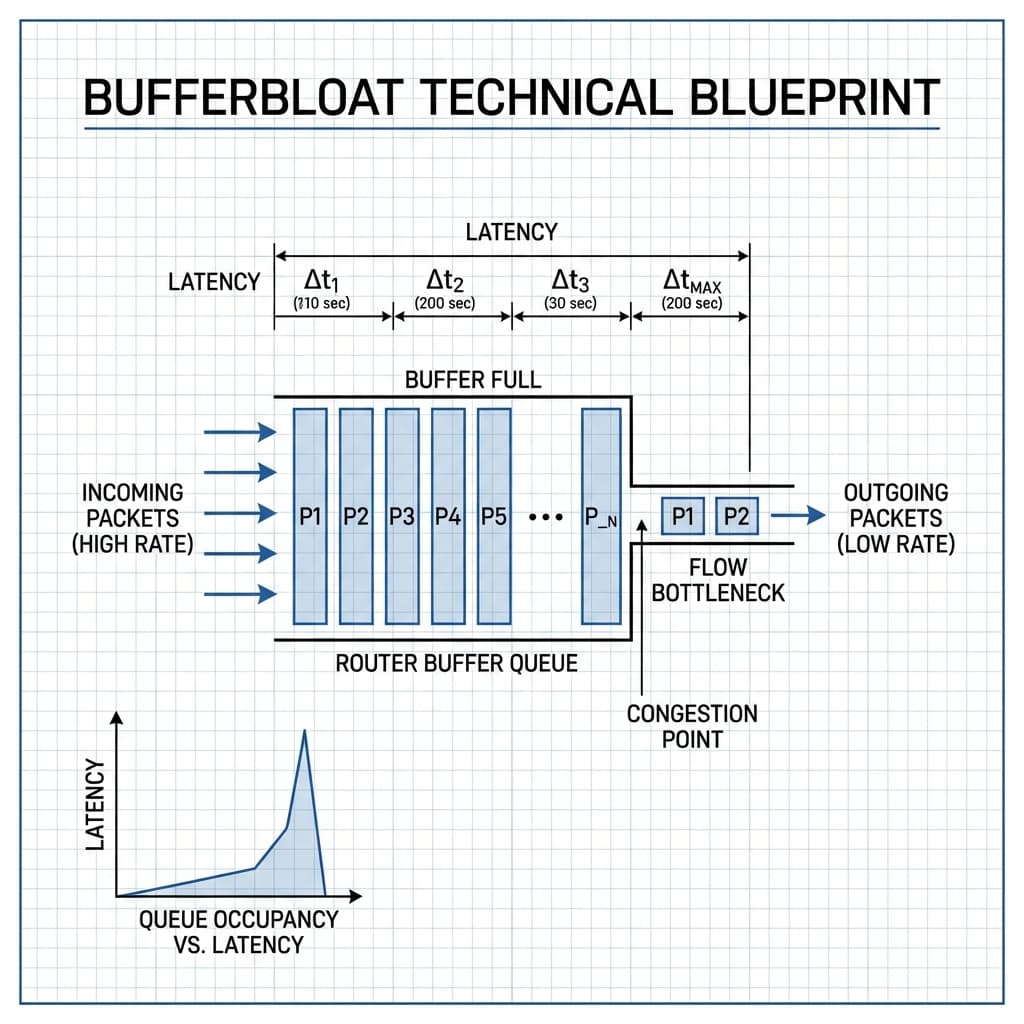
Bufferbloat & Queuing Dynamics
Narrative: High ingress traffic saturating the egress buffer.
Engineering Insight: When ingress traffic consistently exceeds the egress processing rate, the buffer builds up. This increases the total latency (). Once the buffer is full, Tail Drop occurs, leading to packet loss.
How to measure Bufferbloat? The Impact on Jitter
The defining characteristic of Bufferbloat is that latency remains low when the connection is idle, but spikes dramatically as soon as you start a large download or upload. This is often confused with Jitter, but it is specifically tied to congestion and buffer depth.
The Physics of a Standing Queue
To understand bufferbloat, one must understand the Standing Queue. In a healthy network, buffers should be empty most of the time, acting only as a shock absorber for short bursts. A standing queue occurs when the average arrival rate of packets exceeds the departure rate (the uplink speed); for a sustained period.
As the buffer fills, the Sojourn Time—the time a packet spends sitting in the buffer—increases linearly. For a 100 Mbps uplink, a 5 MB buffer can hold 400 milliseconds of data. This means every packet, including time-sensitive DNS queries or gaming inputs, is delayed by nearly half a second while the tail of the buffer waits for the head to be transmitted.
Advanced Active Queue Management (AQM)
Traditional "First-In-First-Out" (FIFO) queuing with Tail Drop is blind to the type of traffic. Modern engineering solves this with algorithms that manage the queue depth proactively.
- CoDel (Controlled Delay): Unlike older algorithms (like RED) that looked at average queue size, CoDel focuses on the minimum delay observed over a sliding window. If the "slowest" packet stays in the queue longer than a target time (typically 5ms); for a specific interval (100ms), CoDel starts dropping packets to force TCP to back off.
- F_fQ_CoDel: This adds Fair Queuing to CoDel. It separates traffic into different "sub-queues" based on a hash of the IP/Port (5-tuple). This ensures that a single large file transfer cannot "bully" a small, low-latency stream like a VoIP call, as the low-rate stream will always have its own empty queue.
- PIE (Proportional Integral controller Enhanced): PIE uses controller theory (similar to an industrial thermostat) to estimate how much to drop or mark based on the current queue delay and the trend of that delay. It is computationally efficient and widely deployed in DOCSIS 3.1 cable modems.
- Cake (Common Applications Kept Enhanced): The current state-of-the-art in SQM. Cake combines bandwidth shaping with a highly evolved version of fair queuing that handles overhead calculations for various ISP technologies (DSL, ATM, Ethernet) automatically, ensuring the buffer never fills at the ISP's bottleneck.
L4S: The Future of Zero Latency
The next frontier in solving bufferbloat is L4S (Low Latency, Low Loss, Scalable throughput). Standard AQM relies on dropping packets to signal congestion, which causes a saw-tooth pattern in throughput. L4S uses Explicit Congestion Notification (ECN) to mark packets instead of dropping them.
When both the sender (your computer) and the link (your router) support L4S, the sender can maintain a near-zero queue depth while still utilizing the full capacity of the link. This is the technology that will finally make "instantaneous" cloud gaming and remote surgery possible over standard internet connections.
FQ-CoDel: The Fair Queuing Scheduler
FQ-CoDel (Flow Queue CoDel) is the de-facto standard AQM algorithm deployed in home routers (OpenWrt, Cake SQM), CPE equipment, and ISP backhaul. It combines two mechanisms: a flow classifier that places each active connection into its own queue (5-tuple hash: src IP, dst IP, src port, dst port, protocol), and CoDel (Controlled Delay) as the per-queue drop policy. The flow classification provides Per-Flow Fairness—a single TCP connection downloading a large file cannot starve 100 other connections making web requests. Each flow's queue receives an equal share of the link's dequeue bandwidth. CoDel monitors the Sojourn Time (the time a packet spends in the queue) and drops packets when the minimum sojourn time over a sliding window exceeds the target of 5 milliseconds:
The key innovation of CoDel is that it uses the Minimum Sojourn Time rather than average queue depth. The minimum tracks the true queueing delay (removing the noise of bursty arrivals), and the control law ensures that the drop interval shortens during persistent congestion (forcing faster adaptation) and lengthens during transients (avoiding unnecessary drops). In high-bandwidth BDP links (e.g., 1 Gbps with 50 ms RTT, BDP = 6.25 MB), the 5 ms sojourn target corresponds to a queue depth of only 625 KB—compared to a typical 1 MB hardware FIFO. The TCP sender reacts to the drop within one RTT, reducing the window by half (for CUBIC) or by (for DCTCP/BBR). The result is that the average queueing delay stays below 5 ms even under 90% link utilization, compared to 100-500 ms for a tail-drop FIFO.
BBR and Bufferbloat: Model-Based Evasion
BBR (Bottleneck Bandwidth and Round-trip propagation time) avoids creating bufferbloat in the first place by operating at the Bandwidth-Delay Product (BDP) knee—the inflection point where the pipe is full but the buffer is empty. Traditional loss-based congestion control (CUBIC, Reno) actively fills buffers until a drop occurs, which means they inherently create bufferbloat during every cycle of the AIMD sawtooth. BBR, by contrast, maintains an explicit model of the path's bandwidth and propagation delay, pacing the sender's rate to match the bottleneck bandwidth exactly:
BBR's ProbeBW phase increases the pacing gain to 1.25 for one RTT, briefly creating a queue of packets. The Drain phase immediately follows at gain 0.75, flushing this queue in the next RTT. The peak queue depth is therefore bounded at 25% of BDP, regardless of the buffer size. On a 100 Mbps link with 50 ms RTT (BDP = 625 KB), BBR's peak queue is only 156 KB, contributing 12.5 ms of queuing delay at most—compared to CUBIC's potential multi-second queue when the buffer is tens of MB. In AQM-enabled networks, BBR interacts synergistically with CoDel: because BBR keeps queues shallow, CoDel's drop rate is near zero, and the combined system achieves sub-10 ms queuing delay at 99% utilization. This is the "BBR + AQM" combination now deployed by CDNs (Cloudflare, Google, Netflix) to deliver low-latency streaming even under peak load. The only caveat is that BBR requires accurate RTT measurements; if the receiver's ACK timestamp has high jitter (> 100 microseconds), the RTprop estimate drifts, causing BBR to underutilize the link by 5-15%.
Addressing Bufferbloat is essential for maintaining Network Stability in environments where bandwidth is shared among many users.